

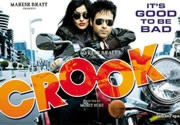
Crook
Synopsis:
Jai has a knack of getting into trouble. His Father was a gangster who wanted to reform. On assurance from his friend Inspector Joseph, Jai''s father agreed to rat on his evil bosses. Inspector Joseph guaranteed him that he would find Jai''s father and Jai a safe passage into the world of good once his bosses have been exposed.
But the unexpected happened. Jai witnessed the fatal double cross on his father, despite his confession, by a senior police officer. Joseph''s valiant effort to save him went in vain. This traumatic incident left a lasting impression on Jai''s mind that there was no point in being good and that ''It''s Good to be Bad.''
Joseph adopted Jai out of guilt and tried to instill his Christian values of finding a God within but the memories from the past had already cast themselves deep in Jai''s mind. Despite repeated attempts to reform him, Joseph failed to ignite the light of good within Jai''s soul. And when matters went almost completely out of hand with Jai''s checkered criminal life, Joseph arranged an alternate identity for him as Suraj Bhardwaj and sent him away to Australia – a land far away from his past.
Jai had promised Joseph in Australia he would stay clear of any trouble. It was a golden chance to feel the grass on the other side of the fence. Almost immediately after landing, Jai met Suhani, an Indian Australian with an unadulterated honest vision of ''one world''. Although she hailed from a conservative traditional Punjabi family that took pride in being Indian, Suhani secretly fostered a much liberal outlook towards life. Her elder brother Samarth was just the opposite. Samarth was convinced that Australians had a one-point agenda to bring Indians down.
Jai found his home with the bumbling punju boys GoldE and gang. They were happy go lucky ''sardar'' boys who knew that the ticket to heaven was through attaining a permanent residency in Australia. GoldE almost echoed Joseph''s voice when he warned Jai to stay out of trouble and concentrate on his work – he arranged for Jai to get a job as a taxi driver in Samarth''s garage.
Suhani was intrigued by Jai''s manner. He was flirting but with a flair. He was lying but in style and he was conniving but with a pure heart. She could spot in the first instant that she met Jai that beyond his prankster lying front, Jai had a deeper side to himself that he refused to acknowledge.
Jai knew that if he could make Suhani fall in love with him he could eventually attain permanent residency by marrying her but her brother was too much of an obstacle. So while Jai was busy scheming for Suhani''s love he was also flirting with Nicole, the stripper from a nearby strip club. But his problems with Nicole were almost similar to Suhani''s as Nicole''s brother, Russel, was a rowdy skinhead from the block.
Trouble followed Jai where he tried to run away from it as he witnessed the cold-blooded racial assault on Samarth. Going to the police would mean
Emraan Hashmi says the word "outsider" with three distinct syllables when he's trying to sound angry in the middle of a screaming match in Melbourne. It's a small thing that bugged me, mostly because he spends the first forty minutes of Crook behaving like he's just wandered onto the wrong studio floor in Goregaon and can't find the exit, which is a state of being that usually requires less vocal effort. Mohit Suri's 2010 thriller arrived trailing clouds of controversy about racial attacks on Indian students in Australia, a hot-button topic that the Vishesh Films factory-line treated with all the delicate social nuance of a falling anvil. Except it wasn't really about racism, or not solely about racism, because no Bollywood production back then could resist turning a ripped-from-the-headlines premise into an excuse for a protracted melodrama involving passports, betrayed loyalties, and people shouting at each other across muddy suburban cricket grounds.
The plot follows Suraj, played by Hashmi with his trademark greasy charm turned down to a low simmer, a con man who makes his living fixing immigration papers for desperate kids wanting out of Punjab. When things go sideways in Delhi, his uncle bundles him off to Australia with a new identity and an instruction to keep his head down. Naturally, he does the exact opposite within six minutes of landing. He falls for Neha Sharma's Suhani, an activist fighting against the growing wave of violent assaults on Indian students, while her brother Sam, played by Arjan Bajwa with a vein in his forehead that looks ready to burst at any second, runs a militant vigilante group dedicated to hitting back. The screenplay by Shagufta Rafique moves between these competing factions with the grace of a dump truck taking a hairpin turn on black ice. There are scenes where characters just stand in brightly lit kitchens talking about cultural identity while a refrigerator hums loudly in the background, a reminder that the sound design was probably finished in an afternoon over cold Samosas.
Hashmi is stuck playing a man defined entirely by his lack of principles until the script decides he needs to have some, which happens roughly around the time the second-half songs start kicking in. He has this slouch that suggests his spine is made of damp cardboard, and while it works well enough when he's playing cynical pimps or corrupted cops like he did in Jannat, it makes him look slightly ridiculous when he's supposed to be standing up for oppressed minorities against racist thugs in hoodies. Neha Sharma, making her Hindi film debut here, spends most of her screen time looking genuinely terrified, which might have been a character choice or simply the result of realizing what movie she was in. She gets lines like "You don't know what it's like to be hated just for the color of your skin," delivered with the breathless intensity of someone reading the back of a shampoo bottle during an earthquake. Arjan Bajwa, meanwhile, is doing a full-throated imitation of Ajay Devgn circa 1999, staring into middle distances and clenching his jaw until his ears turn purple every time someone mentions the motherland.
Visually, the film has that distinct look of mid-period commercial hindi cinema shot on digital cameras that hadn't quite figured out how to handle harsh Australian sunlight, leaving skin tones looking either chalky or radioactive depending on the time of day. The director of photography seems to have discovered the warm filter setting on the editing suite and refused to turn it off, casting every single exterior shot of Melbourne in a golden hour glow that persists even when characters are supposed to be hiding from street thugs at three in the morning. Then there's the soundtrack by Pritam, which dominated radio stations for months before the release and remains the best thing about the entire enterprise. "Mere Bina" plays during a montage where Hashmi walks down a suburban sidewalk looking moody, and for about four minutes, the movie actually manages to capture that specific brand of lonely urban melancholy that Bollywood movies sometimes stumble into when they stop shouting.
The problem is that the film can never decide whether it wants to be an earnest social drama about xenophobia or a standard-issue Vishesh Films pulp exercise involving blackmail, double-crosses, and people getting thrown through plate-glass windows in dimly lit warehouses. You get twenty minutes of genuinely uncomfortable dialogue about assimilation and colonial hangover, followed immediately by an action sequence where Hashmi fights three skinheads in an alley using a bicycle pump. It's not great, not bad, just there, sliding down the memory hole before the end credits even finish scrolling across the screen. Characters switch allegiances because the plot requires a sudden narrative jolt rather than because anything they've experienced warrants the change, leaving the viewer to wonder why anyone in this universe is getting so worked up about anything at all. When Sam finally confronts Suraj about his fake passport and his shifting loyalties, the argument takes place in an empty shipping container yard that echoes so badly you can hear the boom mic operator shifting his weight in the left channel.
Most hindi movies dealing with international politics or cross-border tensions tend to fall back on loud speeches about national pride, but Crook tries a different tack by making its protagonist an unapologetic opportunist who only cares about himself until he's backed into a corner by circumstance. This makes him moderately more interesting than the standard-issue righteous hero, even if the film constantly undermines its own cynicism by forcing him into traditional melodramatic redemption arcs that feel pasted on from an entirely different script. The supporting cast features a rotating collection of Australian character actors who clearly learned their lines phonetically and delivery every single threat with the enthusiasm of high school drama students reading Macbeth on a Monday morning. When the local police inspector shows up to warn the students about going out after dark, he does so with an accent that sounds like a three-way collision between a London cabbie, a Sydney surfer, and someone who watched Crocodile Dundee once in 1987.
By the time the climax rolls around in a burning nightclub—because of course it's a burning nightclub—the narrative coherence has long since evaporated into the Melbourne night air. People are punching each other, guns are being waved about with complete disregard for trigger discipline, and the background music is hitting notes so high they could shatter glass at fifty paces. It's a loud, messy conclusion to a film that started with some genuinely ambitious ideas about diasporic identity before getting completely bogged down in the mechanics of a standard revenge thriller. Hashmi delivers his final lines while bleeding from the left eyebrow, looking less like a man who has found his soul and more like an actor who is just really, really glad the shoot is finally over. You leave the theater or turn off the screen with the distinct impression of having watched a rough draft that everyone involved decided was good enough to print, leaving the heavy lifting to the audience's willingness to forgive structural chaos in exchange for a couple of catchy tunes and a moderately tense face-off.