

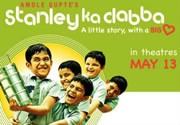
Stanley Ka Dabba
Synopsis:
Imagine this boy in your mind''s eye. He arrives in school much before any of his classmates to drum away his blues on empty benches. He stuffs himself with water instead of the nutritious food that his schoolmates relish during the lunch break. He covers up for his lack of social rank with the finesse of the most seasoned diplomat. Who is this child? What is he like? Why is he anything like he is? Wouldn''t you like to know? Meet Stanley, the protagonist of the much awaited ''It
Amole Gupte eats half my lunch in the first twenty minutes of Stanley Ka Dabba and I am immediately furious because nobody should be allowed to hover over a tiffin box with such predatory enthusiasm. If I'm honest, the whole lunch-stealing premise sounded like a sitcom sketch that had grown way past its bedtime when I first heard the logline, just some flimsy excuse for a morality play about sharing in the fourth grade. Hindi cinema has never struggled to wring tears out of hungry children, which usually means the screen gets thick with earnestness and slow-motion crying by the interval, but Gupte bypasses all that heavy-handed misery. He just puts his camera in a bustling Mumbai school where the kids talk over each other in that hyperactive, semi-incomprehensible bark that teachers spend their entire lives trying to quiet down. Stanley is the kid who doesn't bring a box, lingering near the water coolers or hiding in empty classrooms when the recess bell clangs, not because he is particularly tragic yet, but because he is busy being a real schoolboy with scraped knees and ink-stained knuckles. The film was famously shot over a series of weekends with actual students rather than slick child actors from the casting mills, and you can feel the chaotic energy of real recess leaking through the edges of every single frame.
Partho Numaan plays Stanley with a lightness that completely wrecks any chance you had of watching him with detached critical distance, flashing this toothy, slightly lopsided grin that makes you forgive him for not having his homework done on time. He isn't playing a symbol of underprivileged resilience or carrying the weight of the nation's economic disparity on his slight shoulders, which is a massive relief given how often Bollywood movies treat poor kids either like saints or charity cases. He is just a kid who writes poetry on the back of his notebook and trades comic books under the desk when the English teacher turns her back to write on the blackboard. That English teacher, played by Divya Jagdal with a quiet, observant kindness, notices the empty bench and the missing lunchbox long before anyone else does, her face dropping into this subtle expression of concern that feels entirely earned by the messy human dynamics of the classroom. Then there is Raj Zutshi and the rest of the faculty, lumbering through the corridors with that distinct brand of middle-management exhaustion that anyone who ever went to school in India will recognize instantly. They yell about discipline and neat handwriting and uniform inspections while secretly eyeing each other's lunch boxes for a rogue chicken cutlet or an extra paratha, behaving for all the world like oversized children who never quite escaped the playground.
Then you have Amole Gupte himself playing Babubhai Verma, the chemistry teacher everyone calls beast, and he is a marvel of greasy hair and unearned authority who treats the students' tiffins like a personal buffet. He doesn't just eat their food; he stalks the corridors like a truffle hound sniffing out the best smelling dabba in the entire third-floor hallway, bullying small children out of their mutton biryani and paneer rolls with a straight face. It is a deeply uncomfortable performance because Gupte refuses to make him a cartoon villain with a twirling mustache, letting Verma be genuinely pathetic instead, a lonely, gluttonous man who uses his position to force his way into other people's homes through their cooking. The way he hoards food in his desk drawer and dodges the principal's warnings is pathetic and funny and slightly gross all at the same time, reminding me a bit of how Bob Hoskins used to inhabit characters who were half-comic and half-dangerous without ever needing to raise their voices. He eats with both hands, talking through mouthfuls of food while lecturing the class on the properties of various elements, and you spend half your time laughing at his audacity and the other half wanting to slap him upside his oily head.
The cinematography by Amol Gole does this wonderful thing where it stays right down at eye level with the kids, refusing to look down on them from some lofty adult perspective, which makes the school feel enormous and overwhelming. The hallways are lit with that harsh, fluorescent tube-light glare that gives every classroom a slight headache-inducing buzz, but the recess scenes burst out into the courtyard sun with a natural, dusty warmth that feels like actual Saturday mornings rather than a polished studio set. Hitesh Sonik's music hits the right notes without turning into a tear-jerking machine every time Stanley looks longingly at a classmate's sandwich, though I have to mention that one recurring instrumental motif involving a whimsical flute gets deployed about four times too many during the middle stretch. It's a small thing that bugged me in the moment, that repetitive little toot that pops up every time the kids start running down the stairs, threatening to turn the whole thing into a greeting card commercial before the editing snaps us back to the reality of a scuffle over a rubber eraser. The sound design deserves a medal for capturing the specific acoustic signature of a crowded school in the western suburbs, a wall-to-wall din of plastic spoons rattling against steel tiffins, bicycle bells, running sneakers on linoleum, and teachers shouting over the rising tide of twelve-year-old volume.
Script-wise, the film is structured like a series of expanding circles that start with the simple logistics of lunch and gradually open up to reveal the quiet desperation humming underneath the daily routine. Gupte doesn't give us heavy exposition dumps or flashbacks explaining why Stanley is always alone, trusting the audience to pick up on the subtle cues like the way he washes his face in the school bathroom or dodges questions about his parents with practiced ease. Hindi films usually love a good sob story with a brass band playing behind it, but here the tragedy is kept small and domestic, lingering in the background like a shadow you can't quite step out of. The other kids aren't angels either, occasionally getting annoyed when Stanley forgets to bring his share of the fun or when he takes too long with a drawing, which keeps the classroom dynamics feeling honest instead of turning into a PSA about sharing is caring. When the hammer finally drops and Verma snaps, banning Stanley from the premises until he brings his own tiffin like everyone else, the stakes feel surprisingly massive because they are scaled down to the level of a kid's entire universe.
The final act takes a turn that some viewers found manipulative, shifting the tone from an observational comedy about school life into something much sharper and more bruising, but that gear change is precisely why the movie works. You spend the whole runtime laughing at the teachers bickering over food and the kids trading gossip behind the bicycle shed, only to realize that the innocence you were enjoying was masking something much more precarious. Partho Numaan doesn't have to deliver a grand monologue in the final minutes because his silence does all the heavy lifting, standing outside the iron gates with his empty hands tucked deep into his pockets while the school bell rings behind him. It is an abrupt ending that refuses to tie up every loose thread with a neat bow, leaving you to wonder what happens to Stanley on Monday morning when the recess bell inevitably rings again. You walk out of the theater thinking less about the grand themes of childhood poverty and more about the specific taste of whatever greasy food you brought to school in third grade, which is probably the only way a movie like this can land its punch without bruising the viewer's ribs.