

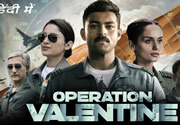
Operation Valentine
vcdSynopsis:
So Operation Valentine is this 2024 aerial action thriller set in the usual volatile neighborhood where tensions between India and Pakistan are always through the roof, and Varun plays Arjun Dev, an IAF Wing Commander who's got this super intense haunted look in his eyes because of a tragic past mission where he lost his wingman, which is just classic tragedy fuel for modern hindi movies.
Manushi Chhillar plays Ahaana Gill, who is also a wing commander and happens to be Arjun's estranged wife, and you can just cut the sexual tension and bitterness with a knife every time they're in the same room together at the air base, which makes you wonder how they even manage to fly planes without crashing into each other out of sheer spite.
Before we even get to the real meat of the story, can we talk about that one background air force officer who has the absolute worst haircut in the history of cinema, like it's genuinely distracting, sitting there at a desk with a beige mug that just says coffee in Papyrus font while national security crises unfold around him.
The plot actually kicks off because of a massive terror attack on a convoy in Pulwama, and the Indian government and military brass need to retaliate hard, so they plan an airstrike across the border, and everyone is pacing around gloomy operations rooms looking at tactical screens with glowing red dots.
Arjun is put right at the center of this secret counter-terror operation because he's basically Maverick if Maverick drank too much black coffee and never smiled, and he has to lead the squadron into Pakistani airspace to bomb terrorist training camps before anyone even knows what hit them.
And then boom, they hit the interval point right when the jets are airborne and missiles are locking on, which is great for bathroom breaks but terrible for your nervous system because the movie just pauses right there on a cliffhanger.
Right after the break, because bollywood movies simply cannot resist the urge to drop a random song when nobody wants it, we get this bizarrely placed romantic flashback track showing Arjun and Ahaana falling in love and arguing over kitchen chores, which completely ruins the pacing of an otherwise tense military retaliation plot.
Stuff happens and the airstrike goes down successfully, but obviously the other side isn't just going to sit there and take it, so they launch a massive retaliatory aerial attack the next day, leading to huge dogfights in the clouds with jets spinning, missiles trailing smoke, and pilots yelling codes into their microphones.
During this chaotic aerial dogfight, Rudra, another key pilot played by Navdeep, gets shot down and captured behind enemy lines, which turns the whole mission from a standard border strike into a desperate rescue operation because leaving your guys behind is a big no-no.
Arjun decides to go rogue against direct orders because he's just that kind of stubborn hero, and he flies his jet back into hostile territory to save Rudra, facing insane amounts of anti-aircraft fire and dodging enemy jets in sequences that probably cost a fortune in CGI.
Ruhani Sharma shows up as well adding some solid support to the squadron dynamics, but honestly everyone is just yelling coordinates and sweating profusely under the harsh fluorescent lights of the control room.
Arjun manages to locate the downed pilot, pulls off a ridiculously dangerous rescue maneuver that defies all laws of physics and aerodynamics, and gets everyone back across the border just in time.
Arjun lands his severely damaged jet on the runway, climbs out of the cockpit with a bloody forehead and a torn uniform, and salutes his commanding officer while a slow-motion patriotic background score swells up to maximum volume.
Varun Tej squints against an artificial sun that looks suspiciously like a studio light with a yellow gel taped over it, and honestly, that one visual choice sets the tone for the entire two-hour slog of Operation Valentine. We are meant to believe we are baking on a tarmac near the border, sweat dripping with tactical urgency, but the air conditioning inside the multiplex is doing a much better job of keeping things cool than the cinematography ever manages. Shakti Pratap Singh, stepping behind the camera for his directorial debut, has clearly watched Top Gun a few dozen times too many, or perhaps not quite enough to understand that Tom Cruise's swagger was earned through twenty years of studio-system polish rather than sheer demographic necessity. Telugu and Hindi movies have long danced around the edges of military drama without ever quite finding a native idiom for the genre, usually defaulting to chest-thumping patriotism that drowns out actual human friction. This one tries to split the difference by catering to both markets simultaneously, leaving the dialogue in a strange, neutered middle ground where nobody sounds like they belong to any specific zip code or military unit.
The screenplay is essentially a series of briefing room arguments punctuated by low-altitude dogfights that leave you squinting at the screen, trying to figure out which CGI dot belongs to the good guys and which one is about to explode into digital shrapnel. It lurches from tense radar tracking to domestic melodrama with the grace of a brick falling down a carpeted staircase. If I'm honest, the romantic flashbacks between Tej and Manushi Chhillar hit you like a surprise tax audit just when the plot starts generating a tiny bit of momentum in the air. Chhillar plays a radar officer with a posture so rigid you half expect her to snap in half during a sudden turbulence sequence, though she does possess a certain screen gravity when the script stops forcing her to gaze longingly at framed photographs. Her performance isn't helped by the sound design, which loves to layer a deafening orchestral swell over scenes where two people are just sitting across a metal desk discussing radio frequencies.
Let us talk about the supporting players for a moment because Ruhani Sharma pops up as a fellow officer with barely enough lines to fill a Post-it note, yet she manages to carve out a tiny bit of distinct personality simply by refusing to stand at attention during casual conversations. It is a small thing, but it bugged me how every single extra in the control room wears their cap at the exact same millimeter of tilt as if governed by some strict aeronautical dress code enforced by a very angry props master. Varun Tej has this habit of chewing on the inside of his cheek whenever he has to deliver a line about national sovereignty, which makes him look less like a seasoned wing commander and more like a man dealing with a stubborn popcorn kernel lodged firmly between his molars. He is earnest, god knows he is earnest, but the role demands an effortless ice-cold charisma that he simply doesn't pull out of his toolkit when the red lights start flashing on the console.
The aerial sequences themselves suffer from that modern digital disease where the camera never stays still for more than three consecutive frames, spinning around cockpit glass like a hyperactive hummingbird until you lose all sense of spatial orientation. You cannot build genuine tension when every missile launch looks like an asset drop from a mid-tier video game released around 2014. Compare this to the grimy, tactile claustrophobia of something like Kathryn Bigelow's Zero Dark Thirty, where every interior feels lived-in and dusty, and Operation Valentine starts to resemble an expensive corporate recruitment video commissioned by someone who has only ever read about fighter jets on Wikipedia. The sound effects department must have had a field day with the bass pedal, because every time a door opens or a jet engine idles, your seat vibrates so violently it tickles your spine, which is admittedly more entertaining than listening to the expository dialogue about cross-border incursions.
Bollywood has spent the last decade trying to crack the code of the slick, high-altitude thriller without realizing that spectacle only works when the audience actually cares who is sitting inside the metal tube hurtling toward the horizon. Here, the political context is painted in such broad, crayon-thick strokes that you half expect a narrator to pop out from behind the wingtip and explain the geopolitical stakes using a chalkboard and a pointer. We get speeches about duty and sacrifice that sound like they were generated by feeding thirty previous war movies into a blender and pouring the lukewarm results straight onto the soundstage. It is not that the sentiment is offensive, exactly, but rather that it is so completely drained of specificity that it floats away from you the moment the credits begin to crawl upward.
There is an odd rhythm to the editing that lingers a full two seconds too long on actors staring blankly into the middle distance after delivering a supposedly devastating piece of intelligence, as if the director were waiting for someone off-screen to yell cut. That extra beat drains the air out of the room every single time, turning what should be a ticking-clock scenario into an exercise in awkward silence. It is a pacing disaster that ruins whatever goodwill the actors manage to scrape together during their more grounded moments of interaction. You can feel the invisible gears of the plot grinding away in the background, pushing characters from point A to point B because the running time demands a mid-air crisis right before the interval block.
By the time the third act rolls around with its obligatory squadron rollout in slow motion, the dust kicked up by the tires looks less like grit and more like dry flour shaken from a burlap sack. The visual effects team clearly ran out of budget or time before they could properly integrate the actors' faces into the cockpit reflections, leaving floating visors detached from actual human heads during several crucial turning points in the dogfight. It creates a weird, uncanny-valley detachment where you are watching a cartoon version of a crisis rather than anything remotely resembling human stakes. The background score follows suit, thumping along with a relentless electronic pulse that tries to manufacture excitement where the script only offers stale recycling of old headlines and predictable narrative beats.
We are left with a cinematic artifact that exists primarily to fill an open weekend slot on the release calendar, ticking off boxes for visual effects, emotional flashbacks, and flag-waving speeches without ever settling down to find its own voice. Chhillar and Tej try their absolute hardest to sell the melodrama, but they are swimming upstream against a tide of derivative writing and shaky geography that makes every tactical maneuver feel entirely arbitrary. You exit the theater trying to remember a single memorable line of dialogue or a distinct character quirk, and you come away with nothing except the faint echo of that bass-heavy engine roar still rattling around inside your skull.