

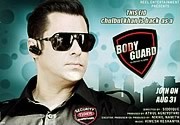
Bodyguard
Synopsis:
When it comes to being punctual and doing his duties perfectly, Lovely Singh is unmatchable. Taking great pride in what he does, he spares no effort in giving his everything to his profession.
Summoned for an assignment of guarding Divya, the daughter of Sartaj Rana, a business tycoon. Lovely Singh accompanies her to her campus, but ends up rubbing her the wrong way with his over-protective nature ...and paranoia about security. She finds him to be a major obstacle in leading a regular campus life. To throw him off-track and get him out of the way, she comes up with a ''master-plan''- that of trapping him in a fake love affair. ''Once he''s smitten by the girl of his dreams and is reveling in his new-found romance, he will leave us alone, and we shall be free to do our own thing unhindered'', says Divya to her friends.
She becomes an anonymous admirer of his and starts hounding him, expressing her ''feelings'' in no uncertain terms. Lovely Singh however proves to be a tough nut to crack, and it takes quite a bit of doing from her side to penetrate his fort-like exterior. But once she succeeds in doing so, he transforms into a completely different person. Divya is triumphant and is all set to relish her regained freedom.
But things take an unexpected turn when she learns a few things about Lovely Singh. Things that she could''ve never even imagined! And she soon finds herself trapped in a dilemma that she''s unable to resolve! And with her, soon enough, Lovely Singh finds himself ensnared in a web of lies, trickery and deceit!
It is the story of conflict- between innocence and mischief, love and power and life and death!
There is a specific kind of sound a leather shoe makes when it stamps hard onto polished marble in a needlessly enormous living room, and it's a sound that repeats about forty times in the first twenty minutes of Siddique's Bodyguard before anyone even bothers to explain why Salman Khan is wearing a blazer that costs more than a small tractor. If I'm honest, the sound mixing in those early scenes is just loud, hitting you right in the molars every time someone turns around too fast. Bollywood movies have always loved an entrance that clears the room, yet here the entrances feel less like character introductions and more like physical assaults on the audience's eardrums, courtesy of a background score that treats every single minor plot point like the arrival of a deity or an incoming mortar shell. You sit there in the dark watching Lovely Singh stride across a college campus with the grim determination of a man who has never once been told that smiling is free, wondering if the audio engineer fell asleep on the compressor button or if this is just what passes for texture these days in mainstream Hindi cinema.
Siddique remade his own Malayalam hit for the northern market, which usually means filing off all the eccentric little corners that made the original work and replacing them with shiny metal plates that bounce the light right back into your eyes. The screenplay lurches forward with the subtlety of a freight train running on square wheels, stopping occasionally for a song sequence that looks like a paint factory exploded inside a luxury resort, then roaring back to life just when you were starting to enjoy the quiet. Rajat Rawail pops up as a sidekick named Tsunami, and watching him try to squeeze actual comedy out of lines that were moldy back when Govinda was still running the box office is genuinely painful, mostly because the camera stays on him three seconds too long after every single punchline dies a slow death in the stifling air. It's a small thing, but that lingering reaction shot happens over and over, trapping the actors in moments of comic failure that no amount of colorful lighting can wash away, turning what should have been a breezy action-romance into a grueling exercise in endurance where you check your watch and realize only four minutes have leaked past.
Salman Khan plays the title character with his trademark expression of mild annoyance, the same look he brought to Dabangg and Ready, though here he wears sunglasses that seem to have their own gravitational pull. He doesn't act so much as he occupies space, daring the frame to contain him while executing fight choreography that relies entirely on slow-motion kicks and bad guys flying backward through plate-glass windows like they were made of balsa wood. Kareena Kapoor, meanwhile, does her usual high-society sneer before melting into a puddle of absolute devotion, and her chemistry with Khan is strictly transactional, functioning because both stars know the exact shape of the shadow they are supposed to cast on the poster. They share scenes with Mahesh Manjrekar and Shatrughan Sinha, veterans who look like they wandered onto the wrong set while looking for the washroom, delivering their lines with a weary professionalism that suggests they cashed their checks before the morning call sheet was even printed. Hazel Keech shows up in a supporting capacity and spends most of her screen time looking slightly confused by the rapid-fire tonal shifts happening around her, a confusion that spreads directly into the audience as the narrative pivots violently from campus romance to domestic melodrama without a single gear shift that makes mechanical sense.
The cinematography by Sejal Shah is all bright primary colors and soft-focus lenses, making every single frame look like an advertisement for cooking oil or laundry detergent, which fits the general aesthetic of commercial Hindi movies from that specific era. There is no dirt, no sweat that doesn't look like glycerin, and no shadow that isn't carefully placed to highlight Salman's jawline, creating a pristine, antiseptic visual world where human emotion is simulated entirely through close-ups of weeping eyes and swelling string sections. Songs composed by Himesh Reshammiya and Pritam blast through the speakers with a relentless, jackhammer energy, featuring lyrics that rhyme words like dil and muskil with the exhausted predictability of a middle school poetry assignment. You get the distinct impression that nobody on the crew cared about the visual storytelling because they knew the star's face on a forty-foot hoarding was going to do seventy percent of the heavy lifting regardless of what was happening in the background.
Beneath the glossy surface and the endless barrage of fight scenes, the film attempts to wrestle with the mechanics of identity, deception, and anonymous affection, though it does so with the grace of a brick falling down a chimney. The central conceit—where Kareena's character calls Lovely under a fake name to torment her overzealous protector—carries a weirdly toxic undercurrent that the script tries to play off as cute romantic mischief, ignoring the fact that she is basically gaslighting a man whose entire personality is built around blind obedience. When compared to something like Imtiaz Ali's Jab We Met, where emotional vulnerability feels earned through messy dialogue and awkward pauses, Bodyguard treats feelings like props to be moved around a chessboard whenever the plot requires a sudden burst of tears or an impromptu dance number. By the time Asrani makes his obligatory, screeching cameo as a flustered authority figure, you realize the movie isn't interested in exploring any of its own themes beyond the basic, contractual obligation to keep Salman Khan on screen for two and a half hours.
There is an awkwardness to the editing in the final reel that feels less like stylistic choice and more like someone lost the master tape and had to tape two different takes together with duct tape and hope for the best, resulting in continuity errors where characters change jackets between cuts while running across a parking lot. The sound design continues its assault long after you've stopped caring who wins the girl or who gets punched through a wall, leaving behind a persistent ringing in your ears that lingers even after you've stepped out of the theater and into the damp evening air. It's an artifact of a very specific machinery, loud and predictable and entirely satisfied with its own mediocrity, refusing to offer anything new to the audience beyond the familiar comfort of a star going through the motions on autopilot.