

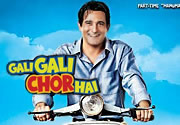
Gali Gali Chor Hai
Synopsis:
Bharat is the quintessential Indian common man, or aam aadmi, who lives in Bhopal, in Central India. He is a cashier at a bank, and, like all bankers, has a trusted sidekick – his scooter. He is also a part-time actor, and portrays the role of Hanuman, at the local Ramleela skit. His family consists of his wife, Nisha, a schoolteacher, and his father, Shivnarayan, a patriotic, idealistic man, who dreams of a corrupt-free nation.
Then there is Amita, the unwanted guest, who is an employee with a call centre. She is a pretty young thing, which is enough reason for Nisha to be slightly insecure about her marriage. Nisha is ambitious for her husband, and would like him to be promoted from cashier to manager at the bank.
Bharat, however, has other goals. He wants to be Ram, the protagonist in Ramleela. Sattu Tripathi, an extremely bad actor, gets to portray Ram, without opposition, because he is the younger brother of the politician, MLA Manku Tripathi. Both the Tripathi brothers dislike Bharat, for different reasons. Sattu is overshadowed by Bharat’s superior acting skills on stage, leading to a rivalry between the two. Manku, on the other hand, is miffed with Bharat, because the extra room in the latter’s house is now used as a re-election campaign room by Mohanlal, Manku’s adversary.
And then one day, Bharat’s table-fan gets stolen. The police constable, Parshuram Khushwaah tells Bharat that the local paanwalla, Bacchu Gulkand, can testify in court that it was none other than Chunnu Farishta, burglar par excellence, who is responsible for the crime.
A rather reluctant Bharat then gets sucked into a system that worships corruption and dishonesty, and is forced to bribe his way through criminals and law keepers alike, just to get this table-fan back. What the system does not seem to realise, however, is that even somebody as common as Bharat can snap, and when he does, he can make life hell for a lot of people.
There is a specific kind of screech that only a poorly maintained ceiling fan can make in an unventilated municipal office, and director Rumi Jaffery opens his movie with it, looping the audio just slightly too long over the opening credits so that by the time Akshaye Khanna actually walks into frame, your teeth are already slightly on edge. Not great, not bad, just there. We are in the realm of the middle-tier Hindi movie that desperately wants to be remembered as a folk-satire on corruption while simultaneously hedging its bets with enough broad sight gags to satisfy a Friday night crowd in a Tier-2 single-screen hall. Khanna plays Bharat, a man whose name is a walking billboard for patriotic irony, a guy who dresses up as a monkey during Ramlila and spends his days fretting over the price of onions and the sudden, inexplicable disappearance of his bicycle from the local market. It is a performance that requires him to look perpetually bewildered, like he has just been handed an extremely complicated tax form written entirely in ancient Greek, and he wears that expression with a dogged, almost admirable persistence.
Shriya Saran floats through the margins as his wife, given little to do beyond looking vaguely concerned while standing near a kerosene stove, though she gets one genuinely great moment where she manages to communicate absolute exhaustion with just the angle of her left shoulder blade. The script, which lurches between broad slapstick and heavy-handed moralizing about the Right to Information Act with the subtlety of a falling brick, never quite figures out what to do with its women, treating them mostly as props who exist to hand over cups of lukewarm tea at dramatically convenient intervals. Mugdha Godse shows up later as an ambitious journalist, and the camera lingers on her high-heeled boots in a way that feels distinctly dated, a relic of an older era of commercial cinema that assumed every female entry needed to be accompanied by a sudden shift in the lighting to something much shinier. The supporting cast is packed with reliable heavy-hitters who have saved worse material than this, though Vijay Raaz is clearly operating on a different frequency entirely, playing a cynical petty thief with a weary detachment that makes you wish the whole movie had just abandoned Bharat's middle-class angst and followed him around the back alleys of Mathura instead.
Anu Kapoor and Satish Kaushik chew through the scenery with the practiced efficiency of veterans who know that if they don't force some energy into the scene, the ambient heat of the projector room is going to put everyone to sleep. They play local politicians and fixers, men who treat bribery like a municipal utility, something you pay every month along with the water bill and the electricity surcharge. Akhilendra Mishra brings his usual low-key menace to a role that demands very little invention, and there's an edit right around the middle of the second act where he delivers a threat about land encroachment, and the editor cuts to a close-up of a passing stray dog that stays on screen for three full seconds after he stops talking, a bizarrely prolonged lingering shot that feels like an editing room accident left in simply because they needed to pad out the runtime. It is a small thing, but it bugged me every single time the sequence replayed in my head.
Visually, the film looks like it was lit entirely by someone who had just discovered the magic of overhead tube lights and refused to turn them off, washing out the streets of Mathura until they look less like an ancient holy city and more like a dusty warehouse on the outskirts of Noida. The cinematography lacks any real texture, preferring to stay at a medium-wide distance that flattens the actors against their painted backdrops, reminding you constantly of the studio floors where half these conversations must have been reconstructed. The soundtrack, composed by Sajid-Wajid, arrives with the subtlety of a brass band marching through a library, dropping tracks that attempt to comment on the socio-political decay of the nation while the background dancers look like they learned their choreography from a YouTube tutorial filmed in a parking lot. It is hard to stay engaged with a song about the common man's suffering when the backing track sounds suspiciously like a discarded demo from a completely different romantic comedy released three years prior.
There is an obvious debt here to movies like *Peepli Live*, though it lacks the sharp, documentary-style bite that made Satish Manwar's *Gabhricha Paus* so devastatingly effective in its examination of rural desperation. Jaffery wants to be a populist satirist, but he keeps losing his nerve and pivoting back to domestic melodrama whenever the ideas get too uncomfortable, softening the edges of his own argument until the critique of bureaucratic rot becomes just another backdrop for a family reconciliation. The film tries to suggest that the real corruption isn't in the high-stakes ministerial offices but in the small compromises ordinary citizens make just to get a birth certificate or a ration card, which is a sound premise that gets completely buried under a mountain of tedious domestic squabbling and farcical mistaken-identity subplots that drag on long after the joke has expired.
Khanna tries his best to anchor the chaos, his hangdog demeanor acting as a kind of dampener against the surrounding noise, but even he looks a bit tired by the time the third-act court sequence rolls around with its mandatory speech about the soul of the nation and the power of the individual vote. Hindi cinema has always struggled to make administrative procedure look cinematic, usually resorting to shouting matches and paper-flinging to simulate the thrill of civic duty, and this entry falls squarely into that same old trap without offering a single new angle on the problem. It exists in that vast, grey middle of the cinematic landscape where nothing is offensive enough to walk out on, but nothing is sharp enough to leave a mark once the credits finally finish rolling and the cleaning crew starts sweeping up the empty popcorn tubs.