

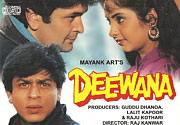
Deewana
Synopsis:
Kajal (Divya Bharti) falls in love and marries a famous singer named Ravi (Rishi Kapoor). They live their newly married life happily for a while, until tragedy strikes: Ravi''s greedy uncle Pratap (Amrish Puri) and cousin Narender (Mohnish Behl), who are determined to lay their hands on Ravi''s wealth. Narender first tries to rape Kajal but fails when he is caught. Pratap then hire hoodlums to murder Ravi, and he is thrown off a cliff. Along with Ravi, Pratap''s son, Narender, also dies.
Kajal''s mother-in-law (Sushma Seth) takes Kajal away from the depression of losing her husband to start a new life. In a new city, the widowed and depressed Kajal tries to get over her pain. One day a young man, Raja (Shah Rukh Khan), accidentally hits Kajal''s mother-in-law, meets Kajal and falls in love with her. When he tells Kajal he loves her, Kajal tells him that she is a widow. Raja''s father tells a bunch of thugs to get rid of Kajal and Raja severs ties with his father after finding out. He begs Kajal''s mother-in-law to have Kajal marry him. As her mother-in-law feels that Kajal should marry again, she persuades her.
Raja and Kajal get married but Raja tells her that he will not touch her until she accepts him. He looks for a job and his friends open a garage with him. One day, Raja goes to check out a jeep but has an accident when the brakes fail. Kajal becomes shocked when she hears this and runs to see him. After returning from the hospital, Kajal accepts him and falls in love with him, and the two are finally happy together. Things are well until one day, Raja rescues a man from hoodlums. He gets him treated and befriends the man, whose name is Ravi.
When Raja brings Ravi to Kajal, she is shocked to see that her husband''s new friend is none other than her first husband, who apparently survived his uncle''s attempt to murder him. When the truth is revealed however, Kajal stays with Raja, and Ravi''s mother leaves with Ravi. Ravi''s uncle figures out that Ravi is alive and has Raja and Kajal kidnapped, saying that he will let them go if Ravi signs the property papers. Raja escapes and he and Ravi beat Pratap, after which they find Kajal, tied up with a bomb strapped around her. Ravi manages to switch off the bomb and take it off her, but Pratap appears and says he will kill Raja and make Kajal a widow again. Ravi protects Raja and he and Pratap fall. Ravi sets the bomb off, causing a large explosion, killing Pratap and him once and for all. Kajal and Raja stay together and live happily ever after, honoring Ravi''s memory.
Shah Rukh Khan enters Deewana riding a motorcycle while wearing a leather jacket that looks two sizes too big, tearing up an asphalt road that seemingly leads nowhere except into the middle of a nineteen-nineties Hindi movie song. It is an aggressive, thoroughly unsubtle entrance designed to signal that the old guard has competition, even if that competition arrives wearing mirrored sunglasses and a grin that borders on feral. Raj Kanwar directs this entire picture like he is running out of gasoline, pushing every dramatic scene past its logical breaking point and dragging actors through melodrama so thick you could carve it with a butter knife. The screenplay by Rajeev Kaul and Praveen Bhardwaj is essentially two different movies stitched together with coarse twine and cheap thread, dropping an entire romantic triangle halfway through just to introduce an elaborate revenge plot involving Amrish Puri chewing on more scenery than a hungry termite. If I'm honest, the editing makes about as much sense as a screen door on a submarine, cutting away from crucial emotional beats just to show another angle of a cascading waterfall or a spinning motorcycle tire.
Rishi Kapoor plays Ravi, the wealthy industrialist who marries the wide-eyed Kajal within about fifteen minutes of knowing her, and he plays him with that comfortable, slightly rumpled charm he spent decades perfecting across dozens of other mainstream hits. He has this way of looking at Divya Bharti with genuine adoration that almost makes you forget how aggressively rushed their courtship is, sliding from chance encounters to domestic bliss without a single breath in between. Then the villains show up, led by Amrish Puri's snarling uncle character who dispatches Ravi with a swift push off a cliff, leaving Kajal a grieving widow before she has even figured out how to unpack her bridal trousseau. Divya Bharti carries the first half of the film almost entirely on her shoulders, crying giant glycerine tears and looking stunned by the sheer velocity of the plot happening around her. She has a fragile, magnetic screen presence that grounds the more ridiculous narrative turns, though the script reduces her to a weeping ornament for long stretches of runtime. Her grief is supposed to be absolute, yet the movie keeps interrupting her mourning to shoehorn in a comedy subplot featuring Alok Nath being generally disapproving and various side characters dropping awkward puns that land with a dull thud.
Enter Khan as Raja, the obsessed fanboy who stumbles into Kajal's life and refuses to leave, bringing a kinetic, almost manic energy that completely upends the polite, measured tone of the first act. He screams his dialogue with a throat-scraping urgency that feels genuinely dangerous in a genre usually dominated by polished, well-mannered romantic leads. When he sings "Aisi Deewangi," he isn't just courting Kajal; he is aggressively demanding the audience's attention, throwing his limbs around with a loose-jointed abandon that recalls a young Al Pacino if he had been raised on a steady diet of commercial cinema and mustard fields. You can trace a direct line from his performance here to the hyper-kinetic intensity he brought to Darr a year later, though here the edges are rougher, less calculated, and far more frantic. He dominates every frame he inhabits, sometimes to the detriment of his co-stars who are left standing in the background looking bewildered while he sprints across another manicured lawn.
The soundtrack by Nadeem-Shravan is inescapable, blasting out of tinny cassette players and auto-rickshaws across the subcontinent for months after release, and honestly, the sheer repetition of "Sochenge Tumhe Pyaar" started driving me crazy by the fourth time it played on the soundtrack. It's a gorgeous melody, don't get me wrong, but the film deploys it as a sonic crutch every single time the plot threatens to stall out for more than sixty seconds. The cinematography by Akram Khan captures the lavish hill stations and opulent drawing rooms with that soft-focus sheen typical of early nineties romantic dramas, washing every exterior in a pastel haze that makes everything look slightly edible. Yet the camera work gets lazy during the action sequences, relying on clumsy speed-ramping and obvious dummy drops that make Amrish Puri's various murder attempts look like outtakes from a low-budget thriller. It is a small thing, but it bugged me how the lighting changes mid-conversation between Rishi Kapoor and Divya Bharti in the honeymoon scenes, shifting from bright midday sun to deep blue artificial shadows without a matching cut in the narrative time.
Beneath the glossy surface and the endless musical numbers, the film deals in anxieties about property, patriarchal control, and the terrifying speed at which modern urban wealth was rewriting traditional family structures. Ravi represents the old-fashioned, benevolent capitalist who provides security and social standing, while Raja represents the disruptive, chaotic energy of the new generation that refuses to play by the rules of arranged marriage or social hierarchy. Kajal is caught between these two archetypes not as a person with her own desires, but as contested territory, a piece of real estate to be claimed by whichever man yells the loudest or survives the longest fall. The narrative eventually resolves itself by bringing back a miraculously resurrected Rishi Kapoor, turning the romantic rivalry into a bizarre ethical puzzle where the older husband must essentially hand his wife over to the younger, more energetic suitor because society demands a neat moral symmetry. It is a convoluted way to solve a love triangle, relying on amnesia tropes that feel lifted straight from a fifty-year-old melodrama.
Deewana works not because its narrative holds together under scrutiny, but because it captures the exact moment the industry started leaning into a faster, more aggressive brand of stardom that would soon dominate the decade. The tonal whiplash between the tear-soaked tragedy of the first hour and the high-energy romantic comedy of the second half creates a viewing experience that constantly keeps you off balance, refusing to let you settle into a comfortable rhythm. It is messy, bloated, and frequently ridiculous, yet it moves with enough raw velocity that you rarely have time to dwell on its structural flaws before another catchy tune starts playing on the soundtrack. By the time the final credits roll over a frozen frame of Shah Rukh Khan laughing hysterically into the camera, you realize you have just watched a star being born in real-time, regardless of whether the movie around him deserves the spectacle.