

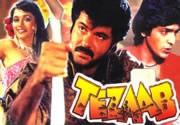
Tezaab (1988)
Synopsis:
About halfway through Tezaab, Anil Kapoor is standing there in this completely ridiculous fringe jacket that looks like it's made out of a cheap rug, and he's totally losing his mind because Madhuri Dixit is dancing on a stage in front of a giant cheering crowd while singing Ek Do Teen, and honestly that specific song sequence goes on for what feels like three business days with all these backup dancers in matching pink sparkly outfits and neon lights flashing everywhere, but to understand how we even got to that chaotic music video moment, you've got to go way back to the start of the film where Munna is just this regular guy who isn't trying to cause any trouble. His dad is this alcoholic professor played by Anupam Kher who's constantly getting beaten up by loan sharks and generally making everyone's life miserable, and Munna tries his best to protect his sister and keep the family afloat, but things just spiral out of control because of course they do in typical 1980s melodrama fashion. So then Munna falls in love with this sweet girl named Mohini who lives next door and her dad is this horrible corrupt police inspector played by Kiran Kumar who beats her and treats her like absolute garbage, and the young couple just wants to hang out and sing romantic duets, but the evil dad keeps tearing them apart and locking her in the house. Right after that, a murder happens, and Munna takes the rap for it to save someone else because he's just that kind of noble hero guy, and he gets thrown into prison for years where he turns into this hardened criminal who goes by the name Munna Diesel, which is a great nickname. Back in the real world, Mohini's dad forces her to become a dancer to pay off his mounting debts, and she's totally miserable until she gets famous and sings that super catchy tune we talked about earlier. Chunkey Pandey shows up somewhere in the middle as this goofy friend named Baban who provides comic relief and gets caught up in all kinds of silly shenanigans that barely make any sense, and he wears these massive oversized glasses and colourful shirts that scream eighties fashion disaster. Anyway, Munna finally breaks out of jail or gets released, and he's super angry about how his life got completely ruined, and he wants revenge on all the bad guys who destroyed his family and stole his girl. He tracks down the corrupt cop and his goons, and there's a bunch of running around and punching people in abandoned warehouses with lots of smoke machines and dramatic sound effects that make every single slap sound like a gunshot. The movie is honestly one of those classic hindi films that really helped shape the trajectory of bollywood back then, especially since it turned Madhuri Dixit into an overnight superstar even though she had been in a few other hindi movies before this one didn't quite pop off the same way. The action gets really intense toward the end with Chunkey Pandey getting mixed up in the fighting and almost getting himself killed because he doesn't know how to throw a proper punch, and then the main villain shows up with a bunch of henchmen to finish Munna off once and for all. So then there's this massive final showdown where everyone is screaming and fighting in a dusty junkyard or an old industrial factory, and Munna takes a ton of damage but keeps getting back up because heroes in these stories never stay down when they've got a point to prove. The police finally show up after all the damage is already done, and the bad guys get what's coming to them in a very loud and violent way that leaves the set looking like a tornado hit it. Munna and Mohini finally get a chance to look at each other without anyone trying to murder them or lock them in a room, and they just stand there breathing heavily while the camera slowly zooms in on their faces as the credits start rolling.
Chunkey Pandey wearing those round metallic sunglasses indoors always bothered me just a tiny bit. Tezaab opens with a kind of restless energy that never quite settles down for the next three hours, jumping between gritty street corners and over-lit melodramatic interiors without giving your eyes a second to adjust. If I'm honest, N. Chandra wasn't interested in subtlety when he sat in the director's chair for this one, preferring instead to shove every single emotion right up against the lens until it blurred. The screenplay borrows heavily from prior action hits of the decade like Sholay while adding a frantic, lower-middle-class desperation that belonged entirely to the late eighties. You can feel the sweat dripping off the celluloid during the dialogue heavy confrontation scenes where characters scream at each other across impossibly wide rooms.
Anil Kapoor plays Munna with a wire-thin intensity that makes you wonder if he actually slept during the entire shoot. He tears through action sequences and emotional breakdowns with the exact same manic look in his eyes, barking his lines with a hoarse urgency that eventually wears you down if you aren't paying attention. Then you have Madhuri Dixit entering the frame as Mohini, and the whole movie suddenly shifts on its axis the second she starts dancing. Her performance in the first half is mostly reactive, standing behind protective older men while looking terrified, but her screen presence was already undeniable enough to anchor the entire enterprise. It is a messy, sprawling thing, this movie, bulging with too many subplots and too many comic relief bits involving Anupam Kher chewing scenery with fake teeth and even faking a stammer that got old about ten minutes after he walked on screen.
Laxmikant-Pyarelal delivered a massive commercial score here, but hearing the exact same instrumental cue every time Munna gets punched by a corrupt cop starts wearing thin by the midpoint. The cinematography by Baba Azmi refuses to sit still, panning across dimly lit chawls with a harsh documentary lighting style that makes everything look a little dirty and lived-in. Hindi movies of this vintage often relied on studio sets that looked like plywood, but Chandra dragged his crew out into real Bombay alleyways and railway platforms, capturing the grime and the actual crowds of a city bursting at the seams. Johnny Lever shows up for about five minutes to do some frantic impressions, and while it adds nothing to the plot, it gives you a quick breather from the relentless misery of the main character's downward spiral.
The entire narrative hinges on systemic corruption and the failure of the legal system to protect the innocent, which was standard boilerplate for commercial Indian cinema at the time. Yet there is a specific kind of rage pulsing underneath the father-son dynamics here that feels slightly more personal than your average revenge thriller from that era. When Suresh Oberoi appears as the upright father destroyed by local thugs, the tragedy feels heavy and earned, even if the staging relies on every single trope in the book. Characters constantly make terrible decisions just to keep the plot moving into the next fight sequence, and you will find yourself yelling at the screen because Munna refuses to walk away when he clearly has the chance. That stubborn self-destructiveness is what separates him from the polished heroes of other contemporary Bollywood productions.
By the time the chaotic courtroom climax arrives, complete with shouted monologues and desperate gunplay, the film has exhausted every narrative trick it started with. The editing choices get downright choppy in the final reel, cutting away from reaction shots half a second too soon as if the projectionist was rushing to swap the reels. You leave the theater or turn off the screen thinking less about the social message and more about how hard Kapoor was breathing during that final sprint through the muddy courtyards. It is rough around the edges and structurally bloated in a way that modern commercial Hindi cinema has largely forgotten how to do, for better and for worse.