

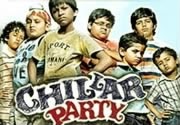
Chillar Party
Synopsis:
Halfway through the film, a bunch of kids wearing underwear on their heads are marching through a fancy apartment complex yelling slogans and holding cardboard signs, and honestly, if you haven't seen Chillar Party yet, this specific visual just captures the sheer chaotic energy of the whole thing. But to understand why these kids are protesting in their underpants, you have to look at how this started, which goes back to a bustling Mumbai housing society where a ragtag gang of young boys spends their entire summer vacation playing cricket and ruling the courtyard with absolute authority. They've got funny nicknames and distinct personalities, and there's Encyclopedia who's always reading dictionaries, and Aflatoon who's got a scheme for everything, and Panauti who everyone thinks brings bad luck, and they're just typical kids hanging out until a new kid arrives from a small town and disrupts their entire social hierarchy. This new kid is Fatka, an orphan boy who washes cars for a living and wanders around with his adorable stray dog named Bhiku, and at first, the gang absolutely hates him and tries to bully him away, but then Bhiku does something endearing and wins them over, so Fatka and the dog become part of the daily routine. The dog becomes the official mascot of the group, and they feed him biscuits and play with him every single day, and Irrfan Khan shows up briefly as a friendly neighborhood uncle who adds a nice touch of grounded warmth to the chaos. It's funny how some hindi movies completely forget how kids actually talk and behave, but this one nails it because the young cast feels totally natural, and Sanath Menon, Rohan Grover, and Naman Jain just steal every single scene they're in with their spot-on comic timing and genuine chemistry. Anyway, everything is going great until the politician shows up in the society, and this politician is an arrogant, power-hungry minister who hates stray animals and throws a massive fit because Bhiku barks at his convoy, and he immediately orders his goons to catch the dog and throw him away in some distant pound. The kids are devastated and they try to fight back, but the adult residents of the apartment complex are too scared of the politician to help them, and they actually support getting rid of the dog to keep the powerful politician happy, which leads to a massive argument in the courtyard where the kids realize they're totally on their own. Right after that, they hatch this crazy plan to protest against the minister, and that brings us right back to the kids marching in their underwear, which is their way of saying that even adults in high-powered positions are acting like fools and don't have any real clothes on morally speaking. The whole society gets annoyed by the underwear protest, and the local media catches wind of it because kids marching in their skivvies makes for great television, and soon enough, the whole city is talking about this bizarre little uprising happening in a posh housing colony. It's wild. It spreads everywhere. Social media wasn't as huge back then, but the news vans descend on the building and interview the kids, and the politician gets seriously embarrassed by the bad PR, and the adults in the society start panicking because they're worried the minister is going to ruin their lives or cancel their permits or whatever rich people worry about in bollywood movies. The kids don't care about any of that adult nonsense and they refuse to back down even when the parents lock them inside their apartments, and they sneak out through the back windows and keep fighting for their furry friend, proving that kids understand loyalty way better than grown-ups do. The pressure gets so intense that the politician's goons are forced to bring the dog back, and Bhiku is finally returned to a cheering crowd of kids who lift him up and celebrate their hard-fought victory against corruption and bullying. Fatka gets to keep his dog, the neighborhood goes back to normal, and the kids stand together triumphant on the rooftop as the camera pans up into the sky.
That stray dog on the corner has a better character arc than half the adult leads in standard hindi films, and I am not even trying to be glib about it. You walk into a children's movie expecting the usual sugar-coated morality play with bright primary colors and adults talking down to the audience like they're slow learners. Then Vikas Bahl and Nitesh Tiwari direct something that actually remembers what being ten years old feels like, which mostly involves intense arguments over nothing and minor injustices that feel like the end of the world. It is messy and loud and the sound mixing in the opening reel is a bit rough around the edges, making some of the overlapping dialogue sound like a football stadium after a controversial penalty. That minor audio glitch aside, the movie immediately grabs you by the collar and refuses to let go.
The screenplay doesn't talk down to its audience, which is a minor miracle when you look at how most modern bollywood projects handle young protagonists. Instead of turning the kids into miniature adults delivering profound life lessons, the writers let them be petty, loyal, cowardly, and fiercely brave all within the span of five minutes. The gang features a motley crew played by Sanath Menon, Rohan Grover, Naman Jain, Aarav Khanna, Vishesh Tiwari, Chinmai Chandranshuh, Vedant Desai, Divji Handa, and Sherya Sharma, each bringing a distinct flavor of playground politics to the proceedings. They cycle through the narrow lanes of their housing society with the casual ownership that only kids have before the real world grinds them down. There is an unvarnished energy here that reminds you of Sai Paranjpye's Katha, that same loose-limbed observational humor where the narrative wanders off to watch a street cricket argument just because it is interesting.
Let's talk about the kids because if the casting had missed by even a fraction of an inch, the entire enterprise would have collapsed into a cutesy mess. Naman Jain as Fatka possesses a kinetic, rubber-faced screen presence that makes you forget you are watching a child actor hit his marks. He doesn't play poverty for cheap sentiment; he plays it with a tough, street-smart survival instinct that makes his eventual integration into the gang feel earned rather than forced. Then you have Irrfan Khan showing up in a brief, uncredited or special appearance capacity that grounds the whole chaotic circus. He plays a politician or a minister's cynical secretary—honestly, the exact bureaucratic tier gets a bit fuzzy in the background noise of the plot—and he brings this weary, bemused detachment to his scenes that elevates the material.
The cinematography by Sudhakar Reddy captures the dusty sunlight of a Mumbai apartment complex without turning it into a tourist postcard. Shadows actually look like shadows instead of professionally graded teal-and-orange blobs, and the camera stays down at eye level with the kids instead of towering over them like an authority figure. Every now and then, though, an edit lingers a beat too long on a reaction shot, as if the director didn't quite trust the audience to get the joke the first time around. That editorial hesitation pops up during the mid-film montage sequences where the background score leans heavily on repetitive brass motifs. If I'm honest, that one recurring brass theme got on my nerves by the third time it dropped during a bicycle chase.
Beneath the slapstick and the barking stray named Bhidu, the film runs on a surprisingly sharp critique of middle-class hypocrisy. The adults in the housing society are terrified of dirt, disease, and disruption, wrapping their gated lives in rules that exclude anything messy or inconvenient. When the kids decide to protect a stray dog against the wishes of the resident welfare association president, the turf war escalates into a genuine satirical micro-cosm of adult politics. The movie refuses to provide a neat, comforting takeaway about tolerance, choosing instead to show how quickly community solidarity dissolves the moment property values and municipal bylaws enter the chat. It captures the exact flavor of a neighborhood WhatsApp group years before those groups actually existed, where everyone is mad about something very small and very specific.
Hindi movies rarely manage to look at childhood without slapping a thick coat of nostalgia over the edges, but this one keeps its fingernails dirty. The climax stretches credibility just a bit with an entire city of children staging a bizarre protest, yet the emotional logic holds steady because the script established the sheer stubbornness of ten-year-olds early on. You leave the theater thinking about how rare it is to see a mainstream commercial venture that lets its young cast behave like real kids instead of tiny, well-behaved marketing assets. It misses a beat here and there, and the pacing in the second act drags slightly when the adults take over the screen for too long, but it earns every bit of its chaotic, barking finale.