

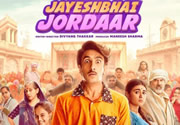
Jayeshbhai Jordaar
Synopsis:
Ranveer Singh is literally dangling from the roof of a speeding bus in broad daylight while screaming at the top of his lungs in absolute panic, and honestly, if you've never watched quirky bollywood movies before, this particular visual is going to fry your brain completely.
So anyway, let's back up because Jayeshbhai Jordaar starts in this super conservative fictional village called Prajapati where patriarchy reigns supreme, and Boman Irani plays the terrifying, moustache-twirling patriarchal grandfather Pruthvapal Patel who also happens to be the village sarpanch, and he hates baby girls with a burning passion.
Ratna Pathak Shah plays Jayeshbhai's equally oppressed mother who silently accepts whatever her husband says while Shalini Pandey plays Jayeshbhai's terrified wife Mudra who is pregnant again and terrified that she's carrying another girl because they've already aborted or lost six previous female fetuses, which is just dark and heavy for a mainstream comedy, but hey, it's a social satire wrapped up in typical colorful chaos.
Jayeshbhai himself is played by Ranveer, and he's not your typical alpha male hero at all because he's a total pushover who lets his dad boss him around, but secretly he loves his little daughter Siddhi played by Jia Vaidya, and he's desperate to save his unborn baby and his wife from the clutches of his murderous family who are planning to kill the baby if it's a girl.
Stuff happens and Jayeshbhai suddenly grows a spine, steals some money, and decides to escape the village with Mudra and Siddhi under the guise of going to a temple festival, but really they're running away to Mumbai to start a fresh life where girl children are actually allowed to breathe and exist without being treated like trash.
And then boom, the family finds out they fled, and Boman Irani's character goes totally ballistic, grabbing his hunting rifle and a whole truckload of angry village thugs to track them down across state borders, which leads to all kinds of slapstick chases and near-misses that make zero practical sense.
Right when the tension is peaking and you think they're about to get cornered at a highway motel, the movie just completely slams on the brakes for a totally random song and dance number because you cannot have traditional hindi films without breaking into choreography when people are actively running for their lives.
We hit the interval point right as the villains close in on a crowded railway station, and honestly, the pacing up to this point has been all over the place, jumping from dark social commentary about female foeticide straight into broad cartoonish comedy where Ranveer is wearing a ridiculous floral shirt that I can't stop staring at because it looks like someone threw up a Hawaiian sofa.
After the break, they manage to board a bus, which brings us right back to that opening scene where Ranveer is hanging off the side while local cops and his angry relatives are trailing right behind them on motorcycles, honking horns and waving machetes.
They eventually crash the bus near a highway dhaba and have to hide out in a truck carrying massive loads of cauliflowers, and during this quiet second, Mudra goes into active labor right there in the vegetable truck while Jayeshbhai has to deliver the baby himself with zero medical training, shouting encouragement and crying hysterically.
The grandfather and his goons finally catch up to the truck just as the baby pops out, surrounding the vehicle with guns drawn and demanding to inspect the newborn to see if it's a boy or a girl so they can dispose of it if it's another female.
Jayeshbhai steps out of the truck, shielding the newborn baby with his own body, and delivers this massive, emotional speech right in front of the entire village mob about how women are the actual backbone of society and how he's done letting his family dictate who gets to live and who gets to die.
The grandfather raises his hand to strike Jayeshbhai, but the local police force, who have finally been tipped off about the honor killing plot by an anonymous tip, arrive in jeeps with sirens blaring and arrest the grandfather and his armed thugs on the spot.
Mudra steps down from the truck holding the healthy newborn baby girl in her arms, smiling proudly alongside little Siddhi, and Jayeshbhai hugs them both tightly as the police vans drive the defeated patriarch away.
Ranveer Singh has this habit of chewing on the last syllable of a Gujarati word like it's a dried clove, and it's a small thing that bugged me through the first twenty minutes of Jayeshbhai Jordaar before I realized it was doing all the heavy lifting for a character who is otherwise just a collection of frightened postures. Divyang Thakkar directs this thing with the frantic energy of someone trying to prevent a room full of toddlers from eating drywall, which mostly means the camera never sits still even when two people are just sitting in a provincial courtyard talking about tractor parts or whatever. You get these dizzying 360-degree pans around dining tables where Boman Irani is aggressively chewing his food while lecturing his shrinking family about dynastic survival, and if I'm honest, the staging gets so hyperactive that you miss the actual texture of the rooms they are standing in. Shalini Pandey barely gets two pages of dialogue across the entire runtime, which feels criminal given how effectively she projects a kind of hardened, silent desperation as a mother carrying yet another female foetus through a gauntlet of patriarchal village elders who treat ultrasound clinics like execution chambers.
The screenplay tries to play child-marriage and female infanticide as a loud, colorful farce, which is a tightrope walk that usually ends with everyone covered in mud. When Jayeshbhai finally snaps and decides to smuggle his pregnant wife and their smart-mouthed nine-year-old daughter—played with wonderful, eye-rolling annoyance by Jia Vaidya—out of their fictional Gujarati village called Pragpur, the movie morphs into a frantic road trip across the dusty interiors of western India. Singh runs around in oversized pastel shirts, flapping his hands and adopting a deer-in-headlights wobble that borrows heavily from the frantic physical comedy Amol Palekar used to pull off in the late seventies, except here the stakes involve thugs with machetes chasing them through bus depots and highway dhabas. Ratna Pathak Shah plays the matriarch with a terrifying, internalized misogyny that makes her more frightening than Boman Irani's cartoonish patriarch, because her cruelty is delivered with the gentle, matter-of-fact tone of someone serving afternoon tea. There is a running gag involving a local police inspector who keeps popping up like a bad rash, and every single time his introductory brass-heavy theme music kicks in, it's the exact same audio cue looped over and over until you want to throw a heavy porcelain mug directly through your living room screen.
Hindi films have a long and exhausting history of handling social issues by wrapping them in loud slapstick and then expecting the audience to weep during a ten-minute monologue in the third act, and this script follows that exact greasy slide without ever finding a fresh angle on the material. The cinematography by Siddharth Diwan tries to brighten up the oppressive thematic gloom by painting everything in sun-bleached yellows and turquoise blues, making a regressive rural nightmare look like a very expensive holiday brochure for a resort nobody wants to visit. When the family hides out in a Delhi safehouse run by a group of progressive activists, the narrative grinds to an absolute halt so that various characters can explain the plot's moral imperative directly to the camera with the subtle grace of a brick falling through a stained-glass window. Singh's performance holds it together through sheer manic velocity, selling lines about gender equality with such desperate sincerity that you almost forget how mechanically the jokes are constructed around him. Yet the supporting players are often left stranded in wide shots while the editing chops up their reaction faces into rapid-fire montages that kill any sense of geographical space or dramatic tension.
There is a specific kind of middle-class moral panic running through recent Bollywood movies that want to critique regressive traditions while still servicing the commercial mandate of keeping everyone comfortable enough to buy popcorn, and Jayeshbhai Jordaar lives right in that awkward grey swamp. It wants to preach against female foeticide with the booming voice of a megaphone, but it also pauses the narrative every twenty minutes to watch Ranveer Singh do a funny dance with a group of confused villagers who look like they wandered off the set of a completely different movie. The soundtrack by Vishal and Shekhar blends generic folk loops with synth-heavy pop tracks that vanish from your brain the second the needle lifts off the groove, leaving behind a hollow sonic footprint that feels cobbled together in a post-production suite six hours before the master drive had to be shipped to theaters. When the climax arrives at a railway station with the usual assortment of running feet, shouting cops, and last-minute epiphanies about the sanctity of daughters, you aren't feeling the emotional weight of a father protecting his bloodline so much as you are just calculating how many minutes are left until the credits start rolling.