

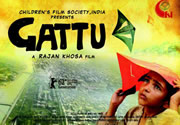
Gattu
Synopsis:
About halfway through the movie Gattu, the kid is literally running across rooftops in broad daylight while wearing this ridiculous, oversized, faded Spider-Man t-shirt with a frayed collar that probably came out of a dusty communal bin, and he's dodging angry neighbors and slipping on loose terracotta tiles just to chase this legendary black kite that everyone calls Kali, and it's honestly a miracle he doesn't break his neck right then and there. But to understand why a street kid is risking his life over a piece of paper and string, you have to look at how this whole obsession started on the dusty rooftops of Roorkee. Mohammad Samad plays this streetwise, mischievous orphan boy who works at his uncle's stationery shop, and he's supposed to be studying or at least sorting pencils and notebooks all day, but he doesn't care about any of that because the sky above the town is constantly filled with colorful kites fighting for dominance, and he just wants in on the action. He's an illiterate kid living day-to-day, and unlike the usual glossy heroes you see in mainstream bollywood, he’s scrappy, sweaty, and always getting yelled at by Naresh Kumar's character, his perpetually stressed-out uncle who's just trying to run a decent business and keep the kid out of trouble. Gattu doesn't go to school, and he spends most of his time dodging chores so he can gawk at the local kite flyers and dream about taking down the ultimate neighborhood menace, this mysterious black kite that rules the local airspace and seems totally invincible to everyone who tries to cut its line.
So then Gattu figures out that the only way he can actually get up close to the kite fighting action and maybe even take a shot at Kali is by sneaking into a local school where the kids play on the roof during recess, and he pretends to be a student just to blend in. The funny thing is, he can't even read or write, so he's faking his way through classes and sweating bullets whenever a teacher looks his way, but he manages to make friends with some of the actual students who teach him a bit about reading and help him out with his grand kite strategy. Right after that, he realizes he needs a proper kite of his own, so he starts stealing scraps of paper and bamboo from the shop and secretly building his masterpiece at night by the flickering light of a single bulb. He's totally consumed by this mission, and every spare second goes into prepping for the big aerial battles, and he even paints little details on his kite just to make it look fierce. Then they have a big neighborhood tournament, and everyone’s shouting and pulling their strings and swearing at each other, and it's loud and messy and totally chaotic. Just like that, he loses his first major match in about ten seconds.
Anyway, he doesn't give up because he's too stubborn for his own good, and he keeps sneaking onto the school roof every single day even though the teachers are starting to notice this random kid who doesn't wear the proper uniform and always smells like cheap stationery glue. He gets caught a few times, but he's too fast for them and he just scrambles over the brick wall and disappears into the alleyways before anyone can grab him. The teachers realize he's an outsider who just wants an education and a chance to play, and instead of just calling the cops, they start feeling a bit bad for him, though his uncle eventually finds out about the whole school charade and loses his mind. There's this huge shouting match at the shop where Naresh Kumar tells him he's wasting his life on stupid toys and needs to focus on real work, and Gattu feels completely crushed because he thought he was actually getting somewhere. But if you compare this to all those overproduced hindi films where the poor kid magically gets adopted by a billionaire or discovers a hidden magical artifact, this movie keeps things grounded in real, dusty, sweaty reality where a kid just wants to fly a piece of paper in the sky. He sneaks out again anyway because you can't keep a kid like that locked indoors when there's a sky full of wind.
The final showdown arrives when Kali is spotted drifting lazily over the town during a massive afternoon wind, and Gattu drops everything he's holding, bolts out of the shop, knocks over a display of cheap pens, and sprints through the narrow, sun-baked alleys with his handmade kite clutched tightly in his filthy hands, scrambling up the rickety wooden ladder to the highest roof he can find, leaping across a dangerous gap between two buildings, and launching his kite straight up into the roaring wind.
Mohammed Samad has a very particular way of squinting when the sun hits the corrugated tin roofs of Roorkee that immediately tells you everything you need to know about Gattu before he even opens his mouth.
Most kid-centric films in the ecosystem of Hindi cinema tend to drown their juvenile protagonists in an unbearable amount of precocious charm that makes you want to throw your popcorn at the screen, but Rajan Khosa’s direction avoids this trap by letting the camera simply watch the boy chew on his pen or kick dust off his sandals with genuine boredom. That approach gives the screenplay room to breathe without choking every single scene with exposition about why an orphan working at a scrap shop might be obsessed with flying kites instead of studying his Hindi alphabets.
When Gattu spots the mysterious black kite known only as Kali, the film doesn't lean on some sweeping orchestral cue to manufacture excitement, though if I'm honest, the background score does lean a bit too hard on traditional flutes whenever the action moves to the rooftop.
The narrative follows this illiterate street kid as he infiltrates a local municipal school just to get higher up for his aerial battles, wearing a stolen uniform that is at least two sizes too small for his scrawny frame, and honestly, the way the school administration reacts to an interloper feels less like a cartoon villain setup and more like the everyday bureaucratic annoyance of underpaid clerks who just want to finish their chai.
Samad carries the entire weight of this movie on shoulders that look like they might snap if a strong gust hits them, anchoring scenes that could easily drift into sentimentality with a stubborn, street-smart posture reminiscent of young boys in Satyajit Ray’s Apu Trilogy.
He doesn't give a performance that feels coached or over-rehearsed; instead, he communicates frustration through sudden, jerky movements and moments where he stares blankly at a wall while older kids argue over manja string.
Naresh Kumar plays the scrap shop owner who employs the boy with a weary, pragmatic tolerance that never curdles into outright cruelty, establishing a dynamic where affection is communicated entirely through shared plates of lentils and the occasional cuff to the back of the head.
The supporting cast features plenty of local faces who clearly aren't professional actors, and while that adds a layer of documentary-style grit to the streets and alleyways, it also leads to a couple of awkward line readings that stick out like a sore thumb during the classroom sequences.
The cinematography by Attar Singh Saini captures the harsh, blinding glare of northern Indian summers without slapping a golden-hour filter over every single square inch of the frame, preferring to let the dust motes dance in the shafts of light cutting through dusty warehouses.
Those rooftop sequences deserve special mention because they avoid the standard rapid-fire cutting of modern action sequences, choosing instead to track the swoops and dives of paper and bamboo with long, patient takes that let you feel the wind.
You feel the tension of the string cutting into calloused fingers, the sudden drop in the stomach when a line snaps, the communal roar of a neighborhood watching two pieces of colored paper duel fifty feet above the concrete.
It is a tactile, messy visual language that refuses to romanticize poverty even as it finds moments of grace in the middle of a junk yard filled with rusted pipes and plastic bottles.
Commercial Hindi movies usually treat the lower-class milieu as a tragic backdrop for melodrama, but here the slums and narrow gullies are rendered as living, breathing spaces where people still find the energy to argue about sports and local gossip.
Beneath the simple quest to conquer the skies and defeat a mythical opponent, the film tackles the rigid class boundaries of contemporary India with a light touch that refuses to preach to the audience from a soapbox.
Gattu's illiteracy isn't treated as a tragic curse that requires an inspirational montage to fix, but rather as an annoying practical hurdle that keeps him from reading the signs on the school walls or understanding the instructions on kite boxes.
Education is framed not as a golden ticket to a middle-class paradise, but as a basic tool for survival and dignity in a world that would otherwise prefer to sweep children like him under the rug.
There is an unspoken sadness humming beneath the bright primary colors of the kites, a recognition that childhood in these neighborhoods is often cut short by the necessity of earning a living.
The film never pauses to pat itself on the back for being socially conscious, which is perhaps its greatest strength.
The pacing sags slightly around the middle third when the plot gets bogged down in a repetitive cycle of Gattu sneaking into the school and getting chased out by the stern headmaster.
That specific bit of cat-and-mouse gets old about halfway through, recycling the exact same reaction shots of bewildered teachers and scattering children until you start checking your watch to see how much runtime is left.
Yet the movie recovers its footing the moment it returns to the sky, shifting focus back to the sheer kinetic joy of the kite battles where social hierarchies momentarily dissolve under the sun.
When Gattu finally faces his aerial nemesis on the rooftops, there are no slow-motion hero shots or swelling choruses to tell you how to feel about his triumph.
He just pulls the string, watches the paper climb, and grins.