

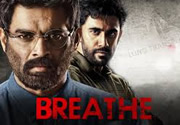
Breathe S01
Synopsis:
Madhavan is literally sobbing in a hospital supply closet while staring intensely at a pack of blue medical gloves like they personally insulted his ancestors, and honestly, the sheer chaotic energy of this show is something else entirely because Breathe S01 isn't your average fluffy romance.
So here's the messy setup of the whole plot without any boring buildup.
Madhavan plays this doting single dad named Danny Mascarenhas, and his young son Josh needs a lung transplant desperately, but the kid is stuck way down at the very bottom of the donor waiting list.
Enter Kabir Sawant, played by Amit Sadh, who is this gruff, smoking-addicted, alcoholic cop with a tragic past who won't stop listening to old cassette tapes and wearing the same leather jacket.
Kabir gets dragged into investigating a string of bizarre, seemingly random deaths where organ donors keep dying in freak accidents right before their organs can be harvested, and spoiler alert, it's not a coincidence at all because Danny is actually hunting them down and staging these accidents to move his son to the top of the list.
Let's talk about the background extras for a hot second because I cannot get over this one background nurse who wears the most hideous neon green orthotic sneakers during a high-tension ICU scene where doctors are literally running around with defibrillators, and it distracts you completely from the grim reality of organ theft in hindi movies.
Danny is running a football coaching camp to pay the bills, and he's dating Rhea, played by Sapna Pabbi, who is gorgeous and sweet and completely oblivious to the fact that her sweet boyfriend is secretly a cold-blooded serial killer murdering people on weekends.
And then boom, Kabir starts putting the pieces together because he's actually a decent detective despite constantly swigging booze from a flask while staring blankly at crime scene photos taped to his dingy apartment wall.
Right around the interval point, which hits you out of nowhere like a flying cricket bat in bollywood movies where everything pauses for a second of pure dread, Danny has to push an elderly man down a flight of stairs to secure another potential match, and the staging of that fall is so ridiculously dramatic with slow-motion flying glasses.
People often talk about how hindi films rely on cheesy formulas, but Breathe S01 drops the musical numbers entirely and just gives us pure, sweaty, moral panic as Danny spirals deeper into madness.
Kabir corners Danny at the football stadium under the blinding floodlights, and they have this sweaty, breathless face-off where Kabir just looks at him and says, "you crossed a line," but Danny doesn't even care because his kid's lungs are failing.
Stuff happens so fast at the end that you get whiplash: Josh finally gets his surgery, the cops close in, Rhea finds out the horrifying truth and looks like she's going to throw up into a potted plant, and Kabir stands outside the operating room holding a bloody handkerchief.
Danny gets arrested, cuffs click shut on his wrists, and he stares blankly through the glass at his breathing son one last time before being shoved into the back of a damp police van.
There is a specific kind of breathless heavy breathing that sound designers love to use right before a plot twist, and Breathe deploys it so frequently during the first episode that you start wondering if everyone in Mumbai has asthma. It is a small thing, sure, but it bugged me every single time the audio mix swelled to remind us that someone was running out of time. Mayank Sharma’s directorial debut in the streaming space tries very hard to strip away the glossy song-and-dance routine we usually associate with Hindi films, opting instead for a gritty procedural aesthetic that feels like it watched too many Nordic noir imports on Netflix. The premise itself demands suspension of disbelief right out of the gate because an organ donor racket orchestrated by an ordinary sports coach is not the kind of thing you pull off casually on a Tuesday afternoon while dodging city traffic and local bureaucracy. Yet the screenplay keeps moving fast enough to prevent you from poking too many massive holes in the logistics, hurtling forward through dimly lit hospital corridors and rain-slicked alleyways that have become mandatory visual shorthand for moral corruption in modern Indian thrillers. The pacing rarely drops below a frantic crawl, which helps mask the occasional contrivance in how the police stumble upon their clues, though it also leaves very little room for the characters to breathe, ironically enough, given the title.
R. Madhavan plays a father whose desperate love for his dying son pushes him into the unthinkable territory of serial murder, and he brings a terrifying, hollow-eyed stillness to the role that elevates the material far above standard pulp. He doesn't chew the scenery when he is killing medical board members; he just looks exhausted, like a man doing accounting work he finds deeply unpleasant. That restraint keeps the character from sliding into standard villainy, even as he systematically terminates innocent people to jump the organ transplant queue. Opposite him, Amit Sadh plays Kabir Sab ?????, a disgraced, alcoholic, chain-smoking cop who solves crimes by shouting at suspects and looking thoroughly pissed off at the universe. If I'm honest, it is a performance that borders on caricature at times, channeling Denzel Washington in Training Day if he had spent the night sleeping on a Mumbai local train, complete with the scruffy beard and the leather jacket that looks like it has survived three monsoon seasons without ever being cleaned. The dynamic between the two leads anchors the entire eight-episode run, setting up a cat-and-mouse chase where you alternate between rooting for the murderer to secure his son's lungs and wanting the grumpy detective to finally catch a break and get some actual sleep. Sapna Pabbi floats through the periphery as Madhavan's supportive wife, doing what she can with dialogue that mostly consists of asking if he has eaten dinner or telling him everything will be fine while looking increasingly worried about the lighting.
The cinematography leans heavily into desaturated blues and murky greens, turning the bustling financial capital into an oppressive concrete labyrinth where daylight only exists to illuminate bureaucratic misery. Every interior is cramped, every outdoor shot is choked with traffic haze, and the camera lingers on close-ups of ticking clocks and dripping IV bags with the subtlety of a sledgehammer to the kneecap. The background score deserves special mention for being aggressively omnipresent, refusing to let a single emotional beat land without an orchestral swell telling you precisely how to feel about a man staring blankly at a bowl of dal. It borrows heavily from the acoustic melancholy popularized by shows like Broadchurch, though it lacks that particular series' knack for local texture, feeling instead like a generic plugin downloaded from a composer's digital toolkit. There is a recurring motif involving an old vinyl record that plays at crucial emotional moments, and by the fourth time it spins up to underscore a father's tearful monologue, you wish someone would just smash the turntable and let the scene play out in dead silence.
Beneath the surface mechanics of the thriller plot, the show wants to examine the elasticity of ethics when applied to parental desperation, asking how many strangers you would push in front of a bus to save your own child. It is an old moral question that bollywood movies have tackled in various melodramatic ways for decades, but stretching it across a serialized format allows for a more agonizing slow-burn look at moral rot. Madhavan's character doesn't transform overnight into a cold-blooded killer; he stumbles into violence incrementally, rationalizing each atrocity as a necessary administrative hurdle until the body count climbs too high for denial. The supporting cast populates this moral vacuum with varying degrees of success, though there is one recurring beat where the forensic doctor speaks in such heavily dubbed English that her mouth movements never quite match the syllables, creating a distracting ventriloquist effect every time she delivers an autopsy report.
Breathe does not reinvent the crime thriller, and it certainly stumbles over its own procedural cliches whenever the investigation requires a convenient coincidence to move the plot forward. Yet it retains enough narrative momentum to keep you clicking through the autoplay countdown at the end of each episode, driven mostly by the sheer magnetic force of its central conflict. It is a messy, occasionally frustrating viewing experience that trades nuance for cheap narrative adrenaline whenever the energy dips too low, but it respects your time just enough not to insult your intelligence outright. When the credits finally roll on the chaotic finale, you aren't left pondering the deep philosophical implications of medical corruption or the failure of the state apparatus to protect its citizens. You are just wondering what Madhavan is going to do with his coffee cup, which is probably the exact reaction the editing room was going for.