

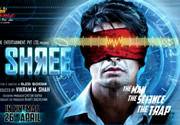
Shree
Synopsis:
It, an ordinary man, works at a telecom company. In love with girl but cannot marry yet as need to make some basic money.
Randhawa, a wealthy businessman, in his ceaseless pursuit of power, has zeroed in on It as his last guinea pig. It is the last piece of puzzle of a scientific experiment, devised by a brilliant scientist, supported by commissioner of police and funded by Randhawa.
If successful, it could change the fate of their lives and that of the whole world. Lured in by promise of a bright and successful future, It trade in 12 hours of his life.
Randhawa offers him 20 lakhs for participating in a experiment which will last for 12 hours. He trusts them and needs the money, excitedly It trade in 12 hours of his life.
But as soon as these 12 hours start, he finds that his simple life has been turned upside down. Accused of murdering the scientist, the commissioner of police and many more people.
It an ordinary man, now is the most wanted man in the city. Now must use his wit and intelligence to prove his innocence. Now he must rise above the ordinary, and become Extraordinary.
There is a specific kind of awkwardness that happens when a television actor tries to figure out where the edge of the frame is in a widescreen movie, and Hussain Kuwajerwala spends the first twenty minutes of Shree looking like he is constantly trying to remember if the boom mic is hovering just above his hair.
Television daily soaps train performers to throw their energy toward the back row of a cheap theater, which makes the early scenes in this particular sci-fi misfire feel oddly loud even when characters are just ordering tea in a cramped Mumbai kitchen. Not great, not bad, just there. The plot kicks off when an ordinary guy working a dead-end job gets roped into testing a corporate time-manipulation device that gives him twelve hours of absolute financial leverage. Rajesh Bachchani directs with the visual flair of a corporate presentation designed by someone who discovered color correction filters yesterday, throwing turquoise and amber washes over every single interior until you start wondering if the electricity bill for the set was paid entirely in mood lighting. The screenplay feels like it was assembled from discarded drafts of The Butterfly Effect written by a committee that had only ever read Wikipedia summaries of Philip K. Dick stories.
Yet there is a stubborn engine underneath all the cheap CGI and the dialogue that sounds like it was translated from German and then back through an app. Anjali Patil brings a bruised, grounded realism to her scenes that constantly threatens to expose the artificiality around her, holding the frame with the kind of weary gravity you usually only see in parallel cinema rather than these mid-tier Bollywood experiments. She plays the protagonist's girlfriend with an exhaustion that feels lived-in, reacting to the sudden influx of cash not with movie-star awe but with the immediate suspicion of someone who knows that nothing in this city comes without a hidden invoice. It is a small thing, but it bugged me how the sound design drops her dialogue completely out of the mix whenever the score swells to tell us we are supposed to feel tense.
Hindi movies have a terrible habit of over-explaining their own science fiction mechanics, and Shree falls into that exact trap repeatedly, halting the narrative momentum just so someone can point at a glowing monitor and explain what a temporal displacement loop is for the hard of hearing. Paresh Ganatra shows up as a sleazy boss and plays the role with broad strokes that belong in a stage farce rather than a thriller about corporate espionage and stolen minutes, chewing the scenery with a determination that feels almost desperate. The camera movements during the chase sequences rely far too heavily on rapid-fire edits that obscure the geography of the street, making every foot pursuit look like a blurry montage of generic concrete pillars and passing auto-rickshaws.
The central conceit asks us to buy into the notion that twelve hours of extra time could somehow solve a middle-class man's mounting debt before anyone notices he has vanished from his desk. It treats time as a literal currency that can be stored in a glass vial, a metaphor so heavy-handed it practically leaves bruises on the audience. When the movie leans away from its high-concept machinery and focuses on the mundane dread of bills piling up on a kitchen table, it actually hums with a strange, anxious energy. Shivani Tanksale makes the most of her limited screen time as a corporate handler who knows more than she lets on, dodging questions with a casual cruelty that feels far more believable than any of the movie's convoluted conspiracy twists.
Rio Kapadia adds a touch of necessary grease to the antagonist role, though he spends most of his scenes standing in front of oversized windows looking important while blue light bounces off his forehead. The soundtrack relies on an electronic motif that repeats so often during the second act that you can practically set your watch to the synth stabs whenever a character checks their digital countdown timer. It is an exhausting auditory experience that leaves very little room for silence or actual suspense, preferring instead to bludgeon the viewer until every revelation feels like an obligation.
Hindi films have occasionally managed to pull off clever speculative fiction on shoestring budgets, but this particular entry gets bogged down in its own mythology. The lighting gets progressively worse as the night scenes drag on, eventually reaching a point where half the actors are performing in near-total darkness while neon signs pulse behind them for no discernible reason. Kuwajerwala eventually settles into a more natural rhythm once the plot stops asking him to look bewildered by monitors and just lets him run for his life through empty stairwells. The supporting players are left to carry the thematic weight of a script that keeps dropping its own ideas halfway through scenes, abandoning moral dilemmas in favor of another poorly choreographed confrontation in a parking garage. By the time the protagonist makes his final, inevitable choice about whether to keep the stolen hours or give them back, the narrative has twisted itself into such a tight knot that the resolution feels less like a climax and more like an administrative necessity.
The editing cuts away from reactions a fraction of a second too late throughout the entire second half, leaving actors standing around blinking after their lines have landed, which drains the tension right out of the room. It is a messy, uneven piece of work that bites off far more than its production budget can chew, stumbling through its genre exercises with a kind of earnest clumsiness that makes it difficult to completely dismiss. Some viewers will find charm in its ambitions, while others will check their own watches long before the twelfth hour runs out.