

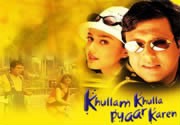
Khullam Khulla Pyaar Karen
Synopsis:
Govinda drops his left shoulder about an inch lower than the right whenever he is trying to look sincere in Khullam Khulla Pyaar Karen, a tiny physical tic that probably made sense in a read-through three years before anyone turned the cameras on in Switzerland or wherever those Alps were supposed to be. It is a strange thing to fixate on during an opening scene that already requires a massive suspension of disbelief involving a rich industrialist, a secret will, and a marriage that has to happen before Tuesday, but once you see that shoulder drop, you cannot look away from it. Hindi movies have always relied on this kind of muscular shorthand for emotional availability, where a twitch or a sudden straightening of the spine stands in for three pages of dialogue explaining why Raja loves Priti Zinta's character so intensely despite them having shared roughly four minutes of screen time prior to the song sequence. If I'm honest, the whole opening twenty minutes feels like it was edited by someone who had a train to catch, cutting away from reaction shots just as the actors are settling into their lines.
Director Harmesh Malhotra is not interested in subtlety, which comes as news to absolutely no one who bought a ticket for this thing back in two thousand two, yet there is a strange, leaden gravity to how he shoots standard comedic setups. When Govinda and Kadar Khan share a frame, the camera sits back at a medium-wide angle and just lets them talk, letting the rhythm of their decades-long comic shorthand carry scenes that should have been trimmed down by half during the offline edit. It reminds me a bit of the pacing in Raja Babu, though without that earlier film's manic, greasepaint energy. Instead, Khullam Khulla Pyaar Karen moves with the heavy, exhausted momentum of a road company production on its four-hundredth night, where everybody on stage knows the punchlines before the setup is even out of the other guy's mouth. The screenplay by Praveen Bhardwaj is less a narrative structure than a series of waiting rooms where characters sit until it is time for someone to shout about property or elopement.
Priti Zinta is working overtime to inject some actual juice into a role that requires her to look confused, look glamorous, and occasionally run across a lawn in heels while pretending she is fleeing for her life from Prem Chopra's thoroughly bored villain. She has this specific way of narrowing her eyes when Govinda delivers a particularly terrible pun that suggests she is mentally calculating how many more days of shooting are left on her contract, and honestly, that bit of internal calculation makes her far more compelling than the script ever allows her to be. Bollywood movies have spent decades perfecting the decorative heroine, but Zinta has too much natural screen presence to just stand there and look pretty under studio lights, so she pushes against the boundaries of her scenes until the frame nearly cracks. When she shares a scene with Kadar Khan, though, she relaxes, recognizing she is in the presence of an absolute master of commercial timing who can rescue a dead line with just a flick of his eyebrows.
Prem Chopra plays the bad guy with the enthusiasm of a man who parked his car in a tow-away zone and is constantly checking his watch to see if he still has time to move it before a ticket gets slapped on the windshield. His dialogue is all delivered at a single, unchanging volume, whether he is threatening to disinherit his nephew or just asking someone to pass the salt during a family dinner scene that goes on for six eternities. It is a small thing, but it bugged me how the Foley artists gave his cane a distinct metallic clink even when he is walking across thick hotel carpeting that would have muffled a falling grand piano. That kind of sloppy post-production work runs through the entire second half of the picture, where the background score by Anand-Milind stomps all over dialogue scenes with stray synthesizer stings that sound like they were lifted from a cheap cassette ad.
The cinematography by Ishwar Bidri lurches between sun-drenched wide shots of foreign tourist spots and flat, overlit interior sets that look like they were constructed out of leftover plywood from a soap opera shoot next door. There is no texture to the light, just a harsh, video-like brightness that flattens out the actors' faces and turns every outdoor sequence into an exercise in squinting against glare. When Govinda dances, which he does with his usual rubber-limbed abandon despite looking slightly heavier in the jawline than he did in his nineties heyday, the camera operators seem confused about whether to focus on his footwork or the thirty background dancers dressed like Swiss ski instructors. It creates a visual stutter that makes the musical numbers feel less like joyous explosions of rhythm and more like endurance tests for everyone involved.
Themes of familial duty versus personal happiness get dragged out every twenty minutes or so, beaten over the head until they turn into grey mush that nobody on screen seems to care about by the time the climax rolls around. Raja wants to marry for love, his uncle wants him to marry for money, and the film treats this ancient conflict with all the philosophical depth of a cereal box commercial. Yet there is something weirdly comforting about watching these high-paid professionals go through the motions of a plot that everyone in the auditorium has seen twenty times before in slightly different packaging. Hindi films have a long and honorable tradition of recycling old shoes until the soles fall off, and Khullam Khulla Pyaar Karen is nothing if not a very worn pair of loafers that still somehow fit on swollen feet after a long day of walking.
The closing fifteen minutes involve a misunderstanding at a railway station that relies so heavily on characters not looking five feet to their left that it makes you want to climb into the screen and point them in the right direction. It doesn't matter, of course, because by then the plot has already dissolved into a series of broad grins and a final freeze-frame that catches Govinda mid-laugh with that left shoulder still dropped down low, as if he is trying to lean into a wind that only he can feel.