

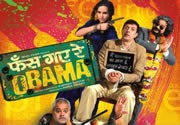
Phas Gaye Re Obama
Synopsis:
It is a satirical take on the Kidnapping happening in poverty stricken parts of India as well as the recession.It is a refreshingly new attempt on comedy which is impressive.The director Subhash kapoor has succeeded in making the film an thoughtful entertainer sans any star power.The cast is a big strength to the movie as every role has been played perfectly.
The protagonist of the film is Mr.Om Shasthri an Nri played by Rajat Kapoor.Mr.Shasthri is taken hostage by a local don Bhaisaheb (Sanjay Mishra) who expects to mint money from his hostage. But what he did not know was that Mr.Shasthri is a victim of the global recession and in neck deep debt. Also Mr.Shasthri''s coming to India in the first place was to sell a piece of his ancestral property so that he can pay of the bank back home in america to avoid eviction from his home.
When Bhaisaheb realise that his hostage is of no use he plans to sell him off to another don for a price.He in turn sells him to a third don played Neha Dhupia who is supposed to be the lady Gabbar.This passing of the hostage continues.How Om Shasthri gets out of this situation and does he pay of his debts in time or not forms the rest of the movie.
Sanjay Mishra clearing his throat before speaking is the single best audio cue in a mid-budget comedy from that entire decade, a dry little rattle that tells you everything about a man trying to maintain professional dignity while elbow-deep in an amateur kidnapping. If I'm honest, the sound mixing on his dialogue in the early scenes is a bit muddy, but you forgive it because the timing cuts right through the static.
Subhash Kapoor made a movie about the 2008 global financial crash by setting most of it inside a drafty, half-built mansion in the scrublands outside Delhi where nobody speaks English and everyone is desperate for wire transfers. The screenplay has this nasty, wonderful habit of letting characters talk past each other for long stretches instead of delivering punchlines, which makes the whole thing feel less like a polished caper and more like a very bad day that keeps getting worse.
Rajat Kapoor plays an American-returned Wall Street guy who goes completely broke and gets snatched by a gang of local crooks who assume every NRI is sitting on piles of hidden cash. He carries this specific look of exhausted disbelief throughout the second act, shoulders dropped, tie slightly crooked, moving through chaos with the glacial patience of a man who used to trade derivatives and now has to negotiate with idiots over lukewarm tea.
Then there is Neha Dhupia running the local mafia outfit with a cigarette permanently wedged between her fingers and a voice that sounds like gravel sliding down a galvanized pipe, commanding every room she walks into without ever raising her volume. She is matched by Amol Gupte as a corrupt politician who treats every extortion demand like a minor bureaucratic hurdle, playing the role with a greasy smoothness that makes you want to scrub your hands.
The supporting cast fills in the margins with jagged, lived-in energy, especially Amit Sial and Manu Rishi, who manage to make their bumbling thugs feel like real people rather than standard comic relief. Pragati Pandey and Sumeet Nijhawan show up in smaller beats that ground the madness in domestic reality, keeping the stakes tethered to actual rent and grocery bills.
The camera work by Anshuman Mahaley stays mostly out of the way, capturing the glare of dusty sunlight bouncing off unplastered brick walls and cheap plastic chairs, though there is one weirdly aggressive zoom on a ringing landline phone that lingers for a full beat too long. That sort of editorial hiccup happens a few times, reminding you that this was put together on tight margins with a crew that had to move fast before the light died.
When people talk about the smarter edge of mainstream Hindi films from that period, they usually point to grander satires or glossy thrillers, but this one works because it doesn't give a damn about looking respectable. It shares more DNA with Dibakar Banerjee's Khosla Ka Ghosla than it does with the slicker heist pictures that came out around the same time, finding its humor in the quiet desperation of people who are terrible at being criminals.
The soundtrack is mostly background noise and frantic percussion that occasionally threatens to drown out the actors, though the recurring accordion theme is a bit much after the fourth time it pops up during a stakeout. It’s a small thing, but it bugged me every time the audio swelled to signal a joke was landing.
The movie is really about how global capital markets and small-town extortion run on the exact same principles of bluffing until someone blinks. Money moves from one set of dishonest hands to another while everyone else just tries not to get caught in the crossfire.
Bollywood movies rarely commit to this level of sustained cynicism about economic desperation without throwing in a romantic subplot or a tearful moral realization halfway through to soften the blow. Here, everyone stays selfish and greedy until the credits roll, which feels entirely correct for a story about people trying to survive a financial meltdown they didn't cause and can't possibly understand.
The final fifteen minutes rush past in a blur of forged documents and missed phone calls that resolves nothing in particular, just a bunch of tired people walking away from a ruined house while the dust settles on another failed transaction.