

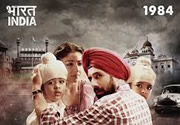
31st October
Synopsis:
There is literally nothing more terrifying than watching Soha Ali Khan desperately trying to hide her entire family under a table while screaming neighbors and breaking glass echo through the Delhi lanes, and I am still recovering from it.
So anyway, to understand why everyone is hiding, we gotta go back to the start of 31st October, which is easily one of the heaviest hindi films you will ever watch. It is October thirty-first, nineteen eighty-four, and Prime Minister Indira Gandhi has just been assassinated by her bodyguards. The streets of Delhi are suddenly an absolute nightmare. Devender Singh, played by Lakhwinder Lakha, is just trying to live his normal life with his wife Tejinder, played by Soha Ali Khan, and their three kids. Devender works for the electricity board and he’s wearing this remarkably hideous brown patterned sweater vest that I honestly could not take my eyes off for the first twenty minutes. Like, the vest has these weird geometric triangles on it that belong in a time capsule from nineteen-eighty, and every time Devender looks stressed about a blown fuse, that brown polyester vest stretches in the most tragic way possible. Right after that establishing domestic bliss vibe, the news hits the television, and the world just caves in. Mob violence erupts out of nowhere, and Sikh families are suddenly hunted in their own neighborhoods. A local politician played by Nagesh Bhonsle with a mustache that screams pure evil is basically orchestrating the chaos from the shadows, whipping the crowds into a frenzy with loudspeakers and cheap liquor. Devender gets a frantic phone call from his Hindu friend Iqbal, who tells him not to step outside because the mobs are checking IDs and burning houses down block by block. The tension ramps up so fast that you forget you are watching a standard drama and not a straight-up horror movie. And honestly, this brings us right to the interval block, because right when the family is huddled in the dark living room staring at each other in sheer terror, the movie just slams the brakes for a dramatic orchestral sting. You know how bollywood movies love a forced intermission, but here it feels exceptionally jarring because you are holding your breath waiting to see if a brick is going to crash through the window.
Right after the break, the situation goes from bad to impossible because the mob actually reaches their apartment building, smashing doors and dragging people out into the street. Devender and Tejinder have to rely on the absolute kindness of a few brave Hindu neighbors who risk their own lives to keep them hidden in a tiny cramped room. There is this excruciatingly long sequence where a group of rioters literally walks inside the apartment, checks the kitchen, and kicks a plastic bucket across the floor while Soha Ali Khan covers her youngest son's mouth so he doesn't cough. The camera pans away to focus on a dusty ceiling fan spinning slowly, and honestly, the sound design here is just brutal with the distant chanting and the sound of iron rods hitting metal gates. They spend the entire night hiding like that, trembling in the dark, whispering desperate prayers while the city burns outside. The next morning arrives, and it doesn't bring any relief because the curfew is still in full effect and the police are either completely useless or actively looking the other way. Devender realizes they cannot stay trapped forever because the kids are starving and water has run out, so he decides they need to make a break for a government relief camp across town. They disguise themselves, cutting their hair and changing clothes, trying to blend in with the smoke and ashes filling the Delhi air. Nagesh Bhonsle’s character pops up again near a railway crossing, barking orders at the thugs and glaring at every passing family to make sure no one is escaping. The climax of the film is basically a relentless, agonizing foot chase through alleys and ruined marketplaces where every corner looks like a dead end. Devender gets separated from Tejinder for a few terrifying minutes, and she has to physically block a rioter's path with a rusted pipe while her kids slip through a hole in a brick wall. They finally reach the crowded gates of the refugee camp, falling into the mud exhausted, bruised, and completely broken. Armed soldiers finally intervene, pushing the remaining thugs back with rifles raised as the heavy iron gates of the camp swing shut to keep the family safe. Tejinder pulls her kids tight against her chest, staring blankly ahead at the sea of other survivors sharing her exact same nightmare. The screen cuts to black abruptly on that exact face of numb survival without any uplifting musical resolution or final voiceover text.
Soha Ali Khan wears a pale salwar kameez that looks entirely too clean for a family running through ash-choked Delhi lanes, and if I am honest, that wardrobe department choice bothered me more than some of the clunkier dialogue. It is a strange thing to watch a historical tragedy where the protagonist's dupatta barely catches a smudge of soot even while dodging mobs with iron rods, but cinema has always struggled to make genuine panic look truly disheveled. The film drops us directly into the chaotic autumn of 1984 without wasting time on introductory title cards or gentle scene-setting, shoving the viewer into a living room where a television set drones on about Indira Gandhi’s assassination before the brick comes flying through the front window. Shivaji Lotan Patil directs with a blunt instrument rather than a scalpel, which turns out to be both the movie's primary limitation and its most stubborn defense against cynicism. Hindi cinema usually handles political trauma by slathering the screen in amber nostalgia or turning historical violence into a chest-thumping speechfest, yet here we get something far more pedestrian and therefore far more nerve-wracking. The screenplay by Harry Sachdeva, who also produced the thing, relies heavily on the ticking-clock mechanics we have seen a thousand times before in Hollywood hostage thrillers, yet it somehow avoids turning the November 1984 anti-Sikh riots into mere entertainment boilerplate.
Lakhwinder Lakha plays Davender Singh, an ordinary factory worker whose only crime is wearing a turban and living in a government colony where old neighbors suddenly transform into baying executioners within the span of one afternoon. Lakha isn't a trained actor in the traditional polished sense, bringing a raw, occasionally awkward stiffness to his physical movements that actually serves the material well because this isn't a John Wick action hero figuring out an escape route with cool calculation. When he hides his family in a tiny pantry, his breathing sounds ragged and wet, the kind of unglamorous panic that makes you shift uncomfortably in your seat. Soha Ali Khan plays his wife Tejinder, anchoring the domestic scenes with a quiet, exhausted desperation that reminds you of her work in Rang De Basanti without ever directly echoing it. They speak in hushed whispers that occasionally get drowned out by distant slogans echoing down the asphalt, and the sound design deserves credit here for keeping the mob off-screen for long stretches, letting human voices carry the terror instead of leaning entirely on a synthetic string score. Nagesh Bhonsle pops up as a sympathetic neighbor who tries to help, and while his character arc is predictable down to the last second, his weary eyes sell the moral cowardice of ordinary people who shut their doors when the shouting starts. It is a small thing, but the extras playing the rioters look a bit too much like college theatre students holding sticks for the first time, lacking that terrifying casualness of real urban violence where perpetrators treat looting like an afternoon errand.
The cinematography by Mohanan uses a sickly yellow grade that feels like looking at old Kodachrome slides left too long in the sun, capturing the dust and the smoke of burning tires with an unblinking gaze that refuses to romanticize the tragedy. There is a tracking shot through a deserted apartment complex that lingers a beat too long on an abandoned tricycle, a clumsy visual metaphor that the editor should have trimmed by about five seconds, yet the sheer persistence of the camera makes up for its lack of subtlety. The background score by Amar Mohile tends to underline every single moment of tension with heavy percussion, hitting the brass notes whenever someone peeks out a window, which gets exhausting by the middle hour. Why do filmmakers assume we won't notice a child crying unless there is a low cello groan underneath it? Still, the tension works because the geography of the apartment is established so clearly that when the mob rattles the back door, you feel the exact perimeter of the entrapment. We have watched countless Hindi movies treat violence as a stylized dance where heroes flip through the air, but Patil slows everything down to a crawl, showing how families spent hours crouched behind refrigerators, listening to boots on the stairs and praying the floorboards wouldn't creak.
There is a stubborn refusal in the second half to turn this into a standard rescue narrative, keeping the focus tightly inside the four walls where the family sits in darkness while the world outside burns itself to ash. The political machinery that enabled the bloodshed gets mentioned in hurried radio broadcasts and passing phone calls, positioning the state not as an active participant on screen but as a vast, indifferent vacuum that leaves citizens to fend for themselves against organized killers. This brings to mind Govind Nihalani's Tamas, though Patil lacks that film's sociological depth and novelistic patience, opting instead for a brisk ninety-minute sprint that treats historical tragedy like a suspense exercise. Is it exploitation to turn real sectarian slaughter into a nail-biting genre exercise about whether the locksmith will arrive on time? That question hovers over the entire enterprise, making it difficult to praise the film's undeniable craft without feeling a slight pang of discomfort at how efficiently it converts human agony into popcorn thrills. Yet the movie never loses its grip on the sheer domesticity of survival, focusing on spilled dal, rationing water from a bathroom tap, and the terrifying sound of a match being struck in the dark hallway outside.
The closing moments do not offer any grand philosophical takeaway about the resilience of the human spirit or the healing power of time, mercifully avoiding the bloated speechifying that usually plagues commercial Indian cinema when it touches upon national trauma. The family simply steps out into the gray, ash-strewn morning light, their clothes ruined, their neighbors watching from behind chipped curtains with averted eyes, and the screen cuts to black without warning. It is an abrupt, satisfyingly harsh ending that leaves you staring at the credits in the dark, wondering about the logistics of the escape rather than pondering a grand message about communal harmony. Lakha gives one last look back at the scorched doorway of his home, his turban slightly askew, before walking down the empty road toward a relief camp, and the camera lingers just long enough to catch the twitch in his jaw before the frame freezes and the projector hums.