

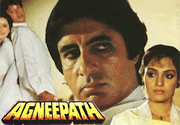
Agneepath (old)
Synopsis:
Amitabh Bachchan talking like a throat-clearing engine idling in neutral is the thing that stays with you long after the credits have guttered out. Vijay Deenanath Chauhan doesn't just speak; he pushes each gravel-scraped syllable through clenched teeth as if the entire language of Hindi films offended his personal dignity. People remember the white suit and the loafers, but the vocal register is the real weapon, raspy and low and deliberately flattened so that when he finally screams at a dying policeman or barks a threat across a rain-slicked dock, the sound tears right through the screen.
Mukul Anand directed this mess with a frantic energy that borrows heavily from Brian De Palma without ever quite understanding how to frame a wide shot. There is a relentless gloss to the production design that smells of late eighties commercial excess, neon gels bleeding into smoky warehouses and helicopters hovering over beaches that look suspiciously like Bombay backlots instead of Mauritius. The script by Santosh Saroj and Ravi Kapoor piles tragedy upon trauma until the narrative groans under the sheer weight of its own misery, pushing the protagonist from an idyllic coastal village to the filthy gutters of the underworld because a local landlord decided to murder his schoolteacher father with a shovel. It’s a relentless grind of a screenplay, punching the audience in the ribs every ten minutes with another flashback to a burning banyan tree or a weeping mother.
Bachchan towers over the enterprise, obviously, but the picture actually breathes when Mithun Chakraborty enters as Krishnan Iyer M.A., a manic street-smart tailor with a heart of gold and a terrible wig who follows Vijay around like a stray dog looking for scraps of affection. Chakraborty plays him with a loose-limbed, desperate charm that cuts through the grim darkness of Bachchan's brooding scowl, and their odd-couple dynamic saves the middle hour from collapsing entirely under the weight of its own self-importance. Madhavi brings a quiet dignity to the thankless role of the woman who loves a monster, though she mostly stands by doorways looking worried while the men scream at each other. Neelam, playing Vijay’s educated sister Shiksha, spends half her screen time crying into someone's shoulder or looking bewildered by the sudden influx of wealth and violence surrounding her family, which feels less like a character arc and more like a punishment for existing in a script written by men who only understood suffering.
Danny Denzongpa plays Kancha Cheena with a calm, reptilian stillness that makes him one of the most effective villains in the history of commercial cinema, sporting a slicked-back mane and an immaculate wardrobe while he casually orders hits on business rivals over a game of pool. He doesn't bellow or chew the scenery the way Amrish Puri might have done in a similar role; instead, he speaks in a low, reasonable tone that makes his sudden bursts of extreme cruelty landing even harder. Kancha's island stronghold, where he runs his drug empire and tortures enemies, looks like a rejected set from a James Bond picture, complete with henchmen in safari suits and guards carrying submachine guns that never seem to run out of ammunition.
There is a recurring musical cue that plays every time Vijay remembers his father’s murder, a shrill synthesized string chord that feels like someone scratching a fork across a slate, and it happens at least eight times too many before the intermission rolls around. If I'm honest, the editing by Waman Bhonsle and Gurudutt Shirali is occasionally baffling, cutting away from reaction shots half a beat too early just to catch Bachchan staring menacingly into the middle distance, as if the director was terrified the audience might forget who the movie was about for even a single second. The cinematography by Pravin Bhatt uses harsh side-lighting that catches every bead of sweat on Bachchan's forehead, turning his face into a topographical map of vengeance and regret. Laxmikant-Pyarelal's score leans heavily on synthetic drums and weeping flutes, creating a sonic landscape that feels stuck somewhere between a traditional folk tragedy and a synthesizer-heavy action picture from Hollywood.
Watching this thing now, you can see the strain of trying to modernize the angry young man persona for a decade that had grown tired of simple proletarian angst and demanded something darker, something closer to the slick crime sagas imported from the West. It sits awkwardly alongside lighter bollywood hits of the era that preferred romance and comedy to blood-soaked vendettas. The themes are biblical and heavy-handed, dealing with generational curses, the sins of the father visiting upon the son, and the corrupting nature of absolute hatred. Vijay wants to avenge his father, but in doing so he becomes identical to the men who destroyed his family, trading his soul for a ledger book of names and a gun with a pearl handle. It's an old story, told here with maximum volume and very little subtlety, a blunt instrument of a movie that relies entirely on the sheer gravitational pull of its leading man to keep from spinning off its axis into complete absurdity.
By the time the final confrontation arrives on that rain-soaked beach with Kancha Cheena laughing maniacally through a hail of bullets, you are exhausted, battered by three hours of shouting, crying, and aggressively melodramatic plot twists that refuse to let up for even a moment of quiet reflection. The death scene goes on for an eternity, Bachchan gasping for air while delivering a final monologue to his mother that ties up every thematic loose end with unnecessary neatness, spelling out the moral of the story for anyone who managed to sleep through the previous hundred and eighty minutes. It's a deeply flawed piece of work, bloated and exhausting and occasionally downright silly in its earnestness, but it refuses to compromise its ugly vision of a broken man chewing his own heart out to feed a ghost. When the screen finally goes black, you don't feel cleansed or satisfied; you just feel like you survived something loud and violent that probably should have stayed in the editing room for another month.