

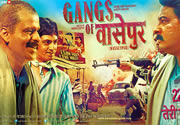
Gangs of Wasseypur
Synopsis:
Pankaj Tripathi eats a boiled egg in the background of a scene where he doesn't have a single line of dialogue, and you spend the first twenty minutes of Gangs of Wasseypur trying to figure out if he is actually chewing or just moving his jaw to annoy someone. If I'm honest, that tiny bit of business tells you more about the texture of this whole sprawling mess than any grand critical thesis ever could. Anurag Kashyap didn't make a movie so much as he uncorked a drain that had been filling up with coal dust, regional politics, and bad blood for seventy years, letting the whole foul-smelling thing spill across five hours of celluloid without worrying too much about whether the carpets were going to get ruined. Most modern Hindi films are terrified of their own shadows, desperately trying to sand down every rough edge so they can play comfortably on a flight to Dubai, but this thing smells like sweat, cheap tobacco, and iron ore from the first frame. It is loud, messy, and occasionally infuriating to watch because nobody involved seemed to care about narrative economy.
The screenplay by Zeishan Quadri and Kashyap moves through decades like a man throwing punches in the dark, hitting bone sometimes and missing entirely other times, yet maintaining a frantic, breathless energy that makes you forget to check your watch. Shahid Khan starts the cycle of violence by robbing coal trains in the British era, and from there the plot metastasizes into a tumor that consumes generations of sons, uncles, and hangers-on who all seem to die with their boots on. Sardar Khan, played by Manoj Bajpayee with a swagger so thick it practically leaves grease marks on the lens, enters the narrative like a force of nature that cannot be negotiated with or reasoned away, establishing a standard of cinematic masculinity that makes most contemporary Bollywood heroes look like they were manufactured in a sterile laboratory. The timeline stretches, characters appear and get shot in the stomach before you have even learned their names, and the narrative structure constantly threatens to collapse under its own weight, but the sheer momentum carries it past the breaking points. There is a specific kind of arrogance in how casually major characters are eliminated in the middle of a sentence, refusing the audience the courtesy of a proper death scene or an emotional chord to hold onto.
Bajpayee dominates the first half with a performance that feels less like acting and more like an exorcism, his voice dropping into a raspy growl whenever he needs to remind someone who owns the town. He chases women, beats rivals with iron rods, and sings old Hindi film songs with a pathetic sort of romanticism that only makes his inevitable demise feel heavier. Then the film shifts focus to Nawazuddin Siddiqui as his son Faizal, a man who spends most of his youth getting high behind a curtain before he is suddenly forced to pick up a pistol and inherit a war he never wanted. Siddiqui plays him with a deadpan stare that suggests his brain is processing things at a different speed than everyone else in the room, blinking slowly while men scream around him. It is a brilliant pivot away from the traditional action star archetype, turning Faizal into a reluctant gangster who is just as likely to forget his own revenge plot because he got distracted by a girl he likes. Tigmanshu Dhulia, meanwhile, brings a chillingly polite menace to the role of Ramadhir Singh, the rival kingpin who understands that power is not just about bullets but about outliving your enemies and managing municipal contracts.
Rajeev Ravi’s cinematography refuses to use the golden-hour filters that usually make rural violence look like a tourism ad, opting instead for a harsh, blown-out daylight that makes Wasseypur look like a purgatory built out of red brick and coal slurry. The camera moves constantly, tracking characters down narrow alleys and peering over shoulders during casual conversations that invariably turn into street fights, giving the impression that nobody in this town is ever safe from an ambush. Sneha Khanvilkar’s soundtrack does something genuinely weird by taking traditional folk idioms and mixing them with electronic percussion and crude, satirical lyricism that comments directly on the action rather than just swelling in the background. It is a noisy movie, stuffed with the sounds of train whistles, cheap cell phone ringtones, and dialogue that is delivered at a volume suggesting everyone is half-deaf from working in the mines. That being said, the constant reuse of the main theme song during every single minor confrontation starts to wear thin by the fourth hour, turning what should have been a signature motif into a blunt instrument that bludgeons the scene instead of lifting it.
There is also the matter of the supporting actors who clearly had their lines dubbed by someone in a Mumbai sound booth three months after the shoot wrapped, creating a jarring disconnect between the gritty visuals and the ultra-clean vocal tracks. It is a small mechanical failure, but it pulls you out of the illusion just enough to remember you are watching a movie made by people working under ridiculous time constraints and budget limitations. This is not the pristine, high-concept urban storytelling of a film like Dev.D, but rather a greasy, mud-spattered epic that is far more interested in the petty grievances of small-town petty thieves than in any grand moral statement about the corrupting nature of power. The men in this story do not have arcs; they simply have trajectories, shooting across the sky like fireworks before burning out against the concrete walls of an unfinished building.
Revenge is usually treated in cinema as a sacred duty or a tragic curse that destroys the soul, but here it is presented as a family business passed down from father to son like a rusted bicycle or a set of old tools. Nobody in these neighborhoods seems to remember why the original blood was spilled, only that the other side owes them three deaths and an apology, turning the feud into an administrative burden rather than a passion. Women in Wasseypur navigate this meat grinder with varying degrees of exhaustion, from Huma Qureshi’s Mohsina, who refuses to let her boyfriend buy her anything until he proves he can handle a gun properly, to Richa Chadha’s Nagma Khatoon, who watches her household disintegrate while she simply tries to keep enough food on the stove for the surviving children. They are the ones who actually have to clean up the mess left behind by men who think dying young is a valid career choice.
You can see the seams of the production coming apart in the final stretch, where the pacing goes entirely haywire and characters who were crucial for two hours disappear into the background because the editors simply had too much footage to wrangle into a coherent shape. Yet that lack of polish is precisely what makes the film endure in a landscape of cinema that has become entirely too sanitized and predictable for its own good. It refuses to let you off the hook with a comforting moral or a neat resolution where the bad guys go to jail and the surviving orphans learn the value of education. The violence doesn't stop because a hero arrives; it stops temporarily because everyone ran out of ammunition or got tired of burying their cousins.
By the time the final sequence plays out in a slaughterhouse with a butcher's knife and a terrible hip-hop track, you aren't thinking about the cinematic lineage of the gangster genre or the socio-economic factors that turned a coal belt into a war zone. You are just watching two tired men try to kill each other in the mud while the dogs bark in the distance, waiting for someone to finally turn the lights out.