

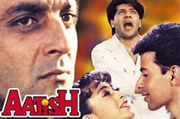
Aatish
Synopsis:
Baba is literally standing on top of a speeding train while wearing this ridiculous leather jacket that looks like it cost five rupees at Chor Bazaar, and he is just screaming at the sky before he shoots some random bad guy right in the kneecap.
So then to understand why they are fighting on a roof, we gotta go back to the start of Aatish, which is one of those classic 90s bollywood movies that doesn't care about your sleep schedule.
Baba plays Baba and Aditya Pancholi plays Amar, and they are basically these two street kids who grew up together under the absolute thumb of this terrifying crime lord named Don Kaka, played by the legendary Ajit with a voice deeper than the Arabian Sea.
Right after that heavy childhood trauma montage, the film jumps forward and Amar has somehow cleaned up his act and become a totally honest police officer, which is super hilarious because you just know it's not going to last for even twenty minutes.
Baba stayed in the underworld life because somebody's gotta pay the rent and look cool in sunglasses, and he is currently working for the main villain while trying to protect his younger brother Atul Agnihotri, who just wants to study and fall in love with Karishma Kapoor in peace.
Karishma is running around in these neon pink outfits that probably blinded the camera crew, and she gets a random song and dance number right after Baba gets shot in the shoulder, which is the kind of wild pacing you only get in vintage hindi films where nobody asked the director to calm down.
Amar keeps trying to arrest his best friend Baba because the badge makes him do annoying things, and they have this massive shouting match in an abandoned warehouse where Baba yells kitna bada ho gaya hai tu before they both start crying about their shared past.
Then comes the interval block, and let me tell you, the guy sitting next to me spilled his popcorn right when the screen flashed INTERVAL in giant red letters while a bomb started ticking under a chair.
The second half gets even messier because Raveena Tandon shows up out of nowhere as Amar's girlfriend, and she basically exists to look worried, wear huge hoop earrings, and hand people loaded pistols during family dinners.
The funny thing is the plot completely forgets about the drugs and the smuggling for like forty minutes just so Atul and Karishma can do a romantic number in Switzerland or Ooty, complete with fog machines and backup dancers wearing oversized sweaters in the middle of summer.
Don Kaka finds out that Baba is actually double-crossing him, so the villain kidnaps the younger brother and ties him to a wooden chair in a dusty cement factory that looks like it hasn't been swept since 1970.
Baba and Amar have to team up again because brotherhood is the only law that matters in these classic hindi movies, and they drive a beat-up jeep straight through a brick wall to save the day.
Bullets are flying everywhere, extras are falling over without even getting touched, and Ajit is just sitting in a velvet chair smoking a cigar while laughing maniacally until Baba jumps through a glass window with a double-barrel shotgun.
They rescue the kid, but Don Kaka gets away in a helicopter because of course he does, leading us right back to that train sequence where everyone is shouting over the sound of the engine.
Baba takes a bullet for Amar because the melodramatic quota of the script wasn't quite filled yet, and he dies in the middle of the railway track while holding his best friend's hand and whispering one last emotional dialogue about destiny.
Amar screams noooo into the sunset, drops to his knees in the gravel, pulls out his service revolver, and shoots the remaining henchmen before walking away alone down the train tracks.
That one leather jacket Aditya Pancholi wears in the second half has a collar that looks perpetually damp, and if I'm honest, it distracted me for at least twenty minutes of screen time while the plot was busy falling apart around him. Sanjay Dutt enters the frame wearing shades indoors, carrying the kind of heavy, slow-burn exhaustion that usually takes twenty years of bad habits to manufacture naturally, which works for a character whose primary job description is standing near abandoned warehouses looking betrayed by everyone he has ever shared a cup of chai with. Director Sanjay Gupta was clearly studying the neon-soaked framing of John Woo via badly dubbed VHS tapes floating around Bombay editing rooms, trying to replicate that specific brand of bullet-riddled brotherhood without always possessing the budget or the editorial patience to make the geography of a shoot-out make sense. You get these sprawling, chaotic confrontations in dry docks and unfinished housing colonies where extras fall over long before the bullet hits them, and yet there is an undeniable kinetic rush to the way the camera tracks a slow-motion sprint across a gravel lot. The screenplay borrows heavily from Deewaar minus the moral architecture, preferring instead to throw its characters into a meat-grinder of revenge plots and misplaced familial loyalty until everybody is sweating through their designer polyester and screaming at each other over the roar of cargo ships. It is loud, messy, and structurally unsound, operating on the kind of fever-pitch logic where nobody ever walks to a destination when they can slide across the bonnet of an Ambassador instead.
Sanjay Dutt plays Baba with a singular, bruised intensity that makes you forget how many times you have seen this exact narrative arc play out across a dozen other mid-nineties Hindi films where the anti-hero has a heart of pure gold buried beneath a crust of cigarette smoke and leather. He doesn't stretch himself here, but he doesn't need to because the camera loves the way the shadows fall across his cheekbones when he is brooding in the back of a stolen jeep. Opposite him, Atul Agnihotri is tasked with playing the naive younger brother who gets sucked into the syndicate because he needs money for a noble reason involving a sister's wedding or some such standard melodrama, and he plays it with a wide-eyed sincerity that occasionally borders on vacant. Karishma Kapoor and Raveena Tandon show up whenever the narrative desperately requires someone to look worried in a brightly colored chiffon saree against a backdrop of potted palms, and while neither actress gets much to sink her teeth into beyond waiting by a telephone, they bring an effortless star wattage that temporarily blinds you to the absurdity of the dialogue they are forced to deliver. Ajit chews the scenery with magnificent, grandfatherly menace as the primary villain, sitting behind an enormous mahogany desk that looks entirely out of place in a hideout made of corrugated tin, murmuring threats that carry the weight of thirty years of Bollywood movies about betrayed syndicates and gold smuggling.
There's a recurring saxophone cue that drops in every time Dutt looks out a rainy window, and after the fourth or fifth repetition, it starts to feel less like a musical choice and more like a persistent mosquito buzzing near your ear in the dark. The cinematography by Sameer Arya leans heavily into hard amber filters and aggressive lens flares, turning every dust-choked industrial estate into an expressionist playground where the lighting is always dramatic even if the source makes zero logical sense. Characters step out of total darkness into pools of harsh white light just to deliver a line about blood being thicker than water, and you just have to surrender to the artifice because fighting it takes too much energy. The soundtrack by Nadeem-Shravan pushes through the speakers with a relentless, synthesized percussion section that threatens to rattle the popcorn out of your lap during the romantic interludes, which are intercut with gangsters plotting drive-by shootings with alarming casualness. Editing choices frequently defy standard continuity, cutting away from a conversation to a close-up of a spinning car tire or a dripping tap for no discernible reason other than the editor probably fell asleep at the splicing machine and left whatever frame was handy rolling on the workprint.
Loyalty remains the blunt instrument this entire narrative uses to bludgeon its audience, suggesting that brotherhood is both a sacred shield against a hostile world and a trap you can never claw your way out of once the blood starts flowing. Nobody in this universe escapes their past, least of all the ones who try to go straight by opening a small garage or running a modest roadside tea stall, because the underworld always sends a former associate with a nickel-plated revolver to remind them of old debts. It is a cynical worldview wrapped up in glossy packaging, where familial bonds are constantly weaponized by older men who view kids as disposable assets in a turf war that has been grinding on since before the protagonists were old enough to shave. You can see the blueprint for much of the grittier modern cinema that would eventually crawl out of the Hindi film industry years later, though those later directors usually remembered to write an ending that didn't rely on twenty minutes of continuous slow-motion carnage in a muddy gravel quarry.
It ultimately lands somewhere between a guilty pleasure and a chore, dragging its feet through endless scenes of men yelling at each other in cavernous industrial spaces before finally giving up and letting the stunt doubles handle the heavy lifting. The pacing completely collapses in the third act when the plot has to pause for a forty-minute wedding sequence that halts all momentum just so the supporting cast can dance badly while wearing clothes that cost more than the entire production budget of a parallel-cinema classic from the same decade. If you happen to be operating on the right wavelength of nostalgia and low expectations, the sheer audacity of its bad taste might just carry you across the finish line without inducing a migraine. Otherwise, you'll find yourself staring at the texture of that damp leather collar on Aditya Pancholi, wondering why nobody on set thought to hand him a towel.