

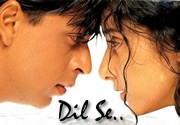
Dil Se
Synopsis:
Preity Zinta eats an apple in her introduction. It is a small piece of business that tells you she is younger, louder, and infinitely more annoying than anyone else in Shah Rukh Khan's orbit, and if I'm honest, that apple bothered me every single time she crunched into it during the first act. Mani Ratnam structures Dil Se around these abrasive, everyday textures rather than smoothed-out romantic beats, pushing his actors into sweaty railway stations and dust-choked plains where nobody looks like a movie star.
Shah Rukh plays Amar, a radio broadcaster who falls for a woman with no name and no paper trail, and he plays him with an exhaustion that feels entirely earned by the script. He is not the cackling, open-armed romantic lead of Dilwale Dulhania Le Jayenge here; he looks like a man who has slept in his clothes for three days and hasn't checked his bank account in a month. He meets Manisha Koirala’s character at a dark train platform, she asks for a cigarette, he gives her one, and the entire architecture of the story tilts on its axis right then and there. Santosh Sivan's camera doesn't romanticize this meeting with soft focus or glowing lamps, instead choosing harsh overhead fluorescents that catch the grease in their hair and the circles under their eyes.
When Manisha disappears, Amar chases her across half the country on trains and buses that rattle your teeth just watching them, a narrative choice that gives the film a bruised, desperate momentum. Ratnam and his cinematographer find poetry in diesel exhaust and peeling railway posters, shooting the landscape of the Indian insurgency not as a political textbook but as a series of hostile roadhouse towns where strangers eye each other with cold suspicion. The dialogue doesn't spoon-feed the political context. It just drops names of factions and provinces into casual conversation as if Amar, and by extension the audience, should already know the stakes, which makes the growing realization of who this woman actually is land with a physical thud rather than a plot twist reveal.
The supporting cast features faces that are clearly dubbed by studio artists whose voices don't quite match the throat-clearing and body language of the regional actors on screen, and it is a small, nagging distraction every time a villain opens his mouth and sounds like an entirely different human being. But then A.R. Rahman's score kicks in to cover up the seams. The soundtrack isn't just a collection of songs dropped into the narrative to sell cassettes, though it certainly did that; it functions as the interior monologue of a man losing his grip on reality. "Chaiyya Chaiyya" is shot on top of a moving train with Malaika Arora and Shah Rukh dancing against whipping winds and overhead branches, and it works because it captures that specific, manic rush of falling for someone who is actively ruining your life.
Preity Zinta plays the modern fiancé who represents everything Amar is leaving behind—stability, family approval, sensible clothes, and a life that doesn't involve dodging police checkpoints in Assam. She is sharp-tongued and completely unafraid of looking foolish, bringing a necessary friction to a romance that would otherwise drown in its own heavy weather. When she confronts Amar about his obsession with a ghost, she doesn't cry or deliver a grand monologue about heartbreak; she just looks at him like he has lost his mind, which he clearly has. It grounds the film in a recognizable human reality even as it spirals into political terrorism and martyrdom.
The ideological core of the film asks a simple, brutal question about what happens when passion outlasts reason, setting up a romance inside a suicide bombing cell. Manisha Koirala plays her role with a stillness that borders on catatonic, her eyes vacant whenever she isn't actively moving toward her objective, which makes her brief moments of warmth toward Amar feel terrifyingly fragile. She isn't a femme fatale in the noir tradition. She is an instrument of state-level violence who happens to be tired, cold, and occasionally lonely enough to let a stranger buy her tea.
By the time the story reaches its climax at a crowded Republic Day celebration in Delhi, the editing starts to stutter, cutting between close-ups of ticking clocks and sweat beading on foreheads with a breathless panic that leaves no room to breathe. Hindi movies rarely tackled insurgencies with this level of visual abstraction, preferring courtroom dramas or gritty police procedurals over poetic tragedies about divided loyalties and doomed geography. The final embrace between Amar and Moina on the steps of the monument is not a happy ending and it isn't a standard tragedy either; it's just two people caught in an explosion of their own making, holding on because there is nothing left to grab.