

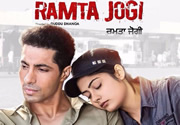
Ramta Jogi
Synopsis:
There is literally this one random scene where a car is speeding down a dusty Punjab highway and Ramta Jogi, played by Deep Sidhu making his big entry, steps right out into the road in slow motion wearing a bright blue shirt and aviator sunglasses while some intense dhol beats drop out of nowhere.
Right after that, he gets into a massive brawl with like twelve guys behind a dhaba and starts tossing wooden benches everywhere and screaming his lungs out, but to figure out why he's acting so wild and punching strangers in the face, we gotta go back to the start of this whole mess.
The movie begins by introducing us to our main guy Jogi who is basically just a carefree youth living life in Punjab, doing regular village stuff, hanging out with his boys, and not really worrying about tomorrow until he literally bumps into our leading lady, who is played by Ronica Singh and brings this huge graceful energy to the screen, and boom, instant love at first sight because that is just how bollywood movies operate.
So then they keep running into each other at local festivals and exchanging these intense longing glances while some completely random romantic track starts playing even though they literally just met and haven't even had a proper conversation yet.
The funny thing is that Ronica Singh's character is actually trapped in this super strict, ultra-powerful political family where her brothers, played by heavy hitters like Rahul Dev and Greesh Sehdev, rule the local area with an absolute iron fist and take zero nonsense from anybody.
Rahul Dev spends the entire first hour walking around with his collar popped and staring menacingly at walls while Greesh Sehdev yells at servants and polishes his hunting rifle just to remind everyone that they are the villains of the story, and honestly, the wardrobe department put Rahul Dev in this maroon velvet jacket for three straight scenes that looked like a heavy curtain from a movie theater.
Anyway, Jogi and the girl keep sneaking around to meet secretly behind old brick walls and whispering sweet nothings, but the bad guy brothers find out way too fast because secrets never stay safe in hindi films.
They catch the two of them talking near a sugarcane field and that brings us straight to the interval point, right when Rahul Dev grabs Jogi by the collar and screams teri maa di as the screen abruptly cuts to black with the loudest possible orchestral sting, forcing you to go buy over-priced popcorn while wondering if our hero is about to get beaten into the pavement.
After the break, the movie turns completely chaotic and throws all logic out the window because Jogi has to go on the run from these corrupt politicians who are sending every goon in the state after him.
They chase him through crowded markets, narrow alleys, and abandoned factories, and there's this weirdly long sequence where Jogi hides inside a massive truck full of empty plastic crates for twenty minutes of screen time just to dodge a police checkpoint, which felt totally unnecessary.
The pacing just falls apart completely here, trading the cute romance for endless fight scenes and screeching tires, which is pretty standard for action-heavy bollywood movies from this era.
The lovers manage to escape the main city on the back of a sugarcane tractor, dreaming about a peaceful life away from the brutal politics and family honor nonsense, but the local enforcers are still tracking their every single move.
They finally reach this desolate, foggy railway station at the edge of town, thinking they finally beat the system and can catch the early morning train to freedom.
Right before they can step onto the train platform, Rahul Dev and Greesh Sehdev emerge from the fog with a whole squad of armed thugs, completely surrounding the couple in a brutal, inescapable trap.
Jogi tries to fight back with a rusty iron pipe he found on the ground, but he's already outnumbered and bleeding out from earlier injuries, and the villains just overpower him in seconds while the train starts pulling away in the background.
Rahul Dev steps forward with a cold glare and delivers the fatal blow right there on the dusty tracks, ending Jogi's life instantly as Ronica Singh's character screams in pure agony over his lifeless body.
She picks up the fallen iron pipe, stares blankly at her own brothers with total emptiness in her eyes, and uses it to violently strike Rahul Dev before the screen instantly cuts to black and the final credits roll without any closure.
The continuity supervisor on Ramta Jogi should have caught that sequence where Deep Sidhu’s wristwatch changes hands between cuts, though if I'm honest, almost nobody in the theater was looking at his wrist anyway because the sound mix had suddenly spiked into the red during a routine conversation in a tea stall.
Punjab-set dramas tend to roll off an assembly line these days where the tractors are shiny, the fields are excessively green, and the romance feels engineered in a Mumbai boardroom by people who haven't smelled wet soil in a decade, yet Guddu Dhanoa’s film occasionally remembers how to get its fingernails dirty. The screenplay by Sarabjit Singh tries to wedge a classic star-crossed lovers panic into the rigid architecture of regional commercial cinema without completely flattening the edges of its characters into talking points.
You can feel the machinery straining when the plot demands that characters make impossible ideological pivots just to get us to the next chase sequence, but the dialogue retains enough local flavor to keep things from sliding into generic melodrama.
Deep Sidhu enters the frame with the kind of raw, unpolished physical presence that recalls John Abraham in his early days before the gloss took over, moving through the countryside with a heavy, deliberate gait that suggests he is constantly dragging something invisible behind him. He doesn’t have much technical range in the quieter stretches, tending to lean too heavily on a stoic squint when the emotional register requires nuance, but when the violence kicks off or the grief needs to look physical, he anchors the picture with sheer bulk. Opposite him, Ronica Singh brings a guarded, watchful quality to her scenes that prevents her from becoming merely the object of the chase, finding tiny ways to telegraph stubbornness through a tilted chin or a sudden stillness in her shoulders.
They aren't given a lot of breathing room by a director who clearly prefers wide-angle tracking shots of vehicles kicking up dust over two-shot conversations in confined spaces, yet they manage to carve out moments of genuine friction between the plot beats. Rahul Dev shows up as the heavy and plays the role with a weary, professional menace that avoids the shouting matches usually expected from villains in commercial hindi films, treating intimidation as a matter of administrative efficiency rather than theatrical rage.
Greesh Sehdev handles his supporting load with a similar lack of fuss, though there’s a recurring editing tic where reaction shots linger for half a second too long after he finishes a line, leaving the actors stranded in awkward silence while the camera tries to figure out where to look next.
The cinematography by Vineet Malhotra treats the flat expanses of the northern plains not as tourist postcards but as an indifferent landscape where things can hide and where things can be easily broken, shooting the night scenes with a desaturated blue that makes every headlamp glare like an alarm. It avoids the hyper-saturated look that ruins so many modern projects, opting instead for a gritty, dust-speckled texture that feels closer to a gritty 1970s thriller than anything currently coming out of major studios.
That visual grit clashes slightly with the musical numbers, which drop in with the predictable rhythm of a commercial obligation, pulling the narrative to a dead halt so people can sing on bridges while extras dance in slow motion behind them. The background score relies heavily on a wailing vocal motif that starts to wear out its welcome around the fortieth minute, appearing every time Sidhu looks into the middle distance or thinks about his complicated family history.
Beneath the genre machinery, the film is actually interested in how family honor functions as a cage built out of local gossip and inherited debt, showing how easily ordinary people can be deputized into enforcers of social code without ever holding a weapon. It’s not a sociological treatise, and it doesn't pretend to offer solutions to the systemic violence it depicts, but it understands the suffocating smallness of village politics where everyone knows your grandfather’s mistakes before you've even made your own.
When the narrative steers toward its inevitable violent reckoning, the direction abandons the earlier atmospheric pacing and rushes the payoff with a breathless haste that leaves half the character arcs dangling in the smoke. You get the distinct impression that a scene or two was left on the cutting room floor to bring the runtime down to a manageable length for single-screen theaters, leaving a jagged scar right where the emotional climax should have hit with full force.
Sidhu takes the final confrontation and plays it with a desperate exhaustion that makes you wish the script had trusted him with more interiority earlier on, rather than relying on him to carry the action scenes purely on adrenaline and volume. It falls apart in the margins if you look too closely at the logistics of the police response or the way characters manage to travel across districts without ever stopping for fuel, but the momentum is fierce enough to carry you past the potholes.
This is a movie that gets by on muscle and attitude rather than precision engineering, a messy slab of regional cinema that refuses to stay inside the neat little box assigned to it by market research.
It leaves you thinking about the gravel kicked up by the tires long after the credits have finished scrolling over a black screen with no background music to soften the landing.