

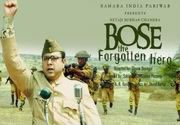
Bose - The Forgotten Hero
Synopsis:
Picture a steamy, dimly lit German room where Sachin Khedekar is pacing back and forth like a caged tiger while trying to convince Nazi officials about something extremely tense and high-stakes, and honestly that whole sequence just stuck in my head because of how sweaty and dramatic it all looked, but to understand how we even got to that random middle-of-the-movie point, you have to go back to the very beginning of Shyam Benegal's epic take on history which stands out among typical bollywood releases because it actually takes its time.
The movie opens way back in India with Subhash Chandra Bose resigning from the Congress party because he's just completely fed up with Gandhi's peaceful approach and he wants a much more aggressive strategy to kick the British out, and it's a huge political mess filled with endless meetings and angry speeches that set up his eventual house arrest.
So then he manages to pull off this legendary escape right out from under the British noses by growing a beard and dressing like a simple Muslim insurance agent named Mohammad Ziauddin, and he sneaks out of his own house in Calcutta in a rambling old car while nobody's looking, and he catches a train and travels all the way across rural India just to cross the border into Afghanistan on foot and horseback with some tribal guides.
The funny thing is, once he finally gets to Berlin, he meets all these German officers and he's trying to get their backing to fight the British, but they are kind of giving him the runaround and making him wait around in cold hotel rooms and eating strange food, and this is where Divya Dutta shows up as his fiercely loyal assistant and confidante, Emilie Schenkl, who is typing out his intense letters and keeping him grounded while he's dealing with the massive stress of trying to free a country from halfway across the world.
Right after that exhausting German stint, he realizes Hitler isn't actually going to give him the real military help he needs for India, so he gets on a literal German U-boat in the middle of the stormy ocean and takes a terrifying, months-long underwater voyage to Japanese-occupied Southeast Asia, which is a wild transition that most standard hindi movies wouldn't even attempt because of the sheer logistical chaos.
Anyway, he lands in Singapore and everything explodes with energy because this is where Rajpal Yadav enters the picture as a dedicated, fiercely enthusiastic Indian National Army soldier who looks up to Bose with total awe and devotion, and they're marching through the jungle and singing songs and recruiting thousands of poor plantation workers and regular folks who give away all their gold and jewelry to fund the freedom fight.
They form a provisional government and declare war on the British, and Bose gives this incredibly fiery speech where he literally tells his troops, give me blood and I shall give you freedom, and you can tell Sachin Khedekar is giving it everything he's got because his voice is completely hoarse and his eyes are bulging with raw patriotic fervor.
The INA actually starts pushing through Burma alongside the Japanese army, but then the monsoon rains hit, supply lines completely collapse, and disease starts wiping out the troops faster than enemy bullets.
The atomic bombs drop on Japan, World War Two ends abruptly, and the whole grand alliance falls apart in a matter of seconds.
Bose has to flee again, so he boards a Japanese bomber plane in Taiwan, the plane catches fire mid-flight after a propeller failure, and he stumbles out of the burning wreckage with severe burns all over his body, taking his final, ragged breath in a makeshift military hospital bed as the nurses frantically try to bandage his charred skin.
Sachin Khedekar wears spectacles in this movie that always look like they were purchased from a prop room ten minutes before the camera rolled, sitting a fraction too high on his nose so he has to tilt his chin upward every time he delivers an impassioned plea to the Indian National Army. It is a small thing, honestly, but it bugged me for three hours.
Director Shyam Benegal has never been much for the sweeping pyrotechnics that usually define cinematic biographies, choosing instead to lean into long, talky interior scenes where men sit in poorly lit offices arguing about the future of a continent while ceiling fans whir with an aggressive, distracting mechanical hum. The screenplay bites off an enormous chunk of history—spanning the escape from house arrest in Calcutta, the submarine journey across treacherous waters, the formation of the provisional government in exile, and the eventual jungle retreat—and compresses it until the seams show quite clearly, particularly in the middle stretches where historical figures are introduced with breathless title cards just so they can deliver exposition and disappear into the crowd. Benegal directs with a workmanlike sobriety that occasionally rises to genuine ferocity, especially during the mass mobilization sequences in Southeast Asia, though he is let down by editing choices that sometimes linger three seconds too long on an extra nodding in solemn agreement, robbing the moment of its momentum.
Khedekar does something interesting with Subhas Chandra Bose, stripping away the booming oratorical cadence everyone associates with the leader and replacing it with a weary, obsessive quietness, though his physical posture occasionally stiffens into something resembling a wooden statue when he is required to address a stadium of extras. Divya Dutta brings a grounded, observational intelligence to her role as Ila Roy, standing at the edge of crowded rooms and watching the men posture with a weary skepticism that feels earned by the script, even if her screen time is frustratingly chopped up by narrative necessity. Then there is Rajpal Yadav, who wanders into the frame every so often as a loyal soldier, his dialogue delivery clipped and entirely devoid of the manic comic energy that made him famous in commercial hindi films, proving he can hold a dramatic space without needing a punchline to anchor him.
The cinematography by Rajan Kinagi is a mixed bag of muddy digital textures and occasionally striking compositions that mirror the sepia-toned archival photographs we have all seen in school textbooks, yet the lighting in the indoor dialogue scenes often looks flat and uninspired, reminiscent of television serials from the same decade rather than a budgeted epic meant for the big screen. Meanwhile, A.R. Rahman provides a score that attempts to elevate the proceedings through soaring choral arrangements, though the main marching theme gets recycled so often during transitional montages that you can set your watch by the brass section's cue. It is a curious artifact of a specific era in historical filmmaking where the ambition of the canvas constantly outstripped the available financial resources, resulting in battle scenes that feel strangely small and contained, fought by twenty people in a clearing when the subtitles insist thousands are dying.
The film grapples awkwardly with the thorny geopolitics of accepting military aid from Nazi Germany and Imperial Japan, framing Bose's pragmatic alliances through the lens of absolute desperation rather than ideological alignment, which works well enough dramatically even if it occasionally feels like the script is holding its breath while rushing past the more unsavory historical realities. Yet the underlying tension between Gandhi's non-violent philosophy and Bose's militant radicalism never quite achieves the intellectual sparks found in Ketan Mehta's earlier work on Sardar Patel, settling instead for polite disagreements in railway carriages and starkly lit rooms where characters state their positions for the benefit of the back rows. There is a persistent weight to the proceedings, an almost palpable sense of duty that presses down on the actors, making everyone look exhausted by the sheer gravity of portraying people who knew they were losing a war against the British Empire.
Watching this sprawling historical epic unfold on a standard television screen, I found myself thinking about Richard Attenborough's Gandhi and how that film managed to make historical inevitability feel cinematic rather than academic, whereas Benegal's film often feels like a very expensive and very earnest illustrated lecture delivered by a professor who is running out of class time. The supporting cast cycles through accents that range from authentically regional to distinctly theatrical, and the sound design frequently drowns out crucial lines of dialogue under the weight of booming timpani drums that refuse to let a quiet conversation stay quiet.
When the credits finally roll, you are left with a lingering impression of an actor who gave a profoundly sincere performance inside a production that could not quite decide whether it wanted to be an intimate character study or a broad national monument, leaving both ambitions half-realized in the sweltering jungle heat of a forgotten campaign.