

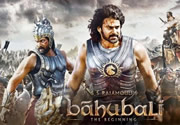
Baahubali-The Beginning
Synopsis:
Smuggled out of the kingdom of Mahishmati as a baby and raised by tribal people in a village located at the foot of a waterfall, Shivudu (Prabhas) is Bahubali, a human with god-like strength and valor. After repeated attempts to scale the mountains and climb up to the top of the waterfall, Shiva finally achieves his goal, only to encounter Avanthika (Tamannaah), a female warrior and member of a rebel group. They soon fall in love. Sivudu takes Avanthika''s goal for himself causing mass destruction in Bhalla Deva''s (Rana Daggubati) castle. Sivudu listens to Kattapa''s story of Amendra Bahubali (Prabhas in dual role). There was once a king who had two sons. Bhalla deva''s father and Sivudu''s grandfather who were brothers. Then Sivudu''s grandpa died and Bhalla deva''s father could not take over since he was physically handicapped. So Bhalla deva''s mother took over. Soon Amendra Bahubali was born. He was an orphan so Bhalla Deva''s parents adopted him. Then Bhalla Deva and Amendra Bahubali had a war against underworld creatures. Bahubali was given the position of king which angered Bhalla Deva. Shiv undue asks Kattapa who killed shivudu''s father and Kattapa reveals that the person was Kattapa himself and the story ends.
I cannot stop thinking about the waterfall. It is frankly enormous, tumbling down green cliffs in a way that looks halfway like a screensaver and halfway like a genuine act of God, and Prabhas climbs it for forty minutes because he wants to see what is living on top. If I'm honest, the whole sequence is slightly too long, lingering on digital mist and rippling back muscles past the point where the physics of the thing make any coherent sense. Yet S.S. Rajamouli directs this nonsense with such absolute, unironic conviction that you stop questioning the spray and just accept that this guy is going to scale an impossible wet wall with a slab of stone strapped to his back. There is no winking at the audience, no postmodern distance, just pure 1980s pulp energy filtered through modern digital effects budgets that make most contemporary Hindi films look like they were shot inside a broom closet.
The screenplay by Rajamouli and V. Vijayendra Prasad owes less to standard screenwriting manuals and more to theAmar Chitra Katha comic books that every Indian kid grew up reading on sticky summer afternoons. Characters do not have arcs so much as they have gear shifts. They stand on ridge lines and declaim their intentions to the heavens while drums beat out a rhythm that rattles the floorboards of the multiplex. Prabhas plays a double role, father and son, though the film spends the first two hours on the son, Shivudu, who goes around painting waterfalls and peeling off clothes to reveal pectorals carved by a very dedicated personal trainer and a lot of digital touch-ups. When the narrative finally pivots to the father, Amarendra Baahubali, the movie changes gears from a loose-limbed adventure story into a heavy-duty royal drama about succession and court intrigue that plays like The Lion King directed by a man who just drank four espressos.
It helps that the antagonist looks like he stepped out of a heavy metal album cover. Rana Daggubati as Bhallaladeva is built like a brick wall and spends half his screen time glaring at things while wearing pelts and horned armor that must have weighed forty pounds. Rana does not do nuance here. He sneers, he breaks iron chains with his bare forearms, and he rides into battle on a motorized chariot with scythes on the wheels that feels wildly anachronistic even for a fantasy kingdom existing in some vague pre-colonial past. Beside them, Tamannaah Bhatia plays a rebel fighter who gets captured, painted blue, and forced to undergo a radical femininity makeover by our hero, which is a bizarre stretch of the plot that hasn't aged particularly well even if the action choreography makes up for the retrograde romantic politics.
Senthil Kumar’s cinematography works overtime to make this fictional empire of Mahishmati look like a sprawling, sun-drenched hellscape where every shadow is painted gold and every battle features at least three thousand digital extras dying in synchronized heaps. The camera never sits still. It swoops under hooves, it tracks arrows in slow motion as they puncture necks, and it occasionally pulls back so far that the actors become tiny little pixels crawling across a computerized landscape. M.M. Keeravani’s soundtrack hits you over the head with percussion that vibrates your sternum, especially during the war sequences where the drums basically take over the mix and leave the dialogue fighting for scraps against wall-to-wall brass.
Then there is Anushka Shetty, who spends the vast majority of this first installment sitting in chains in a courtyard, looking ragged and dangerous, playing the mother of the hero with a kind of quiet, feral intensity that puts the rest of the cast to shame. She barely gets any lines, but her glare does all the heavy lifting. When she finally gets to speak in the sequel, you can tell she has been saving up her energy. Her presence anchors the melodramatic excess in something that actually resembles human grief, even if the film surrounding her is mostly concerned with men lifting heavy boulders and shouting at each other across vast canyon floors.
It is worth noting that this kind of unhinged scale used to be the exclusive domain of historical epics like Ben-Hur, though Rajamouli brings a distinctly vernacular theatricality to the table that Hollywood directors lost somewhere around the turn of the millennium. The action scenes have a rhythm that owes as much to professional wrestling as it does to classical mythology. When a character hurls a massive log at an army of invading savages, it lands with the cartoonish crunch of a Looney Tunes gag, but five minutes later a throat is slit with such sudden, dry brutality that you remember this is an adult epic designed for bloodthirsty crowds.
The editing can be aggressively choppy during the transitional scenes, skipping from a romantic mountain ballad to a military tribunal without bothering to establish geography or time of day. It’s a small thing, but the constant smash cuts to reaction shots of old men stroking their beards while someone delivers a prophecy started to grate on my nerves by the end of the second hour. You wish the movie would slow down and let a space breathe instead of immediately cutting to another wide shot of a CGI fortress gleaming under a fake sunset.
By the time the famous cliffhanger hits, the film has essentially asked you to swallow an entire cinematic meal and then told you the dessert is coming in two years. It is an abrupt, shameless stop that cuts off mid-stride, leaving our heroes staring down an army of tens of thousands while the screen goes black and the credits roll over a reprise of the main theme. You leave the theater feeling slightly exhausted and wondering how any single director managed to keep all these digital plates spinning at once without the whole thing collapsing into a mess of pixels and noise. Rajamouli pulls it off through sheer brute force and momentum, dragging the viewer along behind his chariot whether they want to go or not.