

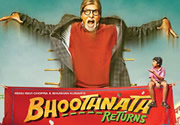
Bhoothnath Returns
Synopsis:
Picture this because it lives rent-free in my head forever: Amitabh Bachchan is literally floating in mid-air inside a high-tech corporate war room while Boman Irani is sweating through his expensive designer suit and screaming at a voting machine like it personally insulted his ancestors.
Right.
Before we get to that total fever dream of a climax in one of the wildest bollywood movies ever made, we gotta go back to the start where the actual ghost business kicks off.
So then, Amitabh's character is our favorite friendly spirit back from the first film, but the poor guy is getting totally bullied down in the afterlife because he didn't scare anyone on earth, so they send him right back to prove his spooky credentials.
He ends up in a shady, trash-heaped neighborhood in Mumbai where normal humans can't see ghosts except for this one ridiculously energetic and street-smart kid named Akhbu played by Parth Bhalerao, and honestly, the kid steals the entire show with his swag and fast-talking dialogue.
Akhbu is wearing these oversized printed t-shirts and rattling off local slang while casually hanging out with a CGI ghost who looks like a legendary superstar, and they form this amazing duo that honestly saves the movie from being way too cheesy.
They decide to pull pranks on corrupt local politicians, and there is this one specific background extra holding a half-eaten vada pav in a gray vest who stands near a tea stall for like four full minutes during a neighborhood argument about garbage collection, and I couldn't stop staring at him chewing slowly while Amitabh is doing spooky voice effects behind a dumpster.
Anyway, Bhoothnath Returns keeps chugging along and the spirit realizes that pranking isn't enough because the local MLA named Bhau represented by Boman Irani is an absolute menace who terrorizes the slum dwellers and steals land meant for poor kids.
So then, the ghosts up in heaven hold a big meeting and basically tell our hero that if he wants respect, he needs to make a real difference down on earth, which leads us straight to the interval point.
Right after that heavy emotional setup about housing rights and systemic corruption in India, the film suddenly drops this bizarre, neon-drenched dance number out of nowhere with backup dancers in glowing tracksuits and Amitabh doing some stiff-jointed hip-hop choreography that makes you wonder what the editor was smoking when they cut this sequence into a movie about municipal elections.
The funny thing is, once the music stops, the plot gets dead serious because Akhbu convinces the ghost to stand for the upcoming elections as an independent candidate against the almighty Bhau.
Boman Irani plays this corrupt politician with so much greasy charm that you almost forget he's the bad guy, especially when he's yelling into megaphones and bribing voters with cheap liquor and broken promises.
The campaign trail is absolute chaos with Amitabh's invisible face speaking through loudspeakers while Akhbu does all the heavy lifting on the ground, and honestly, typical hindi films rarely tackle local politics with this much weird supernatural satire.
Usha Jadhav shows up as a harassed local mother fighting for her family, and her scenes ground the entire fantasy premise in some actual gritty reality, reminding us that behind all the ghost gags, people are actually losing their homes to these greedy politicians.
Akhbu gives these fiery speeches standing on top of a rusted tempo while the crowd goes wild, and Amitabh watches proudly from the side while drinking invisible chai.
Then comes the election day where Bhau tries every dirty trick in the book to rig the booths and intimidate the voters, leading to a massive showdown in the counting room.
Amitabh uses his ghost powers to mess with the electronic voting machines, making them spin wildly and terrifying the corrupt officials who think the building is literally haunted by karmic justice.
The results flash on the screen, Bhau loses his mind, the slum dwellers start cheering in the streets, and the ghost finally earns his respect certificate from the afterlife committee.
Right at the end, Amitabh has to say goodbye to little Akhbu because his ghostly mission on earth is officially complete and his time is up.
The superstar spirit gives the kid one last warm hug, turns transparent in the middle of the crowded slum street, and floats slowly up into the Delhi or Mumbai clouds while a sad, swelling emotional track plays us out.
Akhbu wipes away a tear, looks up at the sky, smiles his usual cheeky grin, and runs off to play cricket with his friends.
Amitabh Bachchan wears that green velvet sherwani like he bought it at a very expensive costume shop three days before shooting and never quite figured out how to sit down in it. If I'm honest, that slight stiffness is kind of the whole deal with the first twenty minutes of Bhoothnath Returns, a sequel nobody asked for that somehow ends up working better than the original weepie it's attached to. The 2008 predecessor was a sticky moral fable about an old ghost haunting a kid until everyone cried buckets and learned to respect their elders, but this follow-up throws out the handkerchiefs and turns into a surprisingly jagged little satire about municipal elections and slum demolition. It’s got a messy first act where the CGI ghosts look like they were rendered on a laptop sitting in a Mumbai coffee shop during a power cut, but once the narrative settles down into the dirty concrete reality of a neglected housing colony, the movie finds a groove that most mainstream Hindi films wouldn't touch with a ten-foot pole.
Director Nitesh Tiwari, working here before he struck absolute gold with Dangal, handles the tonal whiplash with a rough-and-ready competence that feels more like television than cinema. Scenes tumble into each other without any breathing room. Characters walk out of conversations before they’re finished. There’s a distinct lack of polish that works in the movie’s favor because it mirrors the chaotic, half-built neighborhood where the story takes place, full of dangling wires and corrugated tin roofs that rattle every time a local train rumbles past. The screenplay relies heavily on shorthand, establishing corruption with a single bored shrug from a local politician or showing the misery of urban poverty through flies buzzing around an uncollected garbage heap. It doesn't waste time on elegant transitions. Piyush Mishra pops up as a slimy party boss and plays every scene like he just smelled something rotting under the floorboards, chewing his paan with a deliberate malice that makes you forget you're watching a family comedy featuring a friendly spirit.
Then there is Parth Bhalerao as Akhrot, the street kid who teams up with the returned spirit to fix local politics. Child actors in Bollywood movies usually make you want to slide under your seat out of pure embarrassment, screaming their lines with manic energy and crying on cue like they’re auditioning for a commercial for laundry detergent, but Bhalerao has an exhausted, sharp-tongued nonchalance that completely anchors the picture. He doesn't look like a pampered star kid put through an intensive workshop in Andheri; he looks like somebody who actually knows how to dodge traffic on a busy junction and steal mangoes from a vendor who isn't looking. When he trades insults with Bachchan, the veteran actor has to work twice as hard just to keep up with the kid's deadpan rhythm. Their dynamic avoids the sticky sentimentality of the first film, choosing instead a prickly, transactional friendship built on shared grievances and mutual annoyance.
Boman Irani enters about halfway through as the villainous politician Bhau, barking orders into a cellphone while pacing across marble floors that gleam like a freshly waxed bowling alley. Irani is reliable, of course, because he can play this exact brand of smirking opportunist in his sleep, but the role gives him very little to actually do besides sneering at poor people and adjusting his cuffs. It’s a caricature drawn with a very fat marker. There's no nuance to his corruption, just pure grease and volume, which matches the broader political satire of the script. The film takes direct aim at the way elections are fought in this country, poking fun at empty campaign promises, fake rallies, and the strange way voters will forgive a thief if he hands out enough plastic buckets and cheap sarees before polling day. It’s not subtle. You can hear the thesis statement coming from three blocks away, but the sheer bluntness of it is refreshing in an industry that usually prefers to wrap its social commentary in five layers of romantic fluff.
The cinematography by Satyendranath Mohanty stays stubbornly functional, refusing to romanticize the slums or turn the ghost sequences into dazzling displays of digital artistry. Mostly it’s just overcast skies, dusty streets, and flat lighting that reminds you of a documentary shot on a Sony handycam in the mid-2000s. The soundtrack by Ram Sampath and others features a couple of loud tracks that pop up at random intervals, but the recurring background cue where a melancholic flute melody gets interrupted by a sudden burst of electronic percussion started grating on my nerves by the third time it played during a standard dialogue scene. It’s a small thing, but it bugged me every single time. Usha Jadhav gets thrown into the mix as a grieving mother, bringing a heavy, grounded sorrow to a movie that mostly wants to bounce around like a cartoon, though her scenes feel like they wandered in from an entirely different production.
What keeps Bhoothnath Returns from drowning in its own moralizing is the sheer weirdness of its central conceit. A dead man runs for local corporator against a seasoned politician because the bureaucracy in the afterlife is so backed up that spirits have to earn their salvation by solving earthly problems. It’s a profoundly silly idea that the filmmakers treat with absolute deadpan seriousness. Bachchan plays the supernatural candidate with a weary dignity, wearing glasses without lenses and adjusting his shawl as he addresses rallies composed of stray dogs and confused laborers. He’s great in the crowd-interaction bits where he has to look terrified of being touched by living voters. The movie loses its footing whenever it tries to deliver a grand speech about the power of the ballot box, turning preachy and stiff for about ten minutes at a time before bouncing back with a smart visual gag or a sharp retort from the kid.
Hindi movies have a long history of mixing social message with broad farce, stretching back through decades of commercial cinema where a song-and-dance routine had to coexist with a lecture on land reform. This one fits comfortably into that tradition without ever feeling like it belongs in the same conversation as something directed by Guru Dutt or even Rajkumar Hirani. It’s clumsier. It’s louder. It features a horribly mistimed product placement for a popular tablet brand that lingers on the screen for three seconds longer than any human eye can comfortably bear. Yet there is a genuine anger underneath the slapstick that saves it from being entirely forgettable. When the slum dwellers finally stand up to the local thugs, the violence of the confrontation feels earned by the preceding ninety minutes of casual degradation. It stops being a cute fantasy about a friendly ghost and turns into something resembling a dirty street fight.
The ending doesn't bother with a neat resolution where every problem gets solved and the neighborhood transforms into a utopian housing cooperative with potted plants on every balcony. The politicians are still rich, the system is still broken, and the ghost has to move on to his next bureaucratic assignment because that's just how the afterlife works according to the internal logic of this specific script. Bachchan gives a final, tired wave from the back of an auto-rickshaw, looking more like an actor who just finished a grueling twelve-hour shift than a celestial being ascending to a higher plane. Bhalerao eats a handful of peanuts and spits the shells onto the asphalt without looking up. The screen goes black before the final note of the background score can finish resolving its chord.