

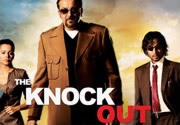
KnockOut
Synopsis:
Sanjay Dutt plays a new age lone ranger who has the latest weapons and gadgets at his fingertips, and is a man who trusts and depends on no one. Working alone, he effortlessly uses his wit, his skills at hand-to-hand combat, and his love for stealth technology, to manipulate and trap his elusive target. The target, played by Irrfan, is a street-smart investment banker who has made his way to the upper echelons of power. A man who unwittingly holds the key to India''s destiny, Irrfan is a man consumed by his own obsessions, an extremely clever and unstoppable foe. Through a brilliant play of truth and pretense, Sanjay strips Irrfan of his arrogance and attitude, opens his heart and confounds his brain, locking him in a tangle beyond redemption... a tangle which can only be unraveled one way... leading to the biggest ''counter-heist'' in the history of this nation.
Hot on the trail of these two men is a hardnosed television journalist, played by Kangna Ranaut. She will stop at nothing... or so she believes, till she is faced with the ultimate call of conscience. Choosing between another man''s life or herself... Choosing between the country or herself. And each time she rises to the occasion, showing that the new India has its heart in the right place, its soul intact.
As the film reaches its action-packed climax, every citizen of this country becomes a witness to the live action that unfolds before television cameras. For a nation that has endured political thieves for six decades, this counter-heist ofa massive scale wakes them up in a way nothing has ever done before.
The film ends in a huge wave of euphoria. The mysterious vigilante fights and wins an impossible battle, a battle that raged not just in the streets of Mumbai but also in the minds of the whole nation. True to style, he manages to walk off into the celebrating multitudes, his identity forever hidden... maybe to strike another day... and India awakens to a new beginning.
Sanjay Dutt wears those amber-tinted sunglasses for roughly eighty percent of the runtime and if I am honest, they start to annoy you around the forty-minute mark. You are sitting there in a crowded press screening with the projector fan buzzing a low, irritating drone overhead, watching him squint through a heavily tinted lens at a computer monitor that is clearly turned off. It is a small thing, but it bugged me from the very first frame. Mani Shankar directs this whole mess like a man who just discovered split-screen editing on a stolen laptop and wanted to use every single transition effect available before the battery died. He shoots most of the conversations between Dutt and Irrfan Khan through glass partitions, through car windshields, through rain-streaked windows of Mumbai high-rises, layering reflections on top of reflections until you cannot actually see the actors' faces. You are just staring at ghostly double exposures of stubble and neon signs while a synthesizer hums behind the dialogue. It feels less like a narrative choice and more like someone panicked in post-production and tried to obscure a lack of proper lighting with digital gauze. Hindi films have long relied on visual sheen to cover up narrative holes, yet this particular brand of slickness feels oddly dated, reminding you of mid-nineties corporate thrillers that played on late-night cable.
The plot lifts its bones directly from Phone Booth, though somebody decided to stretch a single-location claustrophobic panic into a sprawling, multi-city exercise in government corruption and corporate malfeasance. Dutt plays a fixer named Veer who gets pinned to a pavement payphone by a sniper's laser sight, and while that premise worked with Colin Farrell running on nervous energy in a Manhattan alleyway, it hits a strange wall of inertia here. Dutt does not run. He does not really panic either. He just stands there with his broad shoulders squared, shifting his weight from one heavy boot to the other, delivering dialogue in that low, rumbling baritone that sounds like it is being dragged across gravel. He spends the first half-hour trying to negotiate with the invisible voice on the line while pedestrians walk past him completely oblivious, which strains credibility even for Bollywood movies where people routinely break into song in the middle of traffic. Kangna Ranaut shows up later as a sharp-tongued journalist who smells a Pulitzer in the standoff, but her character exists mostly to shout exposition into a cell phone while driving erratically through the western suburbs. Her performance has this jagged, breathless quality that feels like she is acting in an entirely different movie from everyone else on set, pitching her voice a half-octave too high every time the camera cuts to her close-up.
Then you have Irrfan Khan, who wanders into the proceedings playing a shadowy intelligence operative with an unreadable smirk and a habit of chewing on toothpicks. He brings a strange, laconic weight to scenes that would otherwise dissolve into pure nonsense, finding rhythms in terrible dialogue that nobody else on screen can locate. When he stares down Dutt across a dusty warehouse floor, you forget for a fleeting second that the digital bullets flying through the air look like rendered ping-pong balls. Khan operates on a completely different plane from his co-stars, refusing to match their theatrical urgency, choosing instead to drop his voice to a conspiratorial whisper that forces you to lean forward in your seat. It is a waste of his considerable gifts, of course, because the script forces him to explain the entire political conspiracy in a clumsy monologue delivered over a speakerphone while standing near a burning barrel. Gulshan Grover pops up as a corrupt bureaucrat with greased-back hair and a permanent sneer, doing that exact same villain routine he has been recycling since the early nineties with zero variation. You watch him adjust his tie, glare menacingly at a subordinate, and spout hollow threats about national security, and you realize how stagnant certain corners of commercial cinema can get when actors are allowed to coast on pure muscle memory.
The cinematography relies heavily on a muddy, desaturated color palette that makes every location look like it was dipped in cheap motor oil. Exterior scenes in Mumbai feature skies the color of wet concrete, and not in an atmospheric, moody way, but in a way that suggests the camera sensors were struggling with basic white balance during the afternoon shoots. The soundtrack is an absolute disaster of pounding bass drops and screeching electric guitars that kick in whenever anyone so much as opens a briefcase or picks up a ringing telephone. There is this one particular motif—a four-note brass sting followed by a synthesized heartbeat—that repeats itself at least forty times before the intermission. It blares over a shot of Dutt looking concerned, then blares again over a close-up of a digital clock ticking down, and then blares a third time when Kangna Ranaut slams her car door. By the time the third reel rolls around, that specific cue becomes a form of psychological torture, wearing down your patience long before the climax ever arrives. The sound design is so aggressively front-loaded that the dialogue often gets swallowed entirely by the score, forcing you to rely on subtitles even though the characters are speaking Hindi at the top of their lungs.
Beneath the bluster about corporate greed and whistleblowers, the film is essentially an excuse to watch men in dark suits yell at each other through various electronic devices while explosions happen in the background. It wants to say something urgent about the surveillance state and the moral rot at the heart of modern development projects, but it treats these themes like props to be tossed aside whenever a new action beat needs to be set up. The political commentary boils down to bad men doing bad things in sleek glass offices while good men suffer in the dusty streets below. It is all very surface-level, lacking the messy, contradictory energy that made earlier gritty crime dramas feel alive. Characters state their motivations out loud to the camera because subtlety was apparently banned from the editing suite. When Rukshar appears as Dutt's estranged wife, she gets exactly two scenes to register emotional distress, both of which involve her weeping into a landline while staring blankly at a bowl of plastic fruit on her kitchen counter. The screenplay treats the emotional stakes of its protagonist as an afterthought, rushing past his domestic life to get back to another five-minute stretch of digital cross-hair graphics gliding across a computer monitor.
There is a sequence near the end where Dutt has to crawl across an open plaza while avoiding a barrage of high-caliber sniper rounds, and the visual effects work is so embarrassingly shoddy that you can actually see the gray matte lines around the dust clouds kicking up from the concrete. It looks like a cutscene from a poorly optimized video game released during the early days of the PlayStation 3 era. Kurush Deboo shows up briefly as a terrified corporate accountant whose face gets plastered on public billboards by the antagonist, and his frantic energy provides a nice counterweight to Dutt's stoic granite wall act, even if his character exists solely to push the plot toward its inevitable, loud conclusion. You leave the theater with a dull ache behind your eyes, courtesy of those relentless green laser sights and the stuttering frame rates during the chase sequences. It is a frustrating watch because you can occasionally spot the ghost of a leaner, meaner thriller buried underneath all the digital clutter and misplaced stylistic choices. Mani Shankar clearly had ambition on his mind, but ambition without technical discipline or script coherence usually just leads to cinematic pile-ups like this one, leaving talented performers stranded in the wreckage while the credits roll over a final, earsplitting guitar solo.