

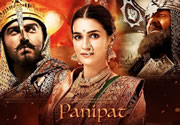
Panipat
Synopsis:
Sanjay Dutt wears an enormous metal helmet for the entirety of Panipat that looks suspiciously light, the sort of foam prop you can spot flexing on the corners when the camera catches a stray backlight from the side.
Ashutosh Gowariker has always loved a map with little wooden blocks on it, pushing troops across the carpet of a war room like he is playing a very expensive game of Risk with his cousins on a rainy afternoon. The ambition is never the problem in these Hindi films, honestly, because you can see every single rupee of the budget splashed across the screen in the form of thousands of extras in matching turbans and armor that jingles like loose change whenever they jog into position. The screenplay by Gowariker, Ranjeet Bahadur, and Chintan Gandhi tries desperately to fit the Third Battle of Panipat into three neat acts, but history refuses to be compressed so easily, leaking out of the edges and leaving characters standing around in empty courtyards talking about grain supplies for what feels like hours. It is a pacing problem that bogs down the middle stretch, where the momentum stalls completely and leaves the audience staring at the grain of the digital skies.
Arjun Kapoor plays Sadashiv Rao Bhau with a flat, unwavering earnestness that works well enough when he is staring down an antagonist across a dusty tent, but completely evaporates the second he has to deliver a quiet line to his wife. There is a strange detachment to his performance, a feeling that he is reading cues off a whiteboard just off-set, which brings to mind his stiff turn in Gunday where the swagger felt equally bolted-on. He tries to muster the necessary fire for the battle sequences, yelling commands with a strained throat, but the emotional core remains hollow, failing to ground the massive geopolitical shifts in anything resembling actual human suffering. Kriti Sanon fares better as Parvati Bai, injecting a dose of actual personality into a script that mostly uses her as a vessel for supportive speeches and occasional swordplay. She manages to carve out a few memorable moments despite wearing silks so heavy they must have required a designated stunt double just to carry the wardrobe from the vanity van to the floor.
Sanjay Dutt chews the scenery as Ahmad Shah Abdali, though he mostly relies on a deep, growling baritone and a lot of squinting to convey the menace of an invading Afghan king. He doesn't need to do much else because the costume department has already done the heavy lifting, draping him in furs and leather that make him look like a heavy metal roadie who accidentally wandered onto a historical reenactment. When these two finally clash, the sound design gets so aggressively loud that you can feel your teeth rattling in your skull, a wall-to-wall cacophony of metal clanging against metal mixed so high that the dialogue gets completely swallowed by the sheer volume of the foley work. The cinematography by C.K. Muraleedharan relies on a washed-out, dusty color palette that tries to look gritty but usually just ends up looking muddy, hiding the intricate work of the production designers behind a permanent Instagram filter of beige and grey.
There is a recurring musical cue that drops every single time someone looks out over a valley toward an approaching army, a heavy percussion beat that repeats so often you start counting the bars between hits just to stay awake during the exposition scenes. It gets old fast, much like the repetitive slow-motion shots of horses kicking up dust that pad out the runtime whenever the directors realized they needed to stretch a scene to meet the three-hour mark. This is a recurring issue in modern Bollywood movies where the scale of the production swamps the narrative until the characters are reduced to tiny, insignificant specks on a landscape canvas.
The historical themes floating around the periphery of the frame are genuinely interesting, dealing with regional alliances, betrayal, and the catastrophic cost of pride, but the film never really engages with them beyond a surface level of grand speeches delivered from horseback. We get endless discussions about Maratha dominance and the defense of the homeland, but the human cost of these political maneuvers is brushed aside in favor of another sweeping drone shot of cavalry charges sweeping across a digitally cloned horizon. It treats history as a series of action figures crashing together rather than a complex web of economic and social pressures that forced thousands of men to march north to their deaths. At three hours, the experience wears you down until you stop caring who wins the final skirmish, ready for the credits to roll just so you can stretch your legs and escape the relentless percussion track echoing in your ears.