

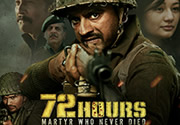
72 Hours-Martyr Who Never Died
Synopsis:
Yeshi Dema is just absolutely screaming her lungs out in the middle of a totally silent room because she just got the worst possible news a soldier's wife can ever get, and honestly, the sheer volume of that grief hits you like a truck out of nowhere.
Let's back up for a second because 72 Hours-Martyr Who Never Died is a wild ride of a biographical war drama based on the actual real-life heroism of Rifleman Jaswant Singh Rawat, and if you haven't seen this indie-leaning entry into the massive ocean of modern bollywood movies, you're missing out on some intense stuff.
The whole thing kicks off with a bunch of heavy-handed exposition about the 1962 Sino-Indian War, where ordinary guys get shoved into extraordinary nightmares up in the freezing mountains of Arunachal Pradesh, and we meet our main guy, who is just so intensely patriotic and chill with his fellow villagers before he's shipped off to army training.
Suraj Dholakhandi plays this legendary soldier with a sort of rugged, quiet dignity that makes you wonder how he manages to keep a straight face while some of the bizarre background props in the army camp look like they were bought at a local discount store for ten rupees.
There's this one particular extra in the mess hall scene who wears this completely hideous, violently orange knitted sweater that doesn't fit him at all, and I swear I stared at that ugly thing for a solid three minutes wondering why the costume department let him walk on set looking like a giant walking traffic cone while a very serious conversation about tactical strategy was happening right behind him.
Stuff happens.
They get deployed to the front lines, and out of nowhere, bang, the shooting starts, and the enemy forces are pushing hard through the rugged terrain, and the battalion is just wildly outnumbered and completely cut off from any kind of reinforcements.
And then boom, right in the thick of all this terrifying artillery fire and guys running around screaming in the mud, the movie decides to hit us with a totally random song and dance sequence that features villagers back home swaying around in traditional attire, which completely kills the tension in the most baffling way possible.
Like, why do hindi films always feel the absolute need to disrupt a gritty, life-or-death military engagement with a folksy melody that belongs in a completely different genre altogether?
Anyway, we finally slam right into the interval point with a literal cliffhanger where explosions are going off everywhere, and you're sitting there munching on your popcorn wondering how anyone is going to survive this absolute mess.
The second half gets even more intense because the actual battle of Nuranang kicks off, and Jaswant Singh Rawat refuses to retreat even when his commanding officers tell him to fall back, which leads to this incredible three-man defense stand where he manages to hold off waves of advancing enemy soldiers for seventy-two whole hours single-handedly.
Alka Amin shows up as his grieving, devastated mother, and her scenes crying into a kerosene lamp in the village hut are genuinely heartbreaking, especially when she delivers that gut-punch line, kya tumne mere bete ko wapas lane ka wada kiya tha, while clutching an old photograph that's clearly falling apart at the edges.
You see him running back and forth between different bunkers, changing the positioning of the light machine guns to trick the enemy into thinking a massive battalion is still holding the ridge, and it is honestly pure chaos on screen with smoke and dirt flying everywhere.
The special effects are a bit cheap, let's be real, because this isn't a massive multi-crore budget blockbuster packed with sleek CGI, but the sheer raw emotion and the gritty indie filmmaking style somehow make it feel way more authentic than a lot of glossy bollywood productions that prioritize looks over actual heart.
He keeps fighting on sheer adrenaline and raw grit, refusing to eat or sleep, just firing rounds into the snowy mist until he's completely out of ammunition and surrounded on all sides by enemy troops who can't believe they were held off by just one guy for three entire days.
The village back home gets the official word about his sacrifice, and the whole community gathers around in total silence to mourn the loss of a true local hero who gave everything for the tricolor.
The final scene shows a bronze bust of the fallen soldier standing proudly in the freezing mountain wind while fellow army officers salute the monument under a pale gray sky.
The sound design in "72 Hours-Martyr Who Never Died" opens with a boot heel grinding down on gravel that sounds less like Foley work and more like someone dropped a microphone right inside a quarry, which immediately tells you nobody was trying to make this sound like a standard release from the machinery of commercial Hindi movies where the sonic edges are always sanded down until they shine like plastic. It's a small thing that bugged me at first, the way the ambient wind noise keeps dropping out between dialogue cuts as if the boom operator had to keep diving behind sandbags, but you get used to it because the film isn't polished enough to hide its own seams and honestly that makes it harder to turn off.
Avinash Dhyani directs and steps into the boots of Rifleman Jaswant Singh Rawat with the kind of stiff-backed earnestness that usually sinks low-budget military biopics before they clear the first reel, yet he avoids the glossy hero-worship traps that hobbled something like "Uri: The Surgical Strike" where every soldier walks around looking like they just stepped off a billboard for protein powder. The screenplay has this habit of letting scenes run about twenty seconds past the point where a tighter editor would have yelled cut, lingering on empty tea mugs and flickering kerosene lanterns while the wind howls against corrugated tin roofs in a way that suggests the freezing altitude of Arunachal Pradesh rather than a studio backlot with a massive industrial fan blowing dry ice into the lens. There is no grand speech about the motherland delivered while looking toward the horizon with a tear welling in the corner of the eye, which feels almost strange given the subject matter, but Dhyani keeps his head down and mumbles his orders into his collar just like people do when they are too cold to care about the poetry of duty.
Alka Amin plays the mother with a quiet, devastating economy of gesture that makes most performances in mainstream Bollywood movies look like they are being performed for the cheap seats in the back row of a circus tent, using just the slight tremor of her thumb against her sari hem to convey fifty years of accumulated grief. She doesn't get many lines that aren't practical directives about firewood or dal, but she anchors the domestic segments of the narrative so thoroughly that when the film cuts back from the frozen bunker combat to her small kitchen in Dehradun, the contrast hurts more than any exploding mortar shell ever could. Suraj Dholakhandi and Yeshi Dema fill out the periphery with a lived-in authenticity that feels entirely divorced from the usual casting calls of contemporary Hindi films, speaking their lines with local inflections that weren't smoothed out in post-production by an overzealous dubbing supervisor who wanted everything to sound like standard Mumbai radio.
Cinematographer Bunty Rawat shoots the mountain passes with a desaturated gray palette that avoids looking like a travel commercial, letting the fog swallow whole platoons until the frame is just shifting shades of slate and charcoal where you can barely tell a man from a boulder. The camera doesn't swoop or crane over the trenches in imitation of Hollywood war epics, but instead stays low to the dirt, bumping along behind soldiers who are too exhausted to run properly, which occasionally makes the geography confusing during the skirmish sequences but brilliantly conveys the blinding panic of a night attack at twelve thousand feet. There's a recurring violin motif on the soundtrack that tries just a little too hard to tell you when to feel sad about a young man freezing in a foxhole, looping around the same four notes until you want to reach into the speakers and cut the string yourself.
The core tension of the picture rests on the idea of a single soldier holding a post long after his battalion has retreated, not out of some hyper-articulated ideological fervor, but because he was told to stay there and nobody came back to countermand the order through the snowy passes. It’s an interesting angle for a biographical drama because it strips away the recruitment-poster gloss and leaves behind only the stubborn absurdity of bureaucracy meeting raw geography, showing how men in uniform often endure the most impossible horrors simply because walking away requires too much paperwork and imagination. The local villagers who aided Rawat during those three days are portrayed not as saintly props or mystical guides, but as pragmatic people who weighed the risk of harboring a stray soldier against the certainty of a patrol coming through later, which gives the second act a gritty texture that saves it from becoming a standard hagiography.
If I'm honest, the second half drags whenever the narrative cuts away from the bunker to show senior officers arguing over field telephones in heated rooms that look suspiciously like someone rented out a municipal office for the weekend. The actors playing the generals have that stiff theatrical posture you usually find in regional historical pageants, shouting their dialogue with a diction that belongs on a stage rather than in a muddy command tent where everyone should be coughing from the woodsmoke. It’s a jarring gear-shift that happens every twenty minutes or so, reminding you that this production didn't have the budget to maintain its illusion of reality once the action moved indoors and away from the punishing wilderness that does most of the heavy lifting for the atmosphere.
There is a specific kind of integrity in watching a movie that clearly cost a fraction of a single star’s vanity trailer budget yet manages to sustain its somber, freezing mood for two hours without ever resorting to computer-generated explosions or patriotic voiceovers to explain the subtext. It reminds you of "The Ghazi Attack" in its cramped, functional approach to tactical spaces, though this project lacks that film's slick studio sheen and is all the better for its rough edges. The picture doesn't try to explain the geopolitical complexities of the 1962 war or point fingers at politicians sitting in Delhi, preferring instead to stay stuck in the mud with the grunts who had to pay for strategic miscalculations with their toes and their breath. That narrow focus might frustrate viewers looking for a sweeping historical overview of the conflict, but it keeps the narrative honest to the experience of one man sitting in a hole in the snow waiting for dawn that never seems to get any warmer.
When the credits finally roll over a silent black screen without a swelling orchestral anthem or a list of surviving veterans giving direct-to-camera testimonials, you realize the production trusted its audience enough to let the dust settle on its own terms. It’s an imperfect, scruffy piece of cinema that struggles with its secondary cast and occasionally trips over its own shoelaces while trying to juggle local folklore with military history, yet it leaves an impression that stays long after the shinier, three-hour epics have faded from memory. You walk away thinking about the sound of that boot heel on the gravel and the way Alka Amin didn't blink when the letter arrived, and that is usually enough to justify ninety minutes in a dark room.