

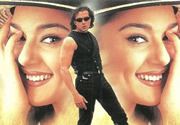
Soldier
Synopsis:
Bobby Deol is standing on top of a speeding truck in the middle of a desert wearing a sleeveless leather vest and a red bandana while firing submachine guns at people who didn't even do anything to him yet and honestly if you haven't seen Soldier yet you're missing out on peak nineties bollywood cinema.
So then to understand why he's up there shooting up the landscape we gotta go back to the start where we meet Preity Zinta looking super cute in her oversized sweaters and matching hats in Australia where she bumps into Bobby who calls himself Raju Malhotra and is just generally being a total flirt in a way only ninety stars could pull off.
The funny thing is before we even get to know why Raju is in Australia there's this random background extra wearing a neon green visor who dances behind Preity for three full seconds during a song about falling in love and it has literally nothing to do with the plot but that is just how hindi movies work sometimes.
Right after that romance gets going they get chased by police because the authorities think Bobby is a ruthless terrorist named Soldier who has been smuggling gold and killing CBI officers left and right which doesn't make sense to Preity because he's too busy giving her puppy dog eyes.
Anyway the interval block hits right when everything gets super crazy with guns and explosions and a big reveal about his real identity and everybody in the theater is eating their samosas while the screen goes black for fifteen minutes.
The second half is pure chaos because it turns out Bobby's dad was an army officer played by Suresh Oberoi who was framed for a massive gold smuggling scandal by a corrupt gang of villains including Dalip Tahil and Ashish Vidyarthi and the whole family name was completely ruined which drove his mom Geeta played by Rakhee Gulzar totally crazy with grief.
Soldier is basically a classic revenge thriller that fits right in with the best hindi films of that decade because the hero doesn't just want justice he wants dramatic slow-motion walks away from massive explosions while wearing sunglasses at night.
Preity sticks by his side the whole time even when things get super dangerous and they have to run through caves and secret hideouts while dodging bullets and jumping off cliffs.
They track down the bad guys one by one in a series of extremely violent confrontations where Bobby reminds everyone why he was such a huge star in those old bollywood movies by ripping off his shirt and beating up twenty henchmen at once without getting a single scratch on his face.
The main villain Pratap Singh finally gets trapped in a burning warehouse after shouting some dialogue about how nobody can touch him and then Bobby looks right at him and says no mercy before finishing him off for good.
Rakhee gets her long-awaited emotional redemption when the truth finally comes out on live television and the family's honor is fully restored to the military records.
Bobby and Preity embrace in a tight hug while the sun sets behind them and the credits start rolling right over a final upbeat dance remix of the main theme song.
Bobby Deol's hair in the first half of Soldier is a distinct historical event that requires its own documentation separate from the actual narrative. It is somehow both feathered and slicked with enough heavy product to weather a monsoon, moving with a terrifying independence of its own while the rest of the scene is happening. The film starts from there, from that strange stylistic commitment, and sort of rolls forward into something that resembles a narrative if you squint at it through enough theater smoke. If I'm honest, the whole opening twenty minutes looks less like a directed motion picture and more like a high-budget music video shoot that got lost on its way to MTV Asia. You get wide shots of Australia that exist purely because the budget permitted plane tickets and someone wanted to see kangaroos next to a man in a leather jacket. It is a strange way to introduce a character who is supposed to be on a cold-blooded mission of vengeance, but logic and tonal consistency were rarely the primary concerns of late-nineties Hindi films.
Director Abbas-Mustan had a very specific bag of tricks, mostly involving white suits, mirrors, fake mustaches, and staircases that went up to nowhere in particular. They stole wholesale from Hollywood thrillers with a brazenness that was almost admirable, taking plot points from films like Double Jeopardy and pasting them onto standard melodrama templates with a glue that smelled faintly of desperation. The screenplay lurches from romance to courtroom drama to action set-piece with zero regard for momentum, pausing whenever Preity Zinta needs to deliver a reaction shot that lasts five seconds too long. You can feel the gears grinding behind every transition. The dialogue hits you with the subtlety of a falling brick, written by men who seemed to believe that subtext was a place submarines lived. Yet there is a weird, relentless energy to the construction that keeps you watching even when the plot stops making any sense whatsoever, which happens roughly every ten minutes. They throw so much nonsense at the screen that some of it actually sticks, or at least stays up there long enough for you to look at it.
Bobby Deol plays Raju, or maybe Malhotra, or perhaps a guy with five different passports who spends his entire time looking mildly confused about where he left his sunglasses. His performance consists primarily of two modes: intense brooding while standing near a cliff, and smiling broadly while running through a field of wildflowers with the female lead. He doesn't stretch himself, but he has a weird physical presence that works for this kind of hollowed-out genre exercise, selling the stunts with a commitment that feels slightly absurd. He lacks the effortless swagger of Shah Rukh Khan in Baazigar, but he compensates by looking genuinely willing to throw himself off a speeding train just because the script demanded some adrenaline. Across from him, Preity Zinta is doing her absolute best to inject life into a character whose sole purpose in the universe is to scream, wear bright pink cardigans, and ask questions that have obvious answers. She has an undeniable spark that punches right through the terrible writing, making you wish the movie was about her character's internal life instead of whatever convoluted revenge plot the men were cooking up in the background.
Then there is Rakhee Gulzar, playing the suffering mother with a degree of gravitas that feels entirely inappropriate for a movie where people get kicked off balconies in slow motion. She brings a tragic weight to scenes that were probably filmed on a Friday afternoon next to a fake fountain. Every time she looks into the middle distance with tears in her eyes, you feel a slight pang of guilt for laughing at the absurd plot twists unfolding around her. The supporting cast is packed with reliable character actors who are clearly just cashing their checks and eating catering sandwiches between takes, though Mohan Joshi manages to chew the scenery with an enthusiasm that borders on performance art. It is a loud, crowded canvas, populated by goons with terrible tattoos and policemen who only show up after the building has already burned down.
The soundtrack by Anu Malik is an absolute assault on the nervous system that somehow loops in your head for days after the credits roll. The title track arrives every time someone takes two steps or remembers a traumatic childhood memory, blaring through the speakers until the bass rattles the popcorn tub in your lap. The cinematography by Ravi Yadav loves sunsets, glowing filters, and shooting Bobby Deol from below so he looks like an avenging deity rather than a guy wearing too much hair gel. Action sequences rely heavily on wirework that looks about as convincing as a rubber chicken, but they have a kinetic joy that modern Bollywood movies often lose in their pursuit of slick, grey-toned realism. You can see the stunt doubles coming a mile away, and the sound effects department clearly bought a cheap CD of bone-crunching noises and pressed repeat until their fingers bled. It's a small thing, but it bugged me how every time someone got punched, the sound of a falling coconut echoed through the theater.
Underneath all the leather jackets and explosions, the film tries to grapple with corruption, honor, and the specific pain of a family torn apart by greedy villains in suits. It is not a particularly deep exploration of these themes, preferring to use them as a flimsy excuse to stage fistfights in abandoned warehouses filled with dry ice. The moral universe is strictly binary, where the good guys are exceptionally pure and the bad guys laugh maniacally while stroking their mustaches in boardrooms. We are supposed to feel the righteous fury of the protagonist, but the movie is too busy being flashy and loud to let any genuine emotion settle into the bones of the story. It doesn't matter much in the end, because nobody bought a ticket for a social commentary on the judicial system.
This was a blockbuster in its day, capturing a very specific mood of late-century commercial cinema before multiplexes and algorithms changed the flavor of the industry. It exists as a time capsule of an era when heroes could wear yellow pants and still be taken seriously as unstoppable killing machines. You cannot really call it a good movie by any objective measure of narrative coherence or artistic restraint. Yet it refuses to be boring, which puts it leagues ahead of most prestige projects that take themselves far too seriously. It creaks, it groans, and it relies on every single cliché in the textbook, yet it somehow crosses the finish line with its ridiculous dignity intact. You leave the theater humming a tune you never wanted to hear again, wondering how three hours passed so strangely.