

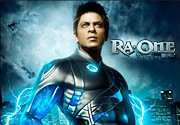
RA One
Synopsis:
Halfway through RA One, Shah Rukh Khan is literally wearing this weird red-and-gold futuristic suit and fighting a holographic villain inside a burning train while shouting at a bunch of passengers to get out of the way, but honestly, before we even get to that absolute mess of CGI and chaos, we gotta talk about how this whole crazy sci-fi ride started because it's wild. Okay, so Shekhar Subramaniam is this nerdy, lovable video game developer living in London with his wife Sonia, played by Kareena Kapoor looking stunning in every single scene, and their son Prateek who thinks his dad is total loser because he can't design a cool game. Prateek wants a villain who is stronger than the hero, and Shekhar's tech coworker Jenny, played by Shahana Goswami, helps them code this insanely powerful antagonist named RA One, where the RA stands for Random Access, which is a detail that stuck in my brain because it sounds like a toaster feature, and they also build a good guy named G. One, and then they ship the game out to be tested by players worldwide. So then, the game goes live and things get weird instantly because Arjun Rampal shows up as the physical manifestation of RA One after escaping the digital realm by hacking into real-world networks using human bodies and glowing red eyes, and he tracks down the game tester who beat his level, who happens to be this random guy living in London, and he just disintegrates him with a blast of energy right there in the street. The funny thing is, Shekhar doesn't even realize his game has broken the laws of physics yet because he's too busy dealing with his kid hating him and eating dinner with his boss played by Satish Shah, who has this running bit about being scared of his wife that takes up way too much screen time before he gets vaporized too. Right after that, RA One comes after Shekhar himself, and they have this massive chase through the city that ends with Shekhar getting killed, which was honestly shocking because Shah Rukh Khan usually doesn't die twenty minutes into a movie unless it's one of those moody drama flicks, but here we are watching our main guy get dusted into pixels while his son watches in horror. Prateek realizes he accidentally unleashed a digital monster, and since he's the only one who knows how the game works, he has to log in and summon G. One to protect them, which brings Shah Rukh Khan back to the screen playing the good guy robot who looks identical to Shekhar except he's jacked, wears blue armor, and has a glowing blue heart on his chest. Anyway, Sonia and Prateek have to pack up and run across London because RA One is hunting them down like a bloodhound, and G. One is tagging along to protect them, though he doesn't fully understand human emotions yet, leading to this awkwardly cute scene where he tries to comfort Sonia and she's just totally freaked out by the fact that her dead husband's pixelated twin is standing in her kitchen eating cereal or whatever. They try to escape to India because Shekhar's family is there, but RA One follows them all the way to Mumbai, proving that digital villains don't need a passport to cross international borders, and things just escalate into total insanity with cars flying everywhere and explosions that probably took up half the budget for these big budget hindi movies. This film tries to do the whole superhero thing that you usually only see in Hollywood blockbusters, but it's got that unmistakable song-and-dance energy that defines the best bollywood movies, even if the musical numbers feel slightly out of place when there's an unstoppable killer robot lurking around the corner. They end up in a massive final showdown inside a virtual reality arena or a train station or something where G. One has to use a glowing red cube to defeat the indestructible bad guy, and Prateek is screaming instructions through a headset while Sonia looks stressed out of her mind. G. One gets completely torn apart and rebuilt like three times during this fight, but he keeps coming back because he's programmed to protect the player at all costs, and he even manages to absorb RA One's attacks and throw them right back. The action jumps from neon-lit alleys to crowded stations in a blur of motion and loud sound effects, and you can barely tell what's actually happening on screen because there's just so much debris flying around. G. One manages to trap RA One in a final containment field and triggers a self-destruct sequence that causes a blinding flash of white light to fill the entire screen, saving the family and permanently deleting the threat once and for all. Sonia and Prateek stand on the street looking up at the sky as the digital dust settles, and a glowing blue light descends from the clouds to reconfigure itself into G. One's form right in front of them with a cheeky smile.
That sound design choice right at the start, where the low-end rumble of the server room bleeds into the dialogue track during a totally mundane family dinner, drove me half out of my mind before the opening credits even finished. If I'm honest, the sound mixing in the first twenty minutes of RA One feels like someone was getting paid by the decibel, layering crash effects over domestic arguments about video games and software licenses. It is a loud movie, yes, but it is loud in that specific, frantic way of a studio throwing every single visual asset onto a hard drive and praying the rendering farm doesn't catch fire.
Anubhav Sinha directs with a manic energy that suggests he watched The Matrix and Terminator 2 back-to-back while mainlining espresso, though without the spatial geography that makes those older action scenes actually readable. When Shah Rukh Khan as G.One slides across a London tarmac in slow motion while digital debris explodes outward in three hundred directions, you cannot tell which way is up or where the characters are relative to each other. The screenplay, co-written by Sinha and Kanika Dhillon, spends an exhausting amount of time trying to bridge the gap between silly comic-book logic and genuine emotional stakes involving a neglected son and a grieving widow, yet it never quite figures out how to make the video game mechanics have any actual narrative weight beyond giving the VFX artists an excuse to render another neon skyscraper collapsing.
Shah Rukh Khan plays a double role here, trading his usual romantic charm for the broad, irritatingly goofy glasses and stuttering cadence of Shekhar Subramaniam, a game designer who wants his kid to think he is cool, before pivoting into the blue-tinted superhero who walks away from explosions without looking back. That transition is rough, landing somewhere between heartfelt homage and expensive vanity project, but Khan commits to the physical wirework with an intensity that honestly makes you feel a little tired just watching him bounce off green-screen walls. Kareena Kapoor has essentially nothing to do except look bewildered in increasingly expensive London coats and react with wide-eyed shock every time a CGI vehicle flies through her living room, which is a waste of her screen presence considering what she managed to do in Jab We Met.
Then you have Arjun Rampal as the title antagonist, strutting around in a leather trench coat with his hair pulled back so tight his facial expressions are entirely optional. Rampal doesn't have many lines, which is probably a blessing given the heavy-handed techno-babble the script forces onto the supporting cast, but he occupies the frame with a cold, metallic menace that works surprisingly well when the camera just lets him stand there and look menacing in the rain. Shahana Goswami and Satish Shah pop up in the early scenes to handle the exposition heavy-lifting at the gaming company, delivering lines about source code and neural mapping with a straight face that deserves some kind of hazard pay. The dubbing on a few of the minor background thugs is slightly out of sync, and once you notice that floating audio lag during the train sequence, it becomes impossible to look at anything else.
Vishal-Shekhar’s soundtrack dominates the proceedings with relentless enthusiasm, though Chammak Challo gets recycled as background instrumental cue far too many times during moments that have nothing to do with dancing or nightclubs. The visual effects, handled by a small army of international studios, range from genuinely impressive particle work during the morphing sequences to bizarrely weightless digital doubles that look like they were pulled straight from an early PlayStation cutscene. It is an uneven visual landscape where a real London double-decker bus will share a frame with a completely unconvincing CGI character tumbling through the air, creating a strange cognitive dissonance that never quite settles down.
Beneath the digital armor and the endless sponsorship placements for consumer electronics, the film attempts to grapple with how children consume digital violence and how fathers fail to communicate their affection through anything other than purchased goods. That paternal anxiety gets buried under so many explosions and laser blasts that you almost forget it was supposed to be the emotional anchor of the entire narrative. Hindi cinema has struggled for decades to find a reliable vernacular for the superhero genre, usually defaulting to mythological tropes or broad slapstick to keep audiences from laughing at the spandex, and RA One tries to bypass that traditional hesitation by simply throwing enough digital currency at the screen to blind the audience to the plot holes.
The climax drags on for what feels like an eternity, bouncing between a burning stadium and a crumbling virtual environment where the rules of physics change depending on which character needs to throw a punch. There is no real sense of danger because every digital asset can be regenerated and every hero can respawn, stripping the final confrontation of the sweaty, desperate desperation that makes classic action cinema work. You leave the theater thinking about the sheer volume of electricity required to render all those blue glowing lines across Shah Rukh Khan’s chest, wondering if the budget might have been better spent on a tighter script that didn't need four different writers to figure out how to end a fight scene.