

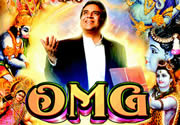
Oh My God
Synopsis:
Picture this, Kanji Mehta is standing right there in the middle of a TV studio holding an antique sword and just absolutely losing his mind while shouting about how God doesn't exist and how all these spiritual gurus are running a total scam, and honestly it's wild to watch because he's usually such a calm, calculating guy who only cares about selling overpriced idols to tourists in Mumbai. But to understand how he even got to that sweaty television set, you have to go back to the very beginning of Oh My God, which is this really fascinating entry in the usual lineup of bollywood movies that tries to tackle religion head-on without being totally boring. Kanji is an atheist antique dealer who doesn't care about rituals at all, and he's got this one specific employee named Mahadev who stands around wearing a very particular yellow cotton kurta that's always slightly wrinkled around the collar, and Mahadev has to listen to Kanji complain about customers touching the brass statues with greasy fingers all day long. So anyway, one afternoon a completely random minor earthquake hits the city, and it's barely a tremor anywhere else, but Kanji's shop is the only building that literally crumbles into dust because karma or bad luck or whatever decided to target him specifically. That's a huge moment.
Right after that happens, Kanji rushes to the insurance office to cash in his policy, but they tell him tough luck because the damage was caused by an act of God, which is legally classified as an act of nature and isn't covered under the fine print. So then Kanji gets really pissed off and decides to file a lawsuit against God, which sounds like a total joke, but he actually serves legal notices to all the local religious trusts and self-proclaimed holy men who claim to represent the almighty on earth, leading to Govind Namdeo playing this hyper-dramatic godman named Siddheshwar Maharaj who walks around in elaborate silk robes and looks like he's smelling something awful all the time. Akshay Kumar shows up on a super cool heavy motorcycle as Krishna, basically looking like a regular guy in a leather jacket who casually drops in to help Kanji navigate the chaos and figure out how to sue the heavens. Mithun Chakraborty is also floating around as this theatrical spiritual leader Leeladhar who wears bright orange outfits and tries to discredit Kanji at every single turn, and Poonam Jhawer is there too as a devoted follower, while Mahesh Manjrekar plays a grumpy lawyer who thinks Kanji's case is completely insane.
The courtroom scenes drag on forever with the judge played by Murali Sharma looking utterly exhausted by all the shouting, and Kanji brings in medical records and property deeds to prove that God is responsible for natural disasters and therefore owes him money for the ruined shop, and Sonakshi Sinha and Prabhu Deva even show up for a flashy dance number in a song sequence that interrupts the plot entirely. Kanji gets super sick at one point because the temple trusts and fake gurus hire thugs to beat him up and terrorize his family until his wife and kids pack their bags and leave him all alone in the wrecked apartment, but Krishna stays by his side and feeds him tea and tells him to keep fighting the system. The funny thing is, Kanji actually wins the case because none of the religious trusts can produce a signed document or proof from God accepting ownership of the earthquake, so the court orders all the temples and religious organizations to pay for the damages out of their own pockets, which makes Kanji rich overnight. He builds a huge fancy new showroom to replace the old rubble, but then he starts getting worshipped like a god himself by masses of blind followers who set up a temple right outside his house, and he realizes he's accidentally created the exact same toxic monster he just fought against. He gets furious, grabs that sword we talked about earlier, marches onto the TV studio set to smash idols and scream at the sky, and then Krishna finally reveals his true divine identity and teaches Kanji that true faith isn't about temples or money, and that's when Sonakshi Sinha and the rest of the cast are probably chilling backstage. Kanji goes home and hugs his family, completely changes his worldview, and shuts down his entire business of selling God-related merchandise. He walks away from the shop forever and smiles at the sky.
That plastic idol of Ganesha dissolving into the muddy creek water during the opening montage of Oh My God had a weirdly cheap sheen to it, honestly. You can almost see the studio glue holding the cheap clay props together if you pause the Blu-ray at the right second. Umesh Shukla directs with the kind of workmanlike television-grade flatness that usually signals a stage play adaptation refusing to trust its own text. It smells like a Gujarati natak brought to the big screens of multiplexes with barely enough budget to pay for the exterior street dressings in Chor Bazaar. Kanji Lalji Mehta is introduced not with a grand cinematic flourish but with the exhausted whine of a shopkeeper watching a customer haggle over a brass Nataraja that probably cost twenty rupees to cast. He sells idols for a living while secretly laughing at the gullibility of the people buying them. Bollywood movies rarely let their protagonists be this openly mercenary without immediately softening them with a sick mother or an orphaned niece.
Paresh Rawal anchors the whole chaotic enterprise with a weary, cynical precision that makes most other contemporary Hindi cinema look like community theatre. He doesn't play Kanji as a villain of pure greed or a misunderstood philosopher of atheism. He plays him as a guy who just wants to pay his suppliers and go home to watch the cricket match in peace. When the earthquake hits and destroys only his shop while leaving every other religious emporium on the street completely untouched, his face drops into this hollow, infuriated slackness that tells you everything about his worldview. The insurance company laughing him out of the office on a technicality involving acts of God gives the narrative its engine. Akshay Kumar rolls in later on a heavy-duty Harley Davidson wearing ripped jeans and a leather jacket, playing Krishna with a casual, almost smug swagger that borders on annoying before he settles into the rhythm. It is a very weird piece of casting that shouldn't work on paper. He breezes through scenes with a toothy grin and a smart-ass remark, pulling Kanji out of his various depressions with the annoying persistence of an uninvited uncle who won't leave the living room couch.
The script adapted from Bhavesh Mandalia’s stage play loses its spatial logic the moment it leaves the shop floor and enters the courtroom. Sets look impossibly shallow, painted flats doubling for expensive legal chambers where Mithun Chakraborty hams it up as a high-pitched godman with enough saffron robes to clothe a small village. Mithun is chewing the scenery so hard you can almost hear the cardboard crunching between his teeth, tossing his head back and shouting lines about faith while Govind Namdeo hovers in the background playing the sniveling manager like a second-rate villain from a ninety-year-old melodrama. The tone lurches wildly between broad farce and heavy-handed sermonizing about institutionalized hypocrisy. One minute Kanji is trading barbs with a divine biker boy eating butter cookies, and the next he is standing in the middle of a crowded street delivering a ten-minute monologue that feels suspiciously like a guest lecture at a management seminar. Sonakshi Sinha and Prabhu Deva show up for a mandatory item song that stops the narrative cold just when it was starting to regain some momentum. It’s a small thing but it bugged me how the editing cuts away from Rawal’s reactive grimaces during the musical break to show background dancers hitting choreography marks that belong in a completely different movie.
There is a distinct lineage here leading back through earlier social satires like Jaane Bhi Do Yaaro, though Shukla lacks Kundan Shah's frantic, anarchic genius for visual chaos. Instead, Oh My God relies entirely on the dialogue to carry its weight, letting the camera sit dead-center in medium shots while characters shout theological arguments across wooden tables. Hitesh Sonik’s background score hits every dramatic beat with the subtlety of a falling anvil, dropping synthetic choir vocals every time Krishna offers Kanji a piece of worldly wisdom. Yet despite the visual monotony and the occasional clunky needle-drop that repeats the same melodic hook three times too many, the central argument holds your attention. It targets the commercialization of faith with a bluntness that feels surprisingly rare for mainstream Hindi films, which usually prefer to dance around religious sensitivities with kid gloves. Kanji suing God because insurance companies won't pay out for acts of God is a genuinely great premise that keeps the picture afloat even when the supporting cast starts shouting at the top of their lungs.
Watching Paresh Rawal dismantle the business model of organized religion through cross-examination is the real meat of the second half. He points out receipts, audit books, and donation boxes with the cold logic of a chartered accountant who has finally had enough of the local temple committee's nonsense. When he stands in the witness box and argues that God doesn't need milk, gold, or expensive silk vestments when millions are starving on the pavement outside, the film risks turning into a very expensive pamphlet. It avoids total collapse only because Rawal plays the material with such total, earthbound exhaustion. He isn't trying to convert the audience to atheism. He just wants his shop back. By the time the courtroom clears and the massive crowds disperse into the evening smog, the picture has essentially talked itself into a corner from which only a convenient supernatural exit strategy can rescue it. It cops out in the final reel with a soft, reconciliatory compromise that tries to have it both ways, letting the faithful keep their idols while telling them to be a bit nicer to their neighbors. That ending is a predictable disappointment, but the hours spent watching a grumpy Gujarati merchant yell at heaven managed to earn a certain amount of stubborn goodwill.