

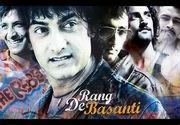
Rang De Basanti
Synopsis:
Halfway through the film, DJ and his slacker crew are sitting around drinking chai while this intense British documentary filmmaker named Sue is screaming at them because they aren't taking their acting seriously at all, and honestly, she's wearing this weird oversized khaki jacket with way too many pockets that really sticks in my mind for some reason. But to understand why a British girl is even hanging out with a bunch of rowdy college dudes in Delhi making an indie movie about Indian freedom fighters, you have to look at how this whole thing started. Sue finds her grandfather's old diary in England, and it's all about how he was a British jailer guarding revolutionaries like Bhagat Singh back in the day, and since she wants to bring that specific story to life, she packs up and heads to India to cast regular kids in a passion project that nobody else wants to fund. She meets Sonia, a bubbly university student who introduces her to DJ, Aslam, Sukhi, and Karan, and they're just typical lazy youths hanging out at the local campus monuments, dodging cops, riding motorcycles, and acting like they don't care about anything. The funny thing is, none of these guys actually care about history or patriotism or politics or anything remotely serious, and when Sue asks them to audition for the roles of Chandrashekhar Azad and Ashfaqulla Khan, they just laugh in her face and treat the whole thing like a giant joke, but she manages to convince them by nagging them constantly and offering them free food and booze, and soon enough, they're all hanging out at the fort rehearsing lines and wearing fake mustaches. Rang De Basanti brings these two totally different worlds together, mixing modern campus life with flashbacks of colonial struggle, and it doesn't feel like your average glossy production because it feels a lot more gritty and raw than most other bollywood movies you'll see on streaming sites today. So then, they start shooting the scenes, and Atul Kulkarni plays this fiery, hyper-nationalist student named Laxman Pandey who totally hates Muslims at first and refuses to act alongside Aslam, but working on the project slowly forces them all to confront their prejudices, and they actually become inseparable best friends who ride around on bikes and drink beer and cause general chaos all over the city. Aamir Khan plays DJ with this bleached-tip hairstyle and an endless supply of swagger, and he's been hanging around college for way too long because he just doesn't want to graduate into the real world, while Soha Khan plays Sonia as the glue holding the friend group together, and Waheeda Rehman shows up as Ajay's grieving mother who lives in a quiet house filled with memories of her pilot son. Karan is the rich kid of the group whose dad is a corrupt defense minister played by Anupam Puri, or wait, Om Puri, and Karan's relationship with his father is totally fractured because his dad only cares about political bribes and PR campaigns, which becomes a huge deal later on when tragedy strikes. Right after that, they finish the documentary shoot, and they're all super emotional about it, but then disaster hits because Ajay, who's an Indian Air Force pilot and Sonia's fiancé, dies in a terrible MiG crash that the government immediately blames on pilot error to cover up a massive defense scam involving faulty jet parts. Everyone's devastated, especially Sonia and Ajay's mom, and they decide to hold a peaceful candlelit protest at India Gate to demand justice and call out the corrupt defense minister, but the police show up out of nowhere and brutally beat up all the peaceful student protesters, and they even put Ajay's grieving mother in the hospital. The minister goes on TV and lies through his teeth, calling the students anti-national thugs who were paid off by foreign elements, and this completely shatters the guys' worldview because they realize the system is totally rigged and nobody in power cares about regular people dying due to sheer greed. They decide they can't just let it go, so they plan a daring, real-life assassination of the corrupt defense minister, mirroring the exact methods of the freedom fighters they played in Sue's movie, and they sneak into a radio station where the minister is giving a live interview, and DJ walks right in and shoots him dead on air. They get arrested immediately, and the media paints them as terrorists, but they don't care because they've made their point and woken up the whole country, and honestly, the sheer scale of Hindi films usually avoids tackling this kind of heavy political rebellion directly, but this one leans right into it with full force. They're locked in a holding cell waiting for their trial, and the government decides to quietly assassinate them inside the facility to avoid any more public embarrassment, and commandos storm the building while the friends call their parents one last time in these heartbreaking phone conversations. They share cigarettes, laugh about old times, and accept their fate without a single ounce of regret, and the movie handles this heavy stuff surprisingly well without feeling too preachy or fake, even though some parts are definitely a bit melodramatic. The sound of gunfire echoes through the empty corridors as the screen goes completely white, and the final credits roll immediately.
There is a specific kind of camera movement in Rakeysh Omprakash Mehra’s Rang De Basanti that I hated from the very first frame, a restless, jittery push-in that treats every Delhi street corner like it’s about to explode. If I'm honest, it feels a bit like the cameraman had too much espresso before rolling, never quite letting a conversation settle before shoving us six inches closer to someone's nostril. It’s a jittery, nervous energy that matches the script's frantic pacing, but my god, it makes you want to hand the director a paper bag and tell him to breathe. Yet this very stylistic tic somehow anchors the entire enterprise, dragging a bunch of twenty-somethings out of their lounge-bar inertia and throwing them directly into the path of history. They aren't freedom fighters when we meet them. They are slackers drinking beer on the steps of India Gate, complaining about jobs, and drifting through life with the magnificent apathy only available to the upper-middle-class youth of a booming capital.
Sue comes to Delhi with her grandfather’s diary and a dream of making a low-budget indie film about Bhagat Singh and his comrades, casting a bunch of local loafers who can barely be bothered to learn their lines. Soha Khan plays Sue with a bright, exhausting earnestness that could easily have curdled into caricature, yet she manages to keep the character grounded even as the plot around her goes completely off the rails into melodrama. She wants to capture the passion of men who died young for an independent country, but she gets stuck with Daljeet, a perpetual student leader played by Aamir Khan with an aggressively dyed blonde tuft of hair and enough smoldering menace to power a small suburb. Aamir is too old for the part by at least a decade, everybody knew it when the movie came out, and somehow he forces you to forget his actual birth certificate within five minutes by sheer force of comedic timing and raw charisma. He plays the clown until the world forces him to stop, shifting gears with a terrifying abruptness that leaves the audience gasping.
The transition from a breezy campus comedy about overgrown boys racing motorcycles into a brooding political thriller about government corruption is handled with astonishing clumsiness, and that is precisely why it works so well. Mehra doesn't ease us into the tragedy. One moment the gang is shooting beer cans off a wall in a sun-drenched courtyard, and the next they are burying their best friend after a fighter jet falls out of the sky due to a faulty defense minister's kickback scheme. Sharman Joshi brings a heartbreaking vulnerability to Sukhi, the softest member of the crew, and when his character meets that abrupt, violent end, the movie sheds its bright wardrobe and puts on mourning clothes. The screenplay by Kamlesh Pandey and Mehra draws a straight, unapologetic line between the British Raj and the current bureaucratic apathy of modern India, suggesting that the masters simply changed the color of their skin while keeping the handcuffs. It is a heavy-handed argument, completely lacking in subtlety, but it hits with the blunt force trauma of a cricket bat to the kneecap.
Then there is the soundtrack by A.R. Rahman, which I have loved for years while simultaneously resenting how it manages to manipulate my tear ducts with the exact same synthesizer patch every single time. "Rooh Rubaru" kicks in during the climax and suddenly you are weeping into your popcorn, forgiving every clunky piece of dialogue about patriotism and sacrifice because the electric guitar riff is just that good. Binod Pradhan’s cinematography splits the difference between the sun-bleached, golden-hour nostalgia of the past sequences and the washed-out, concrete gray of contemporary Delhi, creating a visual dialogue between two eras that shouldn't make sense together. The past scenes are shot with a washed-out sepia that looks like old postcards found in an attic, whereas the present day vibrates with primary colors, neon signs, and the endless dust of construction sites. It reminds me a bit of the frantic visual grammar Steven Soderbergh used in Traffic, though with a great deal more emotional swelling and considerably more brass instruments.
The supporting cast does heavy lifting in corners of the narrative that might otherwise collapse under the weight of their own significance. Waheeda Rehman plays Ajay’s blind mother with a quiet, devastating dignity, sitting in a dim room while her world slowly caves in around her. Om Puri and Kirron Kher chew the scenery as the loud, bickering, yet fiercely protective Punjabi parents of one of the boys, injecting a domestic realism that keeps the high-minded political rhetoric from floating away into the stratosphere. Atul Kulkarni plays Laxman, a right-wing student activist whose rigid ideology crumbles into ash when he realizes his political mentors are just as corrupt as the people he hates, and his performance has an uncomfortable, coiled intensity that never lets you relax. These hindi films often rely on stock archetypes to move the audience along, but here the actors invest every cliché with such physical commitment that you buy into the transformation long before the tragic finale.
Let's talk about the sound design for a second, because there is this one recurring audio cue of a ticking clock that shows up whenever a character is about to make a life-altering decision, and it drives me completely crazy every single time. It’s the kind of sonic shortcut that belongs in a cheap television soap opera rather than a major budget production, popping up during moments of quiet contemplation like an annoying mosquito buzzing near your ear. It’s a small thing, sure, but it bugged me through multiple viewings, pulling me out of the emotional reality just when the actors were doing their best work. But these mechanical missteps fade into the background once the boys storm the radio station to hold the nation hostage with an unscripted broadcast about government accountability. The whole sequence is entirely ridiculous, legally absurd, and logistically impossible, yet it plays like a primal scream against the polite cynicism of the twenty-first century. They aren't trying to start a revolution. They are just trying to wake up a country that has forgotten how to feel angry about anything that doesn't affect its immediate bank account.
The second half trades the easy camaraderie of the campus for prison cells and candlelight vigils, shifting the tone so drastically that you might wonder if a different crew took over during intermission. Kunal Kapoor’s character Aslam tries to navigate the invisible walls of religious division within the group, and his quiet realization that sectarian lines don't matter when the state comes down on you is handled without the usual speechifying you might expect from commercial hindi movies. When the characters finally accept their fate, walking toward gunfire with a strange, radiant calm that feels uncomfortably close to glorifying martyrdom, the film asks a genuinely difficult question about whether violence is ever the only language left for the powerless. It doesn't offer a clean answer. Instead, it leaves you staring at the screen while the credits roll in absolute silence, refusing to comfort you with a catchy pop reprise or a reassuring voiceover about the resilience of democracy.
Rang De Basanti remains an erratic, overstuffed, frequently exasperating piece of cinema that captures the messy, contradictory pulse of contemporary bollywood movies better than almost anything else from its decade. It asks its audience to care about national identity not as a football-match cheer or a flag-waving exercise, but as a painful, ongoing negotiation between what a country is and what its children wish it could become. The flaws are enormous, the runtime is unforgiving, and the political arguments won't survive five minutes of rigorous academic scrutiny if you decide to pick them apart. Yet it lingers in the nervous system long after the television is turned off, an unruly ghost of an era when popular cinema still believed it could knock the wind out of a complacent audience.