

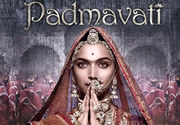
Padmaavat
Synopsis:
Ranveer Singh is literally covered in mud, screaming at his own reflection while wearing enough heavy gold jewelry to fund a small country, and honestly, the sheer drama of this specific scene makes you forget you've been sitting in a cinema chair for two hours watching one of the most wildly extra historical epics ever made in the entire history of bollywood movies.
Let's rewind this absolute mess because Sanjay Leela Bhansali decided to direct Padmaavat, which is a massive period piece that somehow costs a gazillion rupees just to make people look intensely at each other across courtyards, and it all kicks off in the kingdom of Singhal where Deepika Padukone, playing Princess Padmavati, is out in the woods hunting deer and accidentally shoots an arrow that nicks the turban of exiled priest Maharawal Ratan Singh, played by Shahid Kapoor, and instead of getting mad they just instantly fall in love because that is how romance works in hindi films.
They get married and head back to Mewar, living their best royal lives in a pristine white fortress where everything is peaceful until a slimy, exiled priest named Raghav Chetan gets caught spying on their private moments and gets banished, which brings us to the Delhi Sultanate where Ranveer Singh as Alauddin Khilji is busy assassinating his uncle, wiping horse blood on his face, and marrying Mehrunisa, played by Anupriya Goenka, while plotting to conquer the entire world just because he heard rumors about how insanely gorgeous Padmavati is.
Khilji is just completely unhinged throughout this entire movie, eating meat like a caveman while pacing around tents and staring at mirrors, and he marches his massive army down to Chittor and demands to see Padmavati, but Ratan Singh is too proud and traditional to let another man gaze upon his wife's face, so Khilji resorts to playing mind games and getting invited inside the fortress for a polite little dinner where he gets to look at Padmavati through a system of reflections in polished brass mirrors.
That mirror scene is so tense your popcorn gets stuck in your throat, and then right after that, Khilji betrays his guests, captures Ratan Singh, and takes him hostage back to his camp, leading straight into the interval point of the film where everyone in the audience is just gasping and grabbing more soda while trying to process the sheer amount of eyeliner Ranveer Singh is wearing.
Stuff happens and Padmavati goes to Delhi to rescue her husband with the help of her fierce loyalists, successfully sneaking Ratan Singh right out from under Khilji's nose in a daring rescue mission that leaves the Sultan absolutely furious, smashing pottery and screaming at the sky.
Khilji gathers his troops and lays siege to Chittor for six whole months, and honestly, the scale of this battle is massive with catapults and flaming boulders flying everywhere, and the movie wastes zero time rushing through the final conflict where Ratan Singh sneaks out of the fort to fight Khilji in single combat and gets tragically stabbed in the back by a treacherous Delhi soldier.
Padmavati finds out her husband is dead and she looks around at all the remaining women in the kingdom, and they all calmly decide they'd rather burn alive than let Khilji and his invading horde capture and dishonor them.
Khilji sprints desperately toward the castle gates, screaming bloody murder as he realizes he's too late, and he breaks through the wooden doors only to watch helplessly in horror as Deepika Padukone calmly walks straight into the center of a roaring, massive pit of fire.
There is a specific kind of digital sheen that ruins modern historical dramas, and Sanjay Leela Bhansali spends the first twenty minutes of Padmaavat aggressively applying it to everything in sight. It looks less like twelfth-century Mewar and more like a high-end tile showroom after closing time, all polished marble and golden hour filtration that makes even the sweat look synthetic. If I'm honest, the sheer volume of CGI dust motes floating across every frame gets annoying very fast, settling over the actors like digital dandruff whenever the camera tries to manufacture atmosphere.
Bhansali directs with the subtlety of a brass band playing inside a cathedral, yet his screenplay, co-written with Prakash Kapadia, manages some moments of genuine psychological claustrophobia once the action moves inside the fort. The architecture itself becomes a suffocating character during the siege, trapping people in corridors that seem to shrink with every narrative turn while the outer walls take a relentless pounding from an unseen enemy. Still, the pacing drags badly in the middle stretch where the songs arrive with predictable regularity, interrupting whatever momentum the narrative has managed to build just as the tension starts to tighten around the characters' necks.
Deepika Padukone plays Rani Padmavati with a statuesque calm that occasionally borders on the robotic, though that stillness serves a distinct dramatic purpose when the chaos around her reaches fever pitch. She holds her posture with a terrifying rigidity, refusing to blink during confrontational close-ups that would have lesser performers leaking emotion all over the lens, making her every movement feel calculated for maximum visual impact. Anupriya Goenka, meanwhile, pops up as Nagamati in a handful of scenes and delivers her lines with a crisp authority that almost cuts through the heavy-handed pageantry, though she is rarely given enough room to breathe before the edit yanks us back to the principal players.
Then you have Ranveer Singh as Alauddin Khilji, tearing through the movie like a starved animal loose in a butcher shop, gnawing on meat, smearing ash on his face, and generally treating the dialogue as an optional suggestion. It is a wildly unrestrained performance that occasionally tips over into cartoonish territory, reminiscent of Daniel Day-Lewis in Gangs of New York if he had been raised on a diet of terrible heavy metal music and bad temper. He devours every scene he occupies, leaving the other actors to pick at the crumbs of their respective character arcs while he rolls his eyes and snarls at the ceiling with manic intensity.
The cinematography by Sudeep Chatterjee relies far too heavily on circular tracking shots that spin endlessly around characters during moments of high emotion, a trick that feels exhausted after the third or fourth repetition. The soundtrack, also credited to the director, leans into thunderous percussion and chanting choruses that do the heavy lifting whenever the script fails to generate real dramatic stakes, though the mix is so loud in theaters that it vibrates right through the floorboards. It is a lavishly produced spectacle that spends an enormous amount of money making the past look like a pristine music video, failing to notice that the dirt and grime of actual human struggle got scrubbed away in post-production.
Amidst all the CGI armies and sweeping drone shots of desert landscapes, the film occasionally stumbles into surprisingly conservative thematic territory regarding honor and sacrifice, especially during the much-discussed climax. These ideas about female purity and martial pride feel recycled from older, less complicated Hindi movies that traded in the same nationalistic iconography without half the budget. Yet there is a fascinating undercurrent regarding desire and possession that complicates Khilji's obsession, framing his conquests not just as political expansion but as a bottomless hunger for things he can never truly own or domesticate. It keeps the central conflict from turning into a simple morality play, even if the surrounding noise often drowns out the nuance.
What really bothers me, though, is the recurring ADR on the minor soldiers who shout battle cries that sound entirely detached from their physical bodies, as if someone recorded the audio in a small tiled bathroom in Bandra three months after the shoot wrapped. It ruins the immersion during the massive battle sequences, pulling your attention away from the charging horses and toward the flat, lifeless vocal delivery of extras who clearly have somewhere else to be. These small technical fractures happen all the time in modern Bollywood productions where the scale outstrips the attention to detail, leaving behind a glossy surface that cracks the second you look too closely at the seams.
Padmaavat exists in that strange space between high art and blockbuster pandering, never entirely committing to the psychological grit of historical tragedy or the pure, unadulterated joy of mainstream musical cinema. It demands patience from an audience that has already seen these narrative beats played out across countless other historical epics, offering little in the way of surprise outside of Singh's feral physical commitment. You leave the theater with a ringing in your ears and a slight headache from the relentless saturation of reds and golds, wondering if a little more grit and a few less digital extras might have turned this bloated historical fantasy into something that actually felt human.