

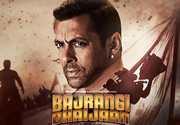
Bajrangi Bhaijaan
Synopsis:
The film starts with a Muslim family watching TV in Sultanpur village, Azad Kashmir, Pakistan, and an expectant mother''s baby kicks when Shahid Afridi leads Pakistan to victory in an India–Pakistan cricket match. A few years later, the baby has grown up to be a young speech-impaired girl Shahida (Harshaali Malhotra). Her mother takes her to Hazrat Nizamuddin Auliya''s Dargah in Delhi, India to pray for her speech being returned.
Unfortunately Shahida gets lost in India with no way to head back over the border to her home, and boards a freight train, and reaches Kurukshetra, India. In Kurukshetra, a brahmin devout Shri Hanuman Pawan Kumar Chaturvedi also known as Bajrangi (Salman Khan) is dancing merrily with other worshippers. Shahida spots and follows Bajrangi, and gets associated with him under strange circumstances. He assumes she''s Hindu and separated from her parents. He buys her a Bajrang Bali pendant to protect her from harm.
On his way to Delhi, Bajrangi quizzes the little girl, and calls him Munni to find out which city she''s from, but she doesn''t respond to any Indian town names. Bajrangi meets Rasika (Kareena Kapoor) on the bus in Delhi where he insists they split change over a ticket. She tries to shake him off but finds him in her own haveli, advising her father on how to wrestle. Rasika thinks Bajrangi has come there to harass her but it turns out her father is Dayanand and so, Bajrangi is invited to stay with them.
That specific, glassy-eyed look Salman Khan gets when he is trying to register complex emotional distress in a hindi movie is worth studying on its own terms, because it completely bypasses traditional acting and goes straight into some sort of primal earnestness that defies critique. You see it right at the start of Bajrangi Bhaijaan, before the plot mechanics have even fully ground into gear, anchoring a character who is fundamentally too simple to exist in any modern cinematic universe yet somehow takes up an enormous amount of room on the screen anyway. Kabir Khan directs this thing with a very strange mixture of grand geopolitical posturing and deeply pedestrian character beats, which means you get sweeping overhead shots of mountain passes followed immediately by scenes where adults stand around explaining basic human empathy to each other like they are reading from a pamphlet handed out at a community center. It is a long haul.
The script, credited to a few different writers including the director and Vijayendra Prasad, is structured like a classic road movie that occasionally pauses to let people shout about national borders across a fence. Pawan Kumar Chaturvedi, who goes by the magnificent nickname Bajrangi, finds himself responsible for a mute Pakistani girl named Shahida who has somehow gotten lost on a pilgrimage train in India. He has to take her home. If I'm honest, the logistics of this journey are completely absurd from the very first frame, relying on a series of geographical impossibilities and bureaucratic oversights that would make a seasoned travel agent weep. Yet the narrative momentum keeps dragging you forward through sheer brute force of repetition, establishing a rhythm where Pawan loses money, finds a train, gets chased by local cops, and feeds the kid an ice cream cone.
Salman Khan carries the weight of this entire enterprise with a bizarrely subdued performance that actually lacks the swagger most of his fans show up for, replacing the usual shirtless muscle-flexing with a kind of clumsy, pigeon-toed goodness that feels closer to his work in Sultan than anything he did during his peak action years. He plays the fool without ever making you feel like he is in on the joke, which is actually a remarkably difficult tone to maintain across two and a half hours without slipping into sheer caricature. Kareena Kapoor Khan wanders in every once in a while as the obligatory love interest whose sole narrative function is to look disappointed in him and then instantly forgive him, a thankless role that she handles with total professionalism while visibly wondering if there was anything better on her schedule.
Then Nawazuddin Siddiqui shows up about halfway through as a down-on-his-luck Pakistani television journalist and immediately sucks all the air out of the room in the best possible way. He plays Chand Nawab with a twitchy, frantic desperation that contrasts so sharply with Khan's immovable boulder of a hero that every scene they share feels like it belongs to a completely different movie, one that might actually be about real people instead of walking national symbols. Siddiqui has this incredible habit of chewing on his lines until they sound like regular speech instead of written dialogue, rattling off complaints about his low ratings and his uncooperative cameraman while everyone else is trying to have a heavy emotional moment about Indo-Pakistani relations. It is a small thing, but his terrible fake mustache in the early reporting sequences is distracting in a way that suggests the wardrobe department just gave up around lunchtime.
The cinematography by K.K. Senthil Kumar or whoever happened to be holding the long lens on the day gives the landscapes a hyper-saturated digital gloss that makes even the dustiest dirt roads look like they were scrubbed with dish soap before the cameras rolled. Every sunset over the Pakistani border looks like it was rented from a tourism board, complete with amber backlighting that catches the tears welling up in the corners of everyone's eyes at precisely the same second. The soundtrack by Pritam leans very heavily on acoustic guitars and swelling string sections whenever the little girl tries to gesture toward her mother, hitting the emotional cue with the subtlety of a falling piano. There is a specific qawwali track that repeats itself during three different montage sequences across the second half, and by the third time the chorus kicked in, I found myself staring at the ceiling tiles just trying to count the acoustic stings.
What saves the whole project from collapsing under the weight of its own message is the sheer physical presence of the child actor, Harshaali Malhotra, who manages to convey an entire internal life without ever speaking a single syllable of dialogue. She does not play cute the way standard child stars in bollywood movies usually do, avoiding that terrible calculated precociousness that makes you want to throw things at the projection booth, and her interactions with Khan have a genuinely unscripted raggedness that feels earned. When she grabs onto his sleeve during a border skirmish, the panic on her face looks real enough to make you forget you are watching a two-hundred-crore religious harmony lecture disguised as family entertainment.
The themes are about as subtle as a brick through a stained-glass window, hammering home the idea that ordinary citizens on both sides of the Radcliffe Line just want to eat biryani and watch cricket while politicians ruin everything. It is a noble sentiment, obviously, but it is delivered with the intellectual complexity of a middle school civics textbook that has been left out in the rain. You are meant to walk out of the theater feeling warm and fuzzy about cross-border peace, even though the film resolves its geopolitical tensions through a massive mob scene that relies entirely on emotional blackmail rather than any actual systemic understanding. It is hard not to think of My Name Is Khan when watching this, another picture that tried to map global politics onto a simpleton protagonist, though this one lacks the nervous, erratic energy that made that earlier effort genuinely unsettling in places.
By the time the climax arrives on a crowded railway platform with thousands of extras screaming into the ether, the emotional logic has stretched so thin that you can practically hear the string section snapping under the strain. Pawan gets beaten up by border guards, the crowd starts chanting his name, and the little girl finally finds her voice to scream uncle just as the train is pulling away. It is loud, it is manipulative, and it works on a purely base, exhausted level because the filmmakers have spent three hours softening you up with ice cream cones and landscape shots. The final frame freezes on a close-up of Salman's face, that same glassy look of profound simple-minded concentration staring right through the lens, and you are left wondering how a movie this broad managed to keep you in your seat for so long.