

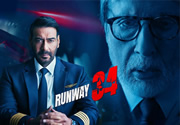
Runway 34
Synopsis:
Honestly, Runway 34 starts off with this insane anxiety-inducing flight turbulence that’ll make you never want to board a plane again, and speaking of bollywood movies, this one really leans into the panic. Ajay Devgn directs and stars as this arrogant pilot who plays by his own rules, and let’s just talk about his sunglasses for a second because he wears these aggressively mirrored aviators indoors, in the dark, during night flights, and honestly who does that while flying a commercial aircraft.
Anyway, back to the plot, we get a flashback or rather we learn that Vikrant is a total Maverick type who loves partying hard, and he’s flying a flight from Dubai to Kochi alongside his co-pilot Tanya Albuquerque, played by Rakul Preet Singh, who is trying her absolute best not to freak out while Vikrant is popping eye drops and acting way too cool for school.
And then things get real bad real fast because bad weather and zero visibility block their planned landing, and they are desperately low on fuel, which is a classic setup you see in tons of other hindi movies, but here it actually feels super claustrophobic and tense.
They don't have enough fuel to make it to their alternate airport, so Vikrant decides to attempt a blind landing on a short runway through thick fog, completely ignoring air traffic control warnings, and it is a total nail-biter.
The plane bounces violently, sparks fly everywhere, passengers are screaming bloody murder, overhead bins are flying open, and everyone is bracing for impact, and boom, right before the interval block hits, they manage to miraculously touch down safely on the tarmac, saving almost everyone onboard.
God, the interval comes right at the moment of the crash landing and it leaves you hanging, which is typical for big theatrical hindi films.
Stuff happens and suddenly the movie completely shifts gears from a disaster survival thriller into a intense courtroom drama, which wasn't on my bingo card.
Enter Amitabh Bachchan as Narayan Vedant, this super stern, ruthless aviation investigator who has zero patience for Vikrant's rebellious attitude, and he sits across from him in these intense inquiry hearings, interrogating every single decision Vikrant made up in the air.
Vedant is wearing this heavy shawl, looking like a disapproving grandfather who will end your entire career with just one single sentence, and trust me, he grills Vikrant relentlessly about why he didn't divert the plane and why he gambled with human lives.
Tanya is cracking under the immense pressure of the investigation, her mental health is completely spiraling, and she’s sweating bullets during her questioning because she knows they broke protocol, even if they saved the day.
Vikrant stays stubbornly defiant throughout the tribunal, refusing to show remorse, and he even smokes a cigarette and acts super casual, which just pisses Vedant off even more.
We get flashbacks to Vikrant's personal life showing he has a drinking problem and makes bad choices, but none of that changes the fact that he literally landed a blindingly foggy plane with zero fuel left.
The tribunal gets more and more aggressive, lawyers are yelling, documents are being slammed down on wooden tables, and Vedant is basically trying to prove that Vikrant's massive ego nearly caused a massive catastrophe.
And then the climax arrives where Vedant runs a flight simulator test to recreate the exact emergency conditions, forcing Vikrant to fly the same impossible landing blind in a controlled environment to prove if it was pure skill or just reckless luck.
Vikrant steps into the simulator, his hands shaking slightly, the red warning lights flash in his face, and he successfully executes the blind landing all over again inside the machine, proving that his split-second dangerous gamble was the only thing that actually worked.
Vedant finally looks at him with a begrudging hint of respect, the tribunal clears Vikrant of criminal negligence though he still faces a temporary license suspension, and Vikrant walks out of the building into the harsh sunlight, takes off his aviators, and looks up at the sky.
Ajay Devgn wears aviators for nearly the entire runtime of Runway 34, and if I am honest, it looks slightly ridiculous in a high-altitude cockpit where the sun is mostly blocked by clouds anyway. But vanity in commercial Hindi movies rarely asks for logical justifications, so we just accept the shades and move into the turbulence. Based on a true incident that made aviation headlines a few years ago, the film splits itself directly down the middle, serving us fifty minutes of white-knuckle disaster cinema followed by two hours of a courtroom inquiry that feels designed to test your bladder capacity. It is a strange structure that lurches from exterior danger to interior bureaucracy without ever finding a comfortable gear to cruise in.
As a director, Devgn has a fondness for digital camera movements that swoop through airplane cabins like angry hornets, tracking crying passengers and flickering overhead lights with aggressive enthusiasm. He wants you to feel the panic in your bones, which is why he constantly tilts the frame and jacks up the volume on the wind noise until your ears ring. The first half moves with a frantic, unsparing energy that recalls the claustrophobic dread of Paul Greengrass's United 93, though Devgn lacks that film's documentary detachment. Instead, he lingers on close-ups of sweat beading on pilot Vikrant Khanna's forehead, establishing him not as an ordinary professional doing a job, but as an ice-veined maverick who treats air traffic control like an annoying suggestion box rather than a safety mandate.
Rakul Preet Singh plays co-pilot Tanya Albuquerque, and she spends the first hour looking terrified while clutching her manual and second-guessing every decision the captain makes. Her performance relies heavily on wide-eyed stares and trembling lower lips, but when the second half kicks in and the legal cross-examination begins, she finds a grounded, nervous intensity that holds the screen against heavier weights. She is the one carrying the actual burden of human error in the cockpit, yet the screenplay frequently pushes her aside so Devgn can engage in a cinematic pissing match with Amitabh Bachchan. It is a dynamic that flattens her character into a pawn.
Then Amitabh Bachchan enters the proceedings as Narayan Vedant, an aviation investigator who looks like he stepped out of a high-fashion thriller with his impeccably tailored suits, scarf, and deep, resonant baritone that could read a phone book and make you feel like you were on death row. He paces around the inquiry room, brandishing a fountain pen like a weapon and speaking in clipped, theatrical sentences designed for maximum impact. Bachchan is undeniably magnetic, but the role requires zero subtlety. He simply glowers at witnesses, drops loaded rhetorical questions into dead air, and acts as the moral compass of an industry that would rather protect corporate balance sheets than admit human frailty. It is a performance that dominates the room entirely, crowding out any genuine tension the legal battle might have otherwise generated.
The cinematography by Aseem Bajaj relies heavily on desaturated blues and aggressive grays during the flight sequences, mimicking the cold sterility of a cockpit during a crisis, before shifting to harsh, theatrical lighting in the tribunal room where every shadow feels deliberately placed. Sometimes the color grading looks like a mid-2000s music video, especially when the film cuts away to slow-motion flashbacks of passengers living their normal lives right before boarding the doomed flight. It is a jarring stylistic choice that pulls you right out of the narrative tension. The background score by Amar Mohile does not know the meaning of an inside voice, booming through every dialogue scene as if ordinary conversation were somehow insufficient to convey the gravity of an aviation tribunal.
There is a recurring needle-drop during the cockpit crisis that returns three separate times, a throbbing electronic beat that tries to manufacture urgency where the acting and editing are already doing heavy lifting. It is a small mechanical thing, but it bugged me every single time it kicked in because it treats the audience like they cannot recognize danger without a persistent bassline telling them to panic. Bollywood movies have a long history of leaning on sound design to prop up dramatic beats, and Runway 34 falls into that trap repeatedly, refusing to let a moment of silence simply exist on its own terms.
Beneath the surface pyrotechnics, the film attempts to wrestle with the slippery nature of accountability in modern systems where pilots are expected to be infallible gods while corporations cut corners on fuel reserves and weather forecasting. Devgn’s character is unapologetically arrogant, breaking protocols because he trusts his own gut over automated readouts, and the movie spends a surprising amount of time indulging his bruised ego. It wants to ask whether breaking the rules is justified if you successfully land a plane in zero-visibility conditions, but it stack-ranks its sympathies so clearly around its leading man that the moral question dissolves into simple hero worship.
The pacing collapses somewhere around the second hour, turning what should have been a taut procedural into a repetitive game of verbal tennis where Bachchan asks a question, Devgn offers a defiant smirk, and the supporting lawyers look on with varying degrees of open-mouthed shock. Hindi films have always loved a good courtroom showdown, but modern writers often forget that legal arguments need procedural friction rather than just grandstanding speeches about duty and honor. When the credits finally roll, you feel less like you have watched a complete dramatic arc and more like you have survived a two-hour lecture on aviation law delivered by a man who refuses to take off his sunglasses indoors.