

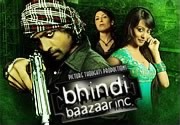
Bhindi Bazaar
Synopsis:
A realistic gripping account of politics set among the dark underbelly of Mumbai pickpockets in the infamous area of "Bhindi Baazaar"....
Like every other commercial organization here too are employees and their designations. They too have field work, administration structure and skill-set, alongside they also have business rivalry; this is a company called Bhindi Baazaar Inc. Here their main trade is to pickpocket. ''Mamu'' is a title of a local mafia-head of Bhindi Baazaar Incorporation, it is a position nobody even thinks to reach, leave aside attempting to be there. Years ago the reigning Mamu snatched it from someone and may be someone has to do the same to be the next, but you never know who it can be, just as you don''t know who your enemy is in the game of Chess, a game where a mere pawn can cross the Chessboard and become a ''Vazir''.
The Film begins with a Game of Chess between ''Shroff'' and ''Darzi'', each move of which unfolds the story which leads to the motive of their meeting. The story unfolds as a quest of a small time pickpocket ''Fateh'', next in line to be Mamu to travel that extra mile and get that position. His fascination with the position and power of name Mamu leads him and his small group of fellow pickpockets and his close friend Darzi through a trail of Betrayals, Revelations, Deceits and Vengeance... but no one gets there clean and though every pawn can be in the run, not every in the Chessboard is destined to be the Vazir. Sometimes the kingmakers use some pieces to reach the ultimate destination.
The conflict takes an ugly turn when the authoritatively regulated world of these small time crooks under Mamu is shaken by a decision of not involving his pickpocket gang for spreading a flu virus through syringes, so that the antidote which is worth crores is put in use, due to which the pharmaceutical company draws rich profits, which gives the rival ''Pandey'' a chance to manipulate Fateh and use him to plan Mamu''s murder. And then begins the streak of betrayals that involved everyone in that world shown through the game of chess and the people through the Chessboard pieces. Nobody in this saga of shady politics is clean, everyone comes out to be mean to their core and have their hidden motives. Every piece in a chessboard has its importance, but when a pawn crosses the whole board and becomes the Vazir it changes the whole structure. This is the story of a pawn and his travel to reach to the other end of the board. This story is of this pawn who manipulates every move so that his way to reach to the top is cleared. This story is about how these small time pickpocket use their intelligence and spontaneity to survive in this mean and political vicinity called Bhindi Baazaar Incorporation.
The Pawn who is sitting in front of Shroff, playing the game of Chess, reveals his quest to reach the position of Mamu, which only Shroff can assign. Shroff is the boss of all and he invite
Shilpa Shukla says a particular line with a flat, half-swallowed consonants kind of delivery that feels less like acting and more like she just walked out of a municipal office in south Mumbai and someone happened to be holding a camera. That specific vocal drop is the only reason to stay awake through the first twenty minutes of Bhindi Bazaar Inc., because otherwise, the movie is trying entirely too hard to look like a lost notebook page from a film school editing bay where nobody knew how to cut back on wide-angle lenses. It sets up its cramped, congested namesake lane with the enthusiasm of a tourist who just discovered a spice market, and if I'm honest, it gets exhausting fast. You have cameras swooping over rooftops like they are looking for a lost drone, tracking petty criminals and corrupt cops and loan sharks who all seem to have practiced their scowls in front of the exact same bathroom mirror.
Director Ananth Narayan Mahadevan has made plenty of commercial Hindi films that came and went without leaving a stain on the culture, and here he is operating with a screenplay by Amit Sangani that treats human trafficking and pickpocketing rings as a series of clever little chess moves played by men in grubby undershirts. The plot revolves around a mentor-student dynamic between veteran street operator Shroff, played by a heavily bearded and perpetually bored-looking Pawan Malhotra, and his eager understudy Mamu, brought to life by Shwetabh Varma with a frantic energy that occasionally crosses into pantomime. They run a syndicate out of a tiny alley where mobile phones are fenced and scams are plotted over lukewarm tea, and their entire operation gets upended when a bag of stolen diamonds enters the mix and starts passing through too many hands too quickly. The trouble is that the narrative structure keeps doubling back on itself through a non-linear timeline that feels less like Quentin Tarantino and more like a jigsaw puzzle where the dog ate three of the edge pieces.
Kay Kay Menon shows up as a rogue cop who exists mostly to smoke cigarettes indoors and deliver dialogue that sounds like it was translated from a cheap paperback thriller found in a railway station kiosk, and he plays the role with his usual half-lidded intensity. He doesn't stretch himself here, but watching him drop into a scene is like watching a professional plumber walk into a flooded basement—he just gets to work without making a fuss about the mess around him. Prashant Narayan, on the other hand, is practically chewing the doorframes as a rival crook with a twitchy eye and a raspy laugh, pushing every scene he is in right up to the edge of farce. That kind of unhinged performance works in something like Murder, where the surrounding pulp can support the madness, but here it floats in a weird vacuum because the film can't decide if it wants to be a gritty social-realist document of urban decay or a flashy pulp noir with colorful lighting.
There is a recurring musical motif involving a street singer and a harmonium that plays every single time someone looks pensively out a grimy window, and it drives you slightly crazy by the third time it drops. The sound design generally suffers from that weird, over-processed boom where every dropped coin sounds like an anvil hitting concrete and every footstep in a muddy alley echoes like a gunshot in a cathedral. The cinematography by Manoj Soni loves a Dutch angle way too much, tilting the horizon whenever two characters argue about money as if the camera itself is getting dizzy from the humidity of the market. You get these long, unbroken takes of characters walking through narrow corridors where the background extras are clearly trying not to stare directly into the lens, and those little cracks in the illusion pull you right out of the grit the production design is working so hard to establish.
Amidst the shouting and the double-crossing, Piyush Mishra wanders through as an old-school ganglord who speaks entirely in rhyming couplets, which is a choice that belongs in a totally different movie—maybe a loud commercial potboiler from the nineties rather than this grungy crime drama. His scenes grind the pacing to a complete halt because every time he opens his mouth, the film stops being a crime thriller and turns into an open-mic poetry night for tough guys. Deepti Naval has a brief, wasted appearance as a grieving mother that feels tacked on simply to give the second half some vague moral anchor, and she plays it with dignity despite having zero room to breathe between the frantic editing cuts. Vedita Gautam and Caterina Lopez show up for an item number that feels obligatory and looks terrible, shot under harsh red lights that make the narrow alleys of the market look like a low-budget music video from midnight cable television.
Hindi movies have a long history of romanticizing the underbelly of Mumbai, turning poverty and crime into a kind of gritty playground for colorful rogues with hearts of gold, but Bhindi Bazaar tries to subvert that by making everyone thoroughly unlikable without actually making them interesting. When Mamu gets betrayed by his own crew, you don't feel a sting of tragedy because the film never establishes what they actually meant to each other beyond a shared fondness for chain-smoking beedis in cramped rooms. The themes of corporate greed versus street-level survival are sketched in broad, crayon-stroke strokes that assume the audience needs a neon sign pointing at the irony of white-collar corruption existing alongside pickpocketing. It wants to say something smart about the commodification of human life in a rapidly modernizing metropolis, but it gets so bogged down in double-crosses and sub-plots about lost briefcases that the social commentary evaporates.
There's a supporting actor playing a corrupt constable who is so obviously dubbed by a completely different person in a studio booth that every time he speaks, his mouth movements and the audio track exist in two separate time zones, and it's a small thing, but it bugged me every single time he appeared on screen. These little technical slips accumulate until the movie starts to feel less like a cohesive vision and more like an edit thrown together over a weekend to clear some contractual obligation before the tax year ended. The climax involves a chaotic standoff in a multi-story parking lot where nobody's spatial geography makes any sense, bodies dropping off balconies while the surviving characters exchange final dialogue that gets swallowed by the terrible sound mix. It ends on a sour, cynical note that feels earned only in the sense that you are equally glad to finally leave the theater.