

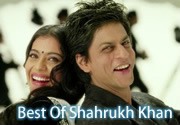
Best Of Shahrukh Khan
Synopsis:
Halfway through the video compilation known simply as Best Of Shahrukh Khan, he's wearing this completely ridiculous green leather jacket with neon yellow zippers and he's singing at the top of his lungs on a snowy mountain while backup dancers in puffy pink parkas try desperately not to slip on the ice, and honestly I couldn't look away from that one zipper that kept flapping against his collar for three straight minutes because it wasn't even zipped up right and you could tell the stylist just threw it on him right before the cameras rolled. But to understand why he's freezing his butt off in the Swiss Alps wearing discount outerwear, you have to look at how this whole journey started, which goes back to the early days when he was just taking over the entire landscape of modern bollywood movies by playing the ultimate antihero in thrillers where he's totally obsessed with Kajol and staring way too intensely through car windows, and then suddenly he's sprinting through train stations in Dilwale Dulhania Le Jayenge to catch Preity Zinta or Kajol again, because let's be real, his romantic chemistry in all these classic hindi films is basically the blueprint for every single cheesy love story that came after. So then we jump forward to the absolute peak of the 90s where he's doing the iconic arm-spread pose in like twenty different songs, and the pacing of the video just goes completely bonkers, cutting from a dramatic rain sequence where he's wearing a drenched black shirt to a totally random comedy number where he's dancing with a bunch of kids in oversized yellow raincoats. Right after that, the movie or whatever you want to call this two-hour music video blast just completely glosses over his entire dramatic phase and dives headfirst into Chak De! India territory where he's screaming at a hockey team and blowing a whistle, and you barely even have time to process the sports drama before he's back in a fancy suit doing the lungi dance with Deepika Padukone. The funny thing is, you start noticing these tiny recurring details across all these decades of hindi movies, like how he always does this thing where he touches his nose with his index finger right before the chorus drops, or how he somehow manages to look deeply brooding even when he's wearing polka-dot shirts and riding a bicycle through a field of yellow mustard flowers. It's just non-stop energy from start to finish, and even when the video drops in some lesser-known track from a flop that nobody remembers, he's still giving it one hundred percent commitment, running down alleys and leaping over vintage cars like he's auditioning for an action movie instead of a sappy romance. He just doesn't stop.
Anyway, after you sit through about forty-five minutes of pure nostalgia hits that define the golden era of bollywood, the compilation shifts gears into the late 2000s where everything gets super glossy and digital-looking, and Shahrukh Khan is suddenly surrounded by giant CGI spaceships and flashing neon lights in Ra.One, which was a wild pivot considering he spent the previous decade mostly rolling around in the grass with Madhuri Dixit. The clothes get tighter, the hair gets slicker, and the dance moves involve way more backup dancers wearing metallic silver bodysuits that probably cost a fortune to make. You're sitting there watching him dodge laser beams and punch robot stuntmen while trying to lip-sync a high-tempo club track, and it's just so vastly different from the simple porch-sitting acoustic guitar ballads of his earlier career, but he pulls it off with that same goofy grin he's been using since television days. And then the video just abruptly tosses in a melancholic ballad from Kal Ho Naa Ho where he's standing on a New York City street corner in a heavy trench coat looking all sad and terminal, and the mood whiplash is so intense you almost drop your popcorn. He looks right into the camera and delivers that classic line about living every day to the fullest, and it hits you that this guy has literally soundtracked three generations of heartbreak and weddings across the entire globe. He’s running through airports again.
The final stretch of the video compilation goes completely off the rails because whoever edited this thing decided to sequence the last ten songs purely by how loud the bass drops are, which means you get modern chartbusters mashed right up against vintage 90s dancetracks with zero breathing room in between. Shahrukh Khan is suddenly doing the tango in a crowded ballroom, then he's shirtless on a beach flexing for the camera while fire dancers spin torches behind him, and honestly the sheer physical stamina required to jump between all these different eras of fashion and choreography is kind of staggering. He slides across the polished marble floor of a palace, winks directly at the lens as the credits start to roll over the bottom corner of the screen, and gives one last trademark bow before the video fades to black.
The audio mix on the third track drops the treble so hard that the bass rattles my laptop speakers, which shouldn't happen with a digital release in this decade. If I'm honest, nobody goes to a compilation reel expecting Dolby Atmos perfection, but there is a baseline of basic frequency separation that gets lost the second the strings swell on Tujhe Dekha To. That specific compression artifact stays through the entire runtime of Best Of Shahrukh Khan, a sprawling assemblage of video songs that plays less like a cohesive narrative feature and more like someone emptied a vault of 35mm prints onto a hard drive and hit shuffle. You sit there watching a man age backward and forward across twenty years of Hindi movies, jumping from the rain-soaked terraces of early romances to the green-screen expanses of later blockbusters without so much as a title card to anchor the chronology. It is a messy way to watch cinema. Yet it forces you to look at continuity in a totally different light because the cuts happen not between scenes in a script, but between entirely different directors, cinematographers, and eras of popular taste. You notice how lighting styles shift from the soft-focus romanticism of Dilwale Dulhania Le Jayenge to the high-contrast digital gloss of standard modern Bollywood releases without the benefit of a gradual transition. The editing rhythm is dictated purely by the beat of the tracks, meaning you get forty-five edits in thirty seconds during an upbeat dance number, followed by a static wide shot that holds on a single wind-swept coat for ten agonizing seconds because the song requires a long vocal sustained note. It makes you realize how much editorial heavy lifting is normally done by dialogue scenes that are entirely missing here.
Shahrukh Khan carries every frame of this thing with a physical vocabulary that is so thoroughly ingrained in the global consciousness that it has almost stopped looking like acting and started looking like weather. Watch the way his shoulders drop when he leans against a fence in Chhaiya Chhaiya compared to the stiff, armored posture of his action numbers. The guy knows where the lens is at every single microsecond, tilting his chin up just enough to catch the rim light even when he is supposedly lost in a moment of utter despair or romantic reverie. It is a performance split across fifty different character names who are all essentially the same guy, a romantic archetype running on diesel and charisma. When placed alongside his work in My Name Is Khan, these musical sequences feel lighter, almost frictionless, lacking the heavy moral gravity of dramatic features but retaining that same intense focus in the eyes. That focus is his superpower. He can be standing on top of a moving train or in the middle of a crowded London street, and the background literally dissolves the second he drops his gaze and looks straight down the barrel of the camera. The supporting actors in these videos mostly function as human props, though you occasionally spot a familiar face from mid-tier Hindi films who looks slightly terrified to be sharing a frame with an actor operating at five thousand volts of sheer star power. It is a strange kind of acting showcase where emotional range is measured entirely by how fast he can open his arms without looking ridiculous.
The cinematography here is a historical record of how digital grading ruined the warmth of Indian celluloid. The earlier tracks captured on film stock have a grain and texture that breathes, letting dust motes dance in shafts of studio sunlight while the later digital captures look entirely scrubbed of friction and life. You can pinpoint the exact year the industry abandoned physical film stocks just by looking at the skin tones, which suddenly shift from organic amber to a flat, orange-tinted digital wash that makes every outdoor location look like a theme park ride. The soundtrack, naturally, is a greatest hits collection of composers who defined an entire generation of pop culture, though hearing them back-to-back without the breathing room of plot development turns the lush orchestration into an auditory assault. It is a wall of sound that never drops below a roar. Even the quiet, melancholic moments feature a persistent string pad lurking in the background just in case you forgot you were supposed to feel something profound. I found myself getting distracted by a recurring visual tic in the choreography where the background dancers are clearly looking at their feet to catch the beat instead of maintaining eye contact with the lead, a small mechanical detail that once noticed becomes impossible to unsee.
Beneath the surface gloss, the underlying theme of these selected songs is the evolution of the Indian lover from a rebellious outsider fighting family hierarchy to an international jet-setter whose primary conflict is internal alienation. The earlier tracks are all about trespassing—climbing walls, defying fathers, running through wheat fields against the explicit wishes of society. By the time you reach the later tracks, the fences are gone and the spaces are entirely virtual, leaving the character to pine against digitally rendered backdrops that feel strangely weightless. It reflects a massive shift in how urban audiences view romance, trading the sweat and dirt of rural and semi-urban settings for sleek airport terminals and glass-front penthouses. The women in these songs shift accordingly, moving from stubborn partners in rebellion to glamorous accessories who exist primarily to validate the hero's emotional depth. It is fascinating to watch this ideological migration happen in fast-forward, compressed into a two-hour music video marathon that skips all the boring dialogue scenes where characters actually have to explain why they are crying. There is no argument about tradition versus modernity here; the modernity won, and it brought a very expensive lighting rig with it.
By dropping any pretense of narrative and just feeding the audience pure kinetic sugar, this compilation highlights the sheer endurance of the star vehicle format in a way that standard narrative features rarely manage. You are left with the distinct impression of an actor who completely understood the assignment of global stardom long before the industry had the infrastructure to support it. The editing might be lazy and the audio compression might make your teeth itch during the high-frequency vocal runs, but the sheer gravitational pull of the lead performance remains entirely undeniable right up until the final fade to black.