

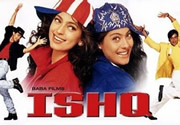
Ishq
Synopsis:
Madhu is literally shrieking in absolute horror while hanging for dear life from a rusty construction crane hundreds of feet in the air because things have gotten completely out of hand in 1990s bollywood movies. Okay wait let me actually back up for a second because Ishq is this wild 1997 romantic drama starring Aamir Khan, Ajay Devgn, Juhi Chawla, and Kajol that starts off as a totally cute rom-com before morphing into an unhinged revenge thriller involving forced abortions and attempted murder.
Let us look at how it begins with Raja who is the mega-wealthy son of industrialist Ranjit Rai, and then we have Ajay who is played by Ajay Devgn and he is this poor mechanic named Ajay who hangs out with Raja because rich-poor friendship tropes are mandatory in hindi films.
Madhu and Kajal show up and they are played by Juhi Chawla and Kajol respectively, and honestly Madhu is poor while Kajal is rich, so Raja and Madhu fall in love while Ajay and Kajal fall in love, which is pretty standard until the parents find out and lose their absolute minds.
Ranjit Rai and Amarish Puri playing Madhu's evil dad Thakur are both obsessed with class status and they refuse to let their kids marry people from the wrong side of the tracks, so they hatch this elaborate, ridiculously cruel scheme to fake a pregnancy and destroy the relationships from the inside out.
And then boom, right before the interval block hits us like a freight train, all the couples are completely torn apart by these vile lies, and people are crying in the rain, and there's that random song where everyone is dancing on a boat that completely derails the emotional tension right when things were getting good.
Seriously, why do nineties hindi movies always drop a bouncy dance number right after a character gets disowned by their parents?
Anyway, post-interval is where the movie completely throws out the romance playbook and goes full horror-thriller mode.
Ranjit and Thakur realize their kids are still trying to be together, so they lock Madhu in a room and try to literally force her to have a medical procedure to terminate a fake pregnancy, and Ajay and Raja have to bust in there and fight off a whole army of goons in a dusty abandoned mill.
There is this one background extra wearing a neon yellow sweater during the big fight scene who just stands by a pile of bricks and does not move for three whole minutes while Ajay Devgn is beating up henchmen with a lead pipe, and I cannot stop thinking about him.
The villains get completely desperate, planting car bombs, hiring assassins, and setting up traps left and right because they would rather murder their own children than let them marry outside their tax bracket.
We reach that crazy climax on the high-rise construction site where Madhu is dangling from the crane, and Sadashiv Amrapurkar's villainous character is laughing maniacally while trying to cut the rope.
Raja and Ajay leap across scaffolding like parkour athletes while dodging falling concrete slabs, and honestly the stunt work here is way more intense than anything else in the entire runtime of the film.
The evil dads finally realize the sheer scale of their own monstrous cruelty when they almost watch their kids fall to their deaths, leading to this massive tearful redemption moment where everyone hugs it out in the dirt.
Raja pulls Madhu back onto the solid steel beam just as the police sirens wail in the background, and the whole crew embraces while the camera pans up to the sky.
Juhi Chawla wears a hat in the second half of Ishq that looks less like a costume piece and more like an emergency measure to keep pigeons from nesting on her head, and if I am honest, that millinery choice distracted me through a crucial confrontation about class and wealth. Hindi movies of the late nineties operated on a logic of hyper-saturated melodrama where subtlety was treated like a communicable disease, which is perhaps why Indra Kumar’s direction feels less like storytelling and more like being yelled at by an enthusiastic uncle at a wedding. There is no middle gear in a film like this, just a frantic idle that shakes the dashboard until your teeth ache. The screenplay by Tanvir Khan and Ishraque Ahmed takes two standard-issue romantic tracks and smashes them together with the subtlety of a falling safe, dividing the world cleanly into scheming millionaires and salt-of-the-earth mechanics who communicate exclusively through virtuous close-ups.
Ajay Devgn spends most of the runtime looking like he has just been informed his car has been towed, which turns out to be precisely the right energy for a rich kid whose conscience is suddenly interfering with his inheritance. Aamir Khan plays the opposite pole with a manic grin that threatens to unhinge his jaw, bouncing around the frame like a pinball fired by pure mischievousness before the second-act tragedy drags him down into the mud of pure, unadulterated suffering. They have a chemistry that works precisely because they are entirely different acting organisms, Devgn all heavy-lidded stillness and Khan all elbows and rapid-fire dialogue delivery. Yet the supporting players are often left to twist in the wind by a camera that refuses to let anyone breathe for more than two seconds without cutting to a reaction shot that lingers just a fraction of a beat too long, as if afraid the audience might have missed the emotion. I found myself staring at Sadashiv Amrapurkar’s wig in scene after scene, wondering if it was rented or owned, because the movie gave my brain so little actual narrative friction to chew on.
There is an awkward stiffness to the way Anu Malik’s soundtrack bursts into the room without knocking, forcing characters to start sprinting through gardens in Switzerland before you have even processed that they changed jackets. The choreography has that specific late-century Bollywood desperation where thirty dancers in identical silver vests appear behind the lead actors out of thin air, though Chawla manages to anchor the musical numbers with a kind of kinetic joy that survives even the most punishingly bright lighting. Cinematographer Baba Azmi points the lens straight at the actors’ foreheads and leaves it there, capturing every bead of sweat during the emotional confrontations with a flat, television-movie brightness that makes the high-end sports cars look like plastic toys from a department store. It reminds me of Raja Hindustani in its complete lack of visual texture, substituting saturated primary colors for actual atmosphere every single time the budget allowed for another crane shot.
Class warfare in this universe is reduced to cartoon villainy, with Dalip Tahil and Mohan Joshi barking orders from leather armchairs while wearing silk robes that practically scream tax evasion. The rich are uniformly terrible human beings who spend their afternoons plotting how to ruin the lives of poor mechanics, and the poor are so relentlessly noble it makes you want to donate a sack of cynical realism to the local village council. That rigid binary drains the stakes from the central romance, because you never doubt for a second that love will conquer all if only the background score can get loud enough to drown out the plot holes. When Madhu and Ajay finally face off against their respective patriarchs, the dialogue sounds like it was translated from a pamphlet on labor rights distributed outside a textile mill in 1974.
What keeps the whole enterprise from sliding entirely into self-parody is the sheer, undeniable wattage of its stars, who sell this ridiculous material with a straight-faced commitment that borders on heroic. When Khan has to weep over a hospital bed, he doesn't hold back, crying actual snot-bubble tears that make you forgive the three terrible comedy sketches involving Johnny Lever that preceded the scene. It is a messy, loud, exhausting piece of commercial filmmaking that refuses to let the viewer sit in silence for even a moment, punctuating every minor plot development with a thunderous percussion hit on the soundtrack. You leave the theater with a slight headache and the distinct feeling you have just been through a very loud car wash, but at least the brushes were clean.