

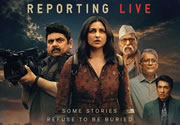
Reporting Live
Synopsis:
Anika Varma works as a television journalist stationed in a metropolitan newsroom, where she consistently covers breaking news events. During a high-profile assignment, Anika receives information regarding a looming security threat that demands immediate public attention. She attempts to broadcast this intelligence, but editorial superiors at the station suppress her report to protect corporate interests. Anika discovers that the information involves a clandestine operation spearheaded by a corrupt government official named R. K. Shastry. While searching for corroborating evidence, Anika encounters a whistleblower named Vikram, who possesses physical files detailing the illicit financial movements of Shastry. Anika and Vikram meet in a public park to exchange the documents, but they find themselves pursued by surveillance teams working for Shastry. A field producer named Mohan attempts to assist Anika by smuggling the files out of the city via a freight train, but Mohan is intercepted and detained by security personnel at the station terminal. Anika gains unauthorized access to a live satellite feed during a peak viewership hour. She bypasses the primary control room and initiates a broadcast of the gathered evidence while stationed inside the transmission bunker. Security forces surround the facility and cut the building's main power supply in an effort to terminate the transmission. Anika uses a secondary emergency generator to maintain the signal for several minutes, revealing the connection between Shastry and the sabotage of the city’s primary infrastructure projects. Law enforcement officers arrive at the studio to place Shastry under arrest after the broadcast reaches the public. Anika leaves the newsroom once the transmission ends, while the remaining files are transferred to a national investigative agency for further legal review.
The sound mix in the opening sequence is slightly off, favoring the ambient city noise just a hair too much over the initial dialogue, and honestly, it took me nearly ten minutes to stop leaning forward in my seat trying to catch every stray syllable. It is a small thing but it bugged me, this slight technical unevenness that haunts the edges of Reporting Live. You watch Deven Bhojani pace a cramped newsroom, his hands betraying a frantic energy that feels earned, and you wonder if the film knows whether it wants to be a frantic procedural or a slow-burn character study. The screenplay pushes for both, often within the same scene, forcing the actors to navigate sudden tonal shifts that would make a less experienced cast crumble under the weight of the conflicting directions.
Saswata Chatterjee enters the frame like a man who hasn't slept in a week, and frankly, he’s the best thing in the whole mess. He plays the cynical veteran with a kind of weary grace, echoing the grounded, lived-in intensity he brought to his turn in Kahaani, though here he is given much less room to breathe. When he stands opposite Parineeti Chopra, the screen crackles with a tension that isn't explicitly written on the page but exists in the way they refuse to look at each other during the quieter moments. She carries the bulk of the film's emotional labor, portraying a journalist caught in a grinder of corporate interest and personal ethics. There are times when her performance feels almost too quiet for the surrounding chaos of the plot, a soft hum amidst the screeching tires and shouting matches that define the third act.
The cinematography leans heavily into desaturated blues and harsh fluorescent lighting, an aesthetic choice that makes the office environment feel like a purgatory of flickering screens and stale coffee. It’s effective, sure, but it gets a bit repetitive once we hit the midway point. There is a specific zoom effect used during a high-pressure interview sequence that feels like it belongs in a different, much cheaper kind of Hindi movie. I kept waiting for the camera to settle down, to just let the human faces carry the weight of the scene instead of relying on these restless, jarring movements that serve only to remind you that a lens is present. The soundtrack mirrors this restlessness, oscillating between a throbbing, synth-heavy score that threatens to drown out the character beats and sudden, jarring patches of complete silence.
The film grapples with the hollow nature of modern news cycles, a theme that feels increasingly relevant even if the delivery here is a bit on the nose. We see the way the truth is chopped up, packaged, and discarded, a process that is mirrored in the erratic editing of the film itself. The script wants us to feel the desperation of the truth-teller, yet it spends so much time obsessing over the mechanics of the broadcast that the characters sometimes feel like footnotes in their own story. It is a cold, calculated look at how we consume tragedy, though it lacks the sharp edge required to make the critique feel dangerous. It’s not great, not bad, just there, floating in the middle of a genre that has seen much more biting satires over the last decade.
There is a recurring shot of a broken clock on the wall of the studio that I suspect is meant to be a heavy-handed metaphor for frozen time, but it just looks like a set decorator forgot to fix the prop. It’s the kind of detail that pulls you right out of the narrative. You want to focus on the moral dilemma facing our leads, but instead, you are staring at a clock face that hasn't moved for three hours of screen time. It reflects the broader issue with the direction, which occasionally prioritizes style and vague gestures toward meaning over the nuts and bolts of a coherent story. You can see the ambition in the performances, particularly when Bhojani decides to drop the nervous tics and just talk, showing us a flicker of the person behind the desk.
Bollywood often struggles when it attempts this level of cynical realism, usually gravitating back toward melodrama or grand moral declarations by the time the credits roll. Reporting Live manages to sidestep the worst of those cliches, keeping the stakes localized and the resolutions messy. The final scene, which denies the viewer a clean moral victory, feels like a necessary corrective to the overblown dramatics of typical Hindi films. It doesn't offer a catharsis, which is a brave choice in a commercial landscape that usually demands everyone go home happy or at least vindicated. The lack of a tidy conclusion is the most honest thing the film does, even if the road getting there was paved with shaky pacing and a few too many lingering reaction shots of the background extras.
Watching Chopra navigate the latter half of the film, you see the exhaustion of her character bleed into her physicality, the way her shoulders slump when the cameras finally cut. It is a precise piece of acting that suggests she understood the script’s limitations better than anyone else involved. She stops playing the high-energy reporter and starts playing a tired human being, and the movie is infinitely better for it. If I'm honest, the entire middle section could have been trimmed by twenty minutes without losing a single meaningful plot point. Those long, drawn-out sequences of technical troubleshooting do nothing to advance the character arcs. They just fill time until the next confrontation occurs.
The supporting cast gets very little to do, mostly relegated to standing in the background and looking stressed, which feels like a waste of the talent on display. I kept waiting for someone to break the mold, to provide a moment of levity or genuine surprise, but everyone stays locked in their assigned lane of agitation. It contributes to a sense of suffocating narrowness that defines the visual language of the project. You are trapped in this newsroom, watching these people slowly disintegrate, and the film refuses to let you out until the final frame cuts to black without any fanfare or lingering resolution.