

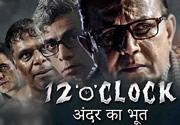
12 O'Clock
vcdSynopsis:
Let us back up for a second because 12 O'Clock is a totally bonkers psychological thriller from the legendary Ram Gopal Varma and it really doesn't care about your traditional bollywood formulas at all.
The movie stars Mithun Chakraborty as a high-powered police officer who has to deal with his family going completely off the rails.
Everything starts normally enough when a young girl named Gauri starts seeing ghosts and acting totally possessed after visiting a spooky old tree, and her parents are just losing their minds trying to figure out if she's losing her sanity or actually dealing with supernatural spirits.
Dalip Tahil shows up as some skeptical doctor or authority figure, I can't even remember his exact title because I was too distracted by this one background extra who wears the most hideous neon green sweater in every single hospital scene, and he's just staring blankly at the wall while terrible tragedy unfolds around him.
Stuff happens and Gauri's behavior gets so violent that she's throwing heavy furniture across the room and screaming obscenities in a deep manly voice, and her poor parents are crying buckets of tears while holding each other in the living room.
Mithun Chakraborty enters the picture as a tough-as-nails cop who is brought in to investigate the bizarre occurrences, and he plays the role with this intense, deadpan stare that makes you wonder if he's about to solve the case or just fall asleep standing up.
And then boom, we hit the interval point right when Gauri levitates three feet off the bed and screams at the top of her lungs while lightning flashes outside the window, which is such a classic trick used in many spooky hindi movies to make you buy more popcorn.
After the break, the plot just races forward at a million miles an hour and we find out that the evil spirit possessing Gauri is actually the ghost of a brutally murdered serial killer who wants revenge on everyone involved in his trial.
Makrand Deshpande plays this super creepy exorcist or holy man or whatever who gets called in to handle the supernatural entity, and his performance is so over-the-top with his wild hair and bulging eyes that you honestly cannot look away from the screen.
He starts chanting weird mantras and throwing holy ash everywhere while Gauri thrashes around on the floor, and the editing gets super choppy with flashing strobe lights that will probably give you a mild headache if you're watching in a dark room.
Characters are running down dark hallways, doors are slamming shut by themselves, and Mithun Chakraborty is drawing giant protective circles on the floor with chalk while barking orders at terrified subordinates.
Hindi films usually love to throw in a random romantic song or a dance number right when the tension peaks, but thankfully this movie spares us from any awkward musical breaks and just keeps hammering away at the spooky ghost business until your nerves are completely fried.
The climax involves a massive showdown in the haunted house where the possessed girl tries to choke her own mother, and Makrand Deshpande has a big wrestling match with the invisible demon while shouting dialogue that sounds like it was recorded inside a metal bucket.
Mithun Chakraborty raises his service revolver, shoots straight at the phantom force possessing the room, the spirit finally gets sucked back into the netherworld with a loud vacuum cleaner sound effect, Gauri collapses unconscious onto the dusty floor, and the credits instantly roll on a black screen.
The sound mix on the opening reel of 12 O'Clock is weirdly hot right around four thousand hertz, making every sharp consonant sound like glass hitting linoleum. Ram Gopal Varma has spent the last decade or two chasing digital ghosts with consumer-grade cameras and lighting setups that look entirely abandoned by anyone who cares about shadow detail, but occasionally he still stumbles into a compositional choice that feels like actual cinema instead of a rich man's home video. You sit there in the dark waiting for the usual cheap jump scares to start popping off like wet firecrackers, only to realize the movie is trying something much quieter and much more annoying with the space inside these rooms. It is a horror film about possession and family trauma, though if I'm honest, it often resembles a protracted real estate dispute where someone happened to bring along a Ouija board.
Mithun Chakraborty plays a police officer named Debabrata, and he looks tired in the way that people who have stopped arguing with their accountants look tired. He does not storm around the interrogation rooms barking orders the way Bollywood cops traditionally do when the script demands immediate energy, choosing instead to lean against doorframes and squint at paperwork as if he suspects every suspect is lying about their taxes. There is a specific kind of low-key exhaustion he brings to the procedural scenes that almost saves them from the clunky dialogue, though you can tell he is operating on autopilot for at least half his close-ups. Opposite him is Makrand Deshpande, playing a psychiatrist who talks in that deliberate, theatrical whisper actors use when they want you to know they are reading from a heavily revised draft of the scene. Deshpande's entire performance consists of looking intensely through thick spectacles and pausing for three beats before delivering lines about repressed memories and supernatural frequencies, which gets old long before the intermission roll.
Dalip Tahil shows up as an authoritarian father figure, and his mustache is so heavily pomaded it commands its own quadrant of the widescreen frame. The supporting cast includes several younger actors who are clearly dubbed by people with very little voice acting experience, creating a jarring disconnect between the physical performance on screen and the flat audio track floating over the top of them. This kind of post-production sloppiness used to be standard operating procedure for low-budget Hindi films, but here it feels particularly grating because Varma tries to stage so many scenes in near-silence, forcing you to listen to the mismatched room tone instead of getting lost in the narrative.
The screenplay feels like it was written on a napkin during a long lunch and then shot without a second pass on the continuity notes. Characters walk into rooms they just left from, plot points regarding the daughter's psychological decline are dropped for twenty-minute stretches while the police commissioner discusses jurisdiction issues, and the supernatural elements arrive with all the narrative grace of a falling anvil. It reminds me a bit of Ram Gopal Varma's earlier factory-floor thriller Darna Mana Hai, except without the structural safety net of an anthology format to keep the pacing from sagging into a swamp. Varma relies endlessly on Dutch angles and quick-zoom reaction shots that would have looked dated in a music video from 1998, let alone a feature film released deep into the digital era.
There is a recurring musical cue involving a distorted music box that plays whenever the haunted girl starts rolling her eyes, and someone on the sound design team decided it needed to be used forty-seven times by actual count. You start dreading the music box more than the ghost, which might actually be a clever psychological trick if we were dealing with a filmmaker who understood irony instead of just hammering the same button until the spring snaps. The lighting throughout the house is supposed to feel oppressive and claustrophobic, but it mostly just looks like the dimmer switch on the wall was stuck halfway between amber and sickly green.
Despite all the technical shortcuts and narrative dead ends, the movie occasionally hits a strange, hallucinatory rhythm during its third act that almost makes up for the slog of the first hour. When the possession finally goes fully physical, the practical effects team pulls off a few genuinely unnerving contortions that owe less to standard ghost stories and more to the body horror of a David Cronenberg picture, complete with wet squishing sounds that linger in the mix long after the camera has panned away to a terrified relative.
Hindi movies have a long and storied history of treating the supernatural as a moral playground for conservative family values, and 12 O'Clock fits neatly into that tradition while occasionally trying to bite the hand that feeds it. Debabrata's investigation is less about finding the truth and more about restoring domestic order to a household that dared to buy an expensive apartment in a questionable neighborhood. The final scenes refuse to offer the clean catharsis you expect from commercial cinema, leaving the characters stranded in a hallway while the credits roll over a pitch-black screen with no musical sting to tell you how to feel.