

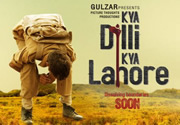
Kya Dilli Kya Lahore
Synopsis:
Picture Vijay Raaz screaming his lungs out at Manu Rishi over a rusty old trunk while some random cricket commentary blares from a transistor radio that shouldn't even be picking up a signal in the middle of nowhere, which is honestly just a typical Tuesday afternoon if you are watching obscure indie hindi movies that completely skip the usual song and dance routine.
So anyway, to understand why these two guys are ready to murder each other over a cardboard box in 1948, we gotta go back to the start where we meet Samarth Pratap Shastri, played by Vijay Raaz, who is an aging Indian army cook living a pretty miserable life in a dilapidated old haveli right near the newly drawn border, and he's basically just muttering to himself and cleaning vegetables while dreaming of the good old days in Lahore before everything went completely sideways.
Right after that, enter Manu Rishi as Rehmat Ali, a Pakistani soldier who sneaks into this exact same abandoned property looking for shelter, and they both realize they used to live in the exact same Lahore neighborhood before the Partition tore the country apart.
They spend the next twenty minutes arguing about petty neighborhood gossip, who owned which sweet shop, and whose mother made better biryani, which is funny because bollywood movies usually give us high-octane action right away, but here we just get two middle-aged men bickering like old married couples over a cup of chai.
The cinematography here focuses way too much on this stupid cracked teacup that Rehmat keeps holding in his left hand, like there is a whole three-minute close-up of just his thumb rubbing a chip on the rim while he complains about the weather, and honestly I could have lived without seeing the ceramic texture in such vivid detail, but whatever, the director really wanted us to feel the dust of Partition.
Then out of nowhere we hit the interval point and you are sitting there eating your popcorn wondering how the heck these two are gonna fill another hour without killing each other, and you almost miss the classic trope where a random background extra walks past holding a stray goat for literally no narrative reason whatsoever.
So then the second half kicks off and the tension actually ramps up because they find out they are not just random strangers from the same zip code, but their lives are tangled up in some heavy emotional baggage regarding a woman named Ishwari whom they both left behind in the riots.
Raj Zutshi and Vishwajeet Pradhan show up briefly to complicate the border patrol situation, yelling a bunch of angry dialogue about borders and passports and national pride, and Vijay Raaz delivers this killer line about how borders are just lines drawn on paper by idiots who never had to pack their belongings in a pillowcase.
The shouting gets louder, the emotional wounds are ripped wide open, and you realize that Kya Dilli Kya Lahore is less about the politics of two nations and more about two traumatized guys who lost their home and have nowhere left to run.
They drop all the tough guy act and start crying together on the floor of the ruined courtyard, hugging each other while the radio keeps crackling away in the background with news bulletins about refugees and train delays.
They finally decide to drop their weapons, pick up their respective bags, and walk away in opposite directions toward their respective countries as the sun dips below the horizon, leaving the dusty courtyard completely empty.
Vijay Raaz wears a British-era army greatcoat that looks three sizes too heavy for his frame, and honestly, the way he drags his left boot through the dirt in the first ten minutes establishes the whole weather of the picture. Partition dramas usually arrive dressed in velvet and soaked in artificial rain, screaming about history from the back benches of a loud studio floor, but this thing starts with two men yelling across a ditch over a pair of boots. If I'm honest, the sound mixing in that opening stretch has this weird, boxy rattle that makes every footstep sound like someone dropping empty cardboard boxes onto a wooden stage, which bugged me right up until the point where the dialogue actually kicked in and made me forget about the technical floors. Bollywood movies rarely trust silence for more than three seconds before some synthesized sarangi starts weeping to tell the audience how to feel, yet here the landscape is mostly just dry grass and abandoned railway sleepers stretching into a flat horizon.
Vijay Raaz plays a Pakistani soldier guarding a ramshackle post in the middle of nowhere, and Manu Rishi is the Indian counterpart hiding in the opposite trench across a scrap of disputed wasteland. They spend the first hour insulting each other's mothers, spitting out regional slang, and arguing about cricket scores with the petty venom of two neighbors fighting over a shared fence. There's none of that theatrical nobility that ruined half the emotional beats in 'Gadar: Ek Prem Katha'; these characters are small, petty, cold, and entirely exhausted by the uniform they wear. Manu Rishi writes his own dialogue here, and the cadence has this specific Delhi street-corner bite that doesn't sound like a screenwriter sat at a mahogany desk for six months trying to win an award. Raj Zutshi and Vishwajeet Pradhan show up later in brief, fragmented sequences that puncture the two-man claustrophobia just enough to remind us that a whole war is happening off-screen while these idiots argue about old restaurant menus in Lahore.
Direction-wise, actor-turned-director-turned-actor-again Vijay Raaz keeps the camera locked into low, dusty angles that trap the actors in a baking trench of their own making. The lighting doesn't do anything clever with shadows or symbolism; it just beats down relentlessly from a washed-out sky until everyone is sweating through their greasepaint. There's a supporting actor who plays an older camp cook or runner near the midpoint whose ADR work is so aggressively detached from his lip movements that I kept checking to see if I had accidentally hit the wrong audio track on my remote, a distracting little mechanical flaw that breaks the illusion of reality every time he opens his mouth.
The central conceit relies entirely on whether you can buy into two mortal enemies sitting around trading insults for ninety minutes without shooting each other, which sounds like a standard theater exercise dragged out onto 35mm stock. But the film avoids turning into a political lecture by keeping the scope relentlessly small, focusing on bad teeth, old tea recipes, and the specific way a certain brand of Lahore biscuit tastes compared to something you buy in Chandni Chowk. Hindi cinema has spent decades treating the partition of the subcontinent either as a grand romantic tragedy or an excuse for massive pyrotechnics, completely ignoring the sheer bureaucratic absurdity of two guys being told overnight that they are suddenly foreign nationals.
There's a subtle musical score by Jaideep Sahni and others that stays remarkably out of the way, preferring the sound of dry wind over sweeping orchestral strings, which keeps the tone grounded even when the script dips into mild sentimentality near the finish line. That rare breed of low-budget Hindi films that actually respects the audience's intelligence usually dies a quiet death on a Tuesday morning with twelve people in the theater, and this one deserved a much louder crowd than it got back when it originally dropped. The camera lingers a beat too long on a reaction shot of Manu Rishi chewing on a dry piece of flatbread, capturing a tiny, exhausted squint that tells you everything about the character's life before the border ever shifted.