

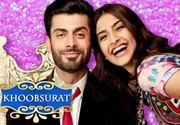
Khoobsurat
Synopsis:
So there is Fawad Khan wearing a crisp royal coat and looking completely annoyed while Sonam Kapoor is just doing star jumps in the middle of a super formal dinner party in Rajasthan and shouting something about living life king-size and honestly I still laugh thinking about it. But to understand why everyone looks like they want to crawl into a hole and die right there, we gotta go back to the start where we meet Dr. Mili Chakravarty who is this chaotic physiotherapist for the Indian Premier League cricket team, which is already a wild career path for a rom-com protagonist, and she is just running around screaming and dropping things and drinking tea out of a mug that says something obnoxious.
Her mom Manju, played by Kirron Kher because no desi household in bollywood movies is complete without her yelling about rishtas, is constantly stressing out about Mili not being a proper lady who can sit quietly and behave. Right after that whole introduction, Mili gets shipped off to the royal palace of Rathore because the patriarch Shekhar needs his legs fixed, and this is where the movie really kicks into gear. The palace is basically a museum of misery run by the terrifying Queen Nirmala Rathore, played by Ratna Pathak, who hates fun and enforces rules that make boarding school look like a rave.
Fawad plays Vikram Singh Rathore, the stoic royal business guy who wears three-piece suits in the desert heat and never smiles once until like the very end, and he and Mili instantly start clashing over his dad's medical treatment. Mili just walks around the palace in the most aggressively mismatched boho outfits with neon jackets and massive jhumkas, and the background extra playing this one guard with the long mustache and slightly crooked turban in scene four just looks so genuinely confused every time she sprints past him down the royal hallway.
Vikram is engaged to Kiara because high-society hindi films love a stiff arranged match to complicate things, but obviously he starts getting distracted by Mili running around playing basketball with the kids and fixing the grumpy grandpa's knees through sheer stubborn cheerfulness. We hit the interval block right when Mili and Vikram are having this tense argument in the dark library about discipline and joy, and honestly, the song that plays right before the intermission is so wildly randomly placed that you just have to laugh while grabbing your popcorn.
The second half rolls around and suddenly everyone is dancing in colorful ghagras for no reason in a royal courtyard, and then Vikram is riding horses and looking brooding while Mili wears a stunning anarkali that makes the whole internet lose its mind. Right after that massive dance sequence, Vikram gets super jealous because Mili's old friend shows up and flirts with her, which leads to this emotional breakdown scene where Vikram realizes he is totally in love with a girl who puts ketchup on her paratha.
Queen Nirmala finds out about their growing chemistry and absolutely loses her mind, calling Mili a chaotic pest and banishing her from the palace right before the big polo match. Mili goes back to her normal life with her cricket players, looking all sad and wearing boring clothes, and Vikram's life goes back to being miserable and gray.
The funny thing is, the dad gets better anyway because of her physical therapy magic, so the royal family realizes they threw out the best thing that ever happened to them. Vikram finally grows a backbone, leaves his stiff fiancee right at some family gathering, and sprints through the airport or train station or whatever equivalent they use in this royal setting.
Khoobsurat delivers that classic happy ending where Vikram shows up at the cricket stadium on a fancy horse or in a vintage car, sweeps Mili off her feet in front of a cheering crowd of confused athletes, and they share a dramatic cinematic hug while the upbeat title track blasts on the speakers.
Fawad Khan wears a pocket square in this movie that I swear was glued to his jacket because it never shifts an inch during scenes where he is literally running across a polo field. If I'm honest, that level of sartorial stability bothered me more than any plot hole in the third act, mostly because the rest of the film is so delightfully, exhaustingly messy. Let's talk about the Disneyification of the classic Hindi film template, which sounds like the opening line of a term paper no one wants to grade, but it's actually just what happens when you take Hrishikesh Mukherjee's 1980 classic and pump it full of neon lighting and millennial anxiety. Director Shashanka Ghosh doesn't try to recreate the quiet, domestic rhythms of the original. He goes for a candy-coated aesthetic that looks like someone spilled a box of macarons all over a royal courtyard in Rajasthan, which works surprisingly well for about forty minutes before the sugar crash sets in. The screenplay, adapted by Indira Bisht and Juhi Chaturvedi, takes the basic premise of an anachronistic, free-spirited physiotherapist invading a stiff-necked royal household and updates it with enough snark to keep it from drowning in its own fairy-tale logic, though it still trips over its own feet whenever it tries to explain why nobody has fired Sonam Kapoor's character for professional misconduct.
Sonam Kapoor plays Mili, a girl who talks to plants and eats ice cream straight from the tub while wearing high-tops with her salwar kameez, a character type that usually makes me want to throw my notebook at the screen. She leans into the manic energy with such absolute, unhinged commitment that you eventually stop fighting it and just surrender to the sheer volume of her outfits. It's a performance that requires her to be annoying for the first hour so she can be charming later, and she nails the annoying part with terrifying accuracy. Opposite her, Fawad Khan has the much harder job of playing the straight man who is perpetually constipated by duty and family pressure, yet he manages to create actual chemistry with someone who spends most of her screen time yelling about back pain. He does this mostly by doing very little, arching a single eyebrow or letting his jaw tighten just enough to suggest a man who would rather be anywhere else in the world than listening to Sonam Kapoor explain why he needs to loosen his tie. It reminds me of Hugh Grant in Notting Hill, that specific brand of flustered posh exasperation where the charm is entirely located in how hard the actor is trying not to roll his eyes. He is wearing armor in every scene, both literally in the form of three-piece suits and figuratively in his posture, which makes the slow dismantling of his stern exterior actually fun to watch even when the script is telegraphing every single emotional beat three scenes in advance.
The supporting cast is where the film finds its actual anchor, particularly Ratna Pathak as the formidable, emotionally frozen queen mother who looks at joy the way a health inspector looks at unwashed lettuce. She doesn't need big monologues to terrorize her staff; she just stands in a doorway with her pallu pinned immaculately and lets her facial muscles do the heavy lifting. Kirron Kher plays Mili's mother with the exact same shrill, high-decibel Punjabi enthusiasm she has brought to every other movie since Devdas, and while it is certainly typecasting, it is also the kind of comforting, predictable carb loading that keeps the middle of the film from sagging too badly. Aamir Raza Husain brings a weary, understated dignity to the role of the paralyzed patriarch, though his character exists primarily to be wheeled from one dramatic intervention to the next like a piece of high-end furniture. The soundtrack by Sneha Khanwalkar and Badshah hits you over the head with the subtlety of a brass band falling down a marble staircase, recycling the same three club tracks until you start hearing them behind your eyelids, which is fine for the dance numbers but terribly distracting during a quiet conversation in a library. The cinematography by Himman Dhamija loves wide-angle lenses and saturated jewel tones, making the palace look less like a real historical site and more like a high-end destination wedding brochure that has achieved sentience.
Hindi movies have always had a complicated relationship with royalty, oscillating wildly between feudal nostalgia and democratic subversion, and this one sits right in the middle, eating popcorn and texting on a gold-plated smartphone. It wants to critique the suffocating traditions of the aristocracy while simultaneously bathing in the aesthetic luxury of it all, a contradiction that gives the narrative a weird, slippery texture where nobody's politics are entirely clear. The themes of breaking generational trauma through the power of stretching exercises and spontaneous dance routines are inherently ridiculous, yet the film commits to them with such earnest enthusiasm that you almost forget how manipulative the emotional engineering is. The editing by Manish More gets a bit lazy in the second half, relying on reaction shots of Ratna Pathak gasping that linger for just half a beat too long, draining the comedic timing right out of the room before the next line can land. It is a light entertainment that refuses to take itself seriously, which is usually a virtue in this genre, except when it suddenly remembers it has a message about family communication and screeches to a halt to deliver a heavy-handed moral about happiness.
At the end of the day, you are left with a romantic comedy that is far prettier than it has any right to be and considerably dumber than its makers probably intended. Fawad Khan became a star across the border almost overnight because of this project, and watching it now, you can see why the screen presence was undeniable even if the material was just slightly above average television fluff. Bollywood movies have churned out dozens of variations on this exact culture clash between the free-spirited outsider and the uptight rich family, and most of them dissolve into sentimental mush long before the credits roll. This one avoids that fate mostly through the sheer kinetic force of its lead actress refusing to stop moving and its lead actor refusing to crack a smile until the very last reel. It is not an important film, and it certainly won't change the way anyone looks at the romantic comedy genre, but it is breezy enough to survive its own worst impulses and charming enough that you forgive the blatant product placement for the high-end cars parked in the palace driveway.