

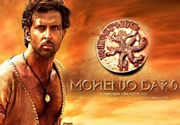
Mohenjo Daro
Synopsis:
Picture this because it still haunts me, Hrithik Roshan is literally wrestling a massive, fully CGI crocodile in the middle of a muddy river while holding a trident, and honestly, if you have ever watched classic hindi movies you know the hero has to fight at least one wild animal before he can earn the right to save the entire city, but let us back up a bit because none of this makes any sense without context. We start out in a peaceful little fishing village called Amri where our boy Sarman is just diving for pearls and dreaming of bigger things, and he has this obsession with a jade-like cylinder or amulet that has a unicorn symbol on it, which belonged to his late dad. The funny thing is, the head of his village tells him not to go to Mohenjo Daro because it is a dangerous place ruled by a ruthless tyrant, but Sarman looks at the amulet, looks at the horizon, and decides to pack his bags for a massive trading expedition because that is just how historical epics roll. So then he arrives in the grand city of Mohenjo Daro, and let me tell you, the set design is wild with these gigantic stone statues, multi-story brick buildings, and people wearing the most ridiculous leather straps and feather headpieces you have ever seen in your life. Right after that, he gets into a street fight with some guards over a stolen horse or a broken pottery piece, and he does this iconic slow-motion hair flip that proves once and for all that Hrithik is still the king of bollywood movies. Then he manages to save a young boy from getting crushed by a runaway cart, and this somehow impresses the local elite, leading us straight into the romance arc with Chaani, played by Pooja Hegde, who is practically glowing in this blue and gold ceremonial outfit that probably weighed fifty pounds. She is the chosen priestess of the river goddess, and she is supposed to marry Moonja, the psycho son of the wicked ruler Maham, who is played by Kabir Bedi with the most magnificent gray beard and booming villain voice you have ever heard. They meet secretly near a public bath, and she dances around with a bunch of other women in a lavish musical number that completely stops the plot dead in its tracks just so everyone can admire the costume budget. Anyway, Sarman finds out that his dad used to be a high-ranking official in Mohenjo Daro before Maham staged a bloody coup and murdered half the council, which turns this whole trip from a simple trading journey into a full-scale revenge mission. We get a bunch of secret meetings in the lower city, where Arunoday Singh plays Moonja with a permanent sneer, terrorizing the local indigo dyers and tax collectors just to remind us how evil the ruling family is. The interval block hits right when Maham figures out that Sarman is the son of his old rival, and he orders his guards to capture our hero for a public execution in the giant amphitheater, leaving us all hanging while we go grab our popcorn. Right after the break, Sarman is thrown into a gladiatorial arena to fight two massive guards wielding spiked maces, but he pulls off some crazy parkour moves and wins the crowd over. That brings us right back to the CGI crocodile fight I mentioned earlier, which happens because Sarman has to prove his worthiness to the river folk before they will join his rebellion. Chaani is forced to go through with her wedding to Moonja to save her father from execution, but Sarman crashes the ceremony with an army of oppressed peasants and lower-caste workers armed with farming tools and torches. A massive riot breaks out across the entire citadel, and buildings start catching fire while people run around screaming in total chaos. Sarman finally corners Moonja on a collapsing bridge above a raging torrent of water, and they have a brutal hand-to-hand brawl until Moonja slips and falls to his doom. Just as everyone thinks they have won, the mighty Indus river suddenly overflows its banks in a giant biblical flood because the great dam upstream has given way from all the fighting and structural neglect. The whole city starts washing away in a massive wave of muddy water, but Sarman and Chaani manage to climb up to the roof of a very tall stone tower with a bunch of survivors. The floodwaters finally recede, leaving the entire civilization buried in silt and mud, and Sarman stands on the highest ridge looking out over the devastated valley with Chaani by his side, ready to build a new and better society from the ruins.
That heavy, slightly metallic ring on Kabir Bedi’s right hand kept distracting me during the dramatic close-ups, catching the studio light in a way that pulled my eyes entirely away from whatever threat Maham was supposedly issuing. You notice things like that when a movie settles into a rhythmic, almost numbing predictability about twenty minutes in, trading historical curiosity for the comfortable, padded constraints of a standard-issue epic. Ashutosh Gowariker has always loved a canvas too big for his framing, and here that ambition swallows the Indus Valley civilization whole, turning an ancient, mud-brick metropolis into a sprawling soundstage where everyone speaks with the carefully modulated cadence of contemporary television actors trying very, very hard to sound ancient. It is a strange sort of enterprise, heavy on digital dust and light on actual dirt, attempting to reconstruct a Bronze Age society using the exact same emotional grammar we have seen fifty times before in various prestige Hindi films. The money is up there on the screen, mostly, rendered in CGI cattle and digital horizons, but the soul of the place stays locked behind a velvet rope.
To tell the truth, the script feels like it was put together by a committee that spent a weekend skimming Wikipedia and then panicked, throwing in crocodiles and political assassinations to keep the kids awake in the balcony. Gowariker’s direction lacks the muscular momentum that kept Jodhaa Akbar afloat through its long runtime, substituting instead a series of static tableaux where characters stand around explaining their motivations to the middle distance. Screenplay-wise, the narrative relies on that ancient trope of the provincial outsider arriving in the big city and accidentally dismantling the corrupt ruling class simply by being more handsome and morally upright than everyone else. Sarman is introduced diving for pearls in a sequence that exists purely to show off Hrithik Roshan’s torso, which is fine, I suppose, except the water looks so artificially blue you keep expecting a lifeguard to blow a whistle. The pacing drags in the middle stretch where our hero gets involved in local trade politics and court intrigue, losing the thread of whatever discovery the civilization might have actually offered in favor of endless speeches about freedom and water rights.
Hrithik Roshan approaches the role of Sarman with the kind of intense, vein-popping sincerity that usually works better when he gets to play modern pilots or troubled corporate heirs. He plays the chosen one with his chin permanently tilted toward the heavens, projecting a nobility that feels remarkably modern and entirely out of place in a society that predates most recorded religion. Opposite him, Pooja Hegde as Chaani looks stunning in Neeta Lulla’s wardrobe, weighed down by so many metallic headdresses and geometric necklaces that her neck seems to be doing half the heavy lifting in every dramatic scene. She spends most of the runtime looking concerned, gazing into the middle distance while waiting for someone else to finish a monologue, and while her presence is undeniably striking, the character has about as much interior life as a museum mannequin. Kabir Bedi makes a wonderfully gravelly villain, chewing the scenery with a magnificent beard and enough theatrical menace to keep the second act from stalling out completely, though his interactions with Arunoday Singh’s petulant prince Moonja feel like a rerun of every bad dynastic drama ever exported by Bollywood. They snarl at each other across courtyards, trade poisoned looks during harvest festivals, and generally behave like soap opera aristocrats who happened to borrow some bronze armor for the weekend.
A.R. Rahman’s soundtrack arrives with enormous expectations, and while the songs are pleasant enough on their own terms, they land awkwardly inside a film that refuses to commit either to gritty realism or full-blown musical fantasy. The background score swells at the exact moments you expect it to swell, hitting emotional cue-cards with the subtlety of a brass band marching through a library. Visually, the cinematography by C.K. Muraleedharan oscillates wildly between gorgeous, sun-bleached wide shots of the river and murky, poorly lit indoor confrontations where everyone is standing too close to a smoke machine. That digital river water bothers me still, a flat blue sheet that ripples whenever a digital crocodile needs to attack someone, reminding you every few minutes that you are watching a computer screen rather than a lost world. It’s a small thing, really, but those synthetic textures accumulate over two and a half hours, wearing down your willingness to suspend disbelief until you are just counting the edits in a sword fight.
Beneath the bluster, the film wants to be a parable about ecological collapse and the tyranny of monopolies over essential resources, but it couches these lectures in such simplistic terms that the argument dissolves into noise. We are told repeatedly that water is life, that the city has lost its way, that Maham’s tariffs are choking the common man, yet the script treats these socioeconomic factors as mere obstacles for an exceptional individual to punch through rather than systemic conditions requiring actual thought. The crowd scenes feature extras marching in neat diagonal lines that betray every attempt at organic chaos, looking less like a starving citizenry and more like a dance troupe waiting for the cue to start their formations. This tendency to clean up the past, to scrub away the grit and the ambiguity in favor of a clean hero-versus-monster binary, turns a potentially fascinating historical fiction into just another noisy entry in the modern catalogue of big-budget Hindi movies that mistake scale for significance.
There is a sequence near the climax where a massive flood wipes out half the set, and watching CGI mud wash away digital granaries brought to mind Roland Emmerich’s 10,000 BC, another prehistoric disaster epic that relied entirely on digital spectacle to cover up a complete absence of narrative pulse. At least Emmerich had the good sense to keep his runtime short and his tone cheerfully absurd, whereas Mohenjo Daro takes itself with a solemnity that feels borderline punitive by the time the third act gets rolling. You leave the theater not with a sense of having visited a forgotten era, but rather with a mild headache from the percussion and a lingering wonder about how anyone could spend that much money on turquoise headgear and still forget to write a compelling middle section.