

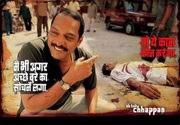
Ab Tak 56
Synopsis:
Halfway through Ab Tak 56, Nana Patekar is sitting in his office wearing this totally beat-up, greasy-looking brown leather jacket that looks like it's seen about twenty years of Mumbai monsoon weather, and he's just staring intensely at a little plastic cup of lukewarm chai while some rookie cop rambles on about protocol and paperwork, but to understand why he's so completely fed up and exhausted you have to look at how this whole gritty crime drama started out. Right from the opening scenes, it's clear this isn't like your usual flashy bollywood movies with song and dance numbers every ten minutes, because instead we get dropped right into the murky, hyper-realistic underbelly of real-world police work. Nana plays Sadhu Agashe, an encounter specialist in the Mumbai crime branch who doesn't care much for red tape, and the guy has already taken down dozens of bad guys by the time the film really gets rolling. He's got this calm, almost bored demeanor when he's kicking down doors, and honestly, the movie spends a solid ten minutes focusing entirely on him trying to fix a squeaky office fan with a rusty butter knife while a frantic informant calls him on a landline that has this annoying static buzz. That scene goes on forever. Then he just shoots a guy in a warehouse and we are knee-deep in internal affairs investigations. The funny thing is, Kunal Vijaykar shows up playing this slimy, fast-talking television journalist who wants to expose the police force for going rogue, and he's always wearing these horribly bright striped ties that clash with everything, and he keeps shoving his camera microphone right into Sadhu’s face whenever he steps out of a police station. Sadhu just ignores him completely and keeps walking, which is hilarious. Anyway, Sadhu's team includes Jatin Shukla as one of the eager junior officers who's just trying to learn the ropes and survive the endless stakeouts in cramped cars where everyone is sweating through their polyester shirts and eating cheap street food out of old newspaper wrappers. They get assigned to track down this massive extortion syndicate operating out of the city slums, and there's a lot of running up and down narrow staircase concrete apartments where people are yelling in Marathi and Hindi, and honestly, if you're a fan of gritty hindi movies, this whole stretch is just relentless. Gunfights. No music. Just shouting.
So then the pressure from the politicians starts mounting because the media won't shut up about police brutality, and the commissioner keeps calling Sadhu into his air-conditioned office to yell at him about human rights violations, but Sadhu just stands there staring blankly at the wall picking his fingernails like he's listening to a faucet drip. He doesn't apologize. He never apologizes. The politicians want clean hands, but they still want the mob bosses dead, so they use guys like Sadhu as disposable weapons and then act shocked when blood gets on the carpet. The political corruption angle gets super messy, and Jatin Shukla's character starts getting nervous because he realizes the higher-ups are setting them up to take the fall if a federal inquiry actually goes through. They're sitting in a dimly lit tea stall at three in the morning, and Jatin's character is spilling cutting chai all over his saucer because his hands are shaking so bad, and Sadhu just takes the cup away from him without saying a word and drinks it himself. Cold. Just like that. The plot moves fast from here. Sadhu gets suspended. The gangsters find out. An assassin comes to his house. It's Tuesday. The whole dynamic shifts when Sadhu's wife gets caught in the crossfire of the escalating turf war, and even though she survives the initial scare, it pushes Sadhu past his breaking point where he stops caring about badges, department rules, or political cover-ups. He goes rogue. Completely rogue. He leaves his service revolver on the desk, grabs an unregistered piece from an old informant, and walks out the back door into the rain.
Right after that, the movie turns into this one-man-army revenge march through the neon-lit alleyways of the city at night, and Kunal Vijaykar's journalist character is frantically trying to follow the trail in his dented hatchback, filming everything on a bulky handheld camera while dodging stray bullets and angry locals. The storytelling here strips away all the usual glitz you expect from mainstream bollywood, focusing instead on the heavy, exhausting toll of violence, showing how these encounters aren't thrilling action sequences for the cops involved, but rather just messy, depressing chores that leave everyone feeling hollow. Sadhu tracks the main syndicate leader to an abandoned textile mill filled with rusted machinery and hanging dust sheets, and there's this tense standoff where they don't even talk much, just exchange weary glances that communicate years of institutional rot and mutual hatred. Sadhu raises his gun, pulls the trigger once, and walks out into the dawn light without looking back.
Nana Patekar smells like a stale cigarette and cold tea in Ab Tak 56, and that stale, trapped indoor odor stays with you long after the credits cut to black. Most Hindi movies about cops and underworld dons treat violence like it is some kind of operatic dance where everyone wears leather jackets and slow-motion water droplets hang in the air around their boots. This movie doesn't do any of that. It drops you straight into the humid, fluorescent-lit basement offices of the Mumbai Police encounter squad where the tea is always lukewarm and nobody has slept a full eight hours since the monsoon started.
Shimit Amin directs with a kind of dry, ruthless efficiency that makes most mainstream Bollywood look like expensive dress-up. He frames rooms so they feel low-ceilinged and claustrophobic, shooting through doorframes and over shoulders until you feel like you are standing too close to people who are sweating through their cotton shirts. There are no swooping crane shots coming down from the ceiling to show us the grand scale of the metropolis. Instead, the camera stays at eye level or lower, tracking boots clicking against linoleum corridors and stopping dead in narrow stairwells where a guy can get cornered with nowhere to run. The screenplay by Sandeep Srivastava refuses to give us heroes with golden hearts or villains who explain their dark childhoods over background strings. If I'm honest, the dialogue is sometimes a bit flat in the middle stretches, just bureaucrats arguing about paperwork while men with guns wait in unmarked cars downstairs.
Then you have Nana Patekar playing Sadhu Agashe, and he doesn't seem to be acting so much as he is just inhabiting a skin he has worn for thirty years. He doesn't raise his voice when he gives an order to shoot someone; he just drops his chin and mumbles through tobacco-stained teeth, and that quietness is what makes it terrifying. Watch the way he handles a cup of tea while listening to a junior officer panic over a departmental inquiry, his fingers yellowed and his eyes completely glazed over with absolute boredom. It is a performance built entirely out of throwaway physical habits, like the way he rubs the back of his neck or leaves his shirt collar unbuttoned past the point of professional decency. Kunal Vijaykar plays the slimy journalist sniffing around the department with just enough oily charm to make your skin crawl, though the sound mixing on his dialogue scenes occasionally feels a bit thin, like his lines were looped in a small booth three weeks after the shoot wrapped.
Jatin Shukla shows up as the anxious junior who still thinks the rules matter, and his wide-eyed terror provides a nice, jagged contrast to Patekar's calcified cynicism. You can trace a direct line from Patekar's weary exhaustion here to the way Manoj Bajpayee carries himself in Satya, though Bajpayee is all coiled spring and twitchy nerve while Patekar is more like an old refrigerator that hums too loud and refuses to die. The supporting cast isn't filled with famous faces doing cameos; they look like actual cops you would see arguing with a bus conductor in Dadar, with their cheap trousers and tired postures. The background score is thankfully sparse, avoiding those massive orchestral stabs that tell the audience how to feel every two minutes. Instead, you get a low, rattling electronic drone that sounds like an air conditioner struggling in the middle of May, building tension through pure rhythmic repetition rather than melodic tricks.
The movie is ostensibly about the ethics of extra-judicial killings, but it rarely pauses to lecture the viewer or pose big moral questions about the state of the law. It treats these encounters like a dirty plumbing job that nobody wants to do with their bare hands, but someone has to crawl under the sink anyway. The politicians use the squad when it suits their election schedule, and then they throw them under the bus the second a human rights lawyer opens his mouth on television. That dynamic feels depressingly familiar, operating without any grand cinematic flourishes to soften the blunt edges of institutional hypocrisy. There is a specific scene where Agashe sits in an empty interrogation room peeling an orange with his bare fingers while a senior bureaucrat reads him the riot act, and Patekar doesn't look angry or defiant. He just looks tired of the same conversation happening in slightly different rooms every five years.
It's a small thing, but the continuity on the bloodstains during the second raid bothered me more than it probably should have, jumping from a heavy splatter to a thin smear between cuts. You notice those little production seams because the rest of the film is so relentlessly stripped down and documentary-like that any artificial touch sticks out like a sore thumb. Hindi films usually love to redeem their tough-guy protagonists with a crying wife or a tragic backstory involving a dead sister, but Agashe's domestic life is just a silent apartment where his wife serves him food he barely touches before heading back out into the night. He doesn't have a grand philosophy about cleaning up the streets, and he certainly doesn't think of himself as a crusader for justice. He just has a gun, a list of names, and a phone that keeps ringing while he is trying to take a nap.
By refusing to give us the catharsis of a proper courtroom trial or a redemptive monologue, the film leaves you with a strange, hollow feeling in your stomach as the credits roll over a black screen. It is an honest piece of work about men who live in the grayest possible margins of a city that never stops moving long enough for anyone to catch their breath. The closing stretch doesn't tie up the loose ends with a neat moral bow, and it doesn't try to tell you whether Agashe is a monster or a municipal necessity. He just walks back out into the glare of the traffic, gets into the back of a dented Ambassador, and tells the driver to head toward the western suburbs.