

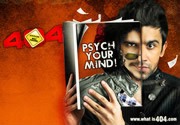
404
Synopsis:
Halfway through the movie, Imaad Shah is sitting in this totally weird, dimly lit college room staring at a wall while wearing this faded, mustard-yellow corduroy jacket that honestly looked like it smelled heavily of stale cigarette smoke and cheap hostel laundry, and he's completely losing his mind over a phantom sound that nobody else can hear. But to understand why he's acting like such a total mess, you have to look at how this whole psychological rabbit hole started, which brings us back to the beginning of 404, a really unusual psychological thriller that doesn't feel anything like your standard run-of-the-mill bollywood releases that usually rely on song-and-dance routines or flashy melodrama to keep people awake. So anyway, this brilliant medical student named Abhimanyu just transfers into a prestigious campus and ends up taking room 404, which famously used to belong to another student named Gaurav who tragically jumped out of the window because he was completely convinced the room was haunted by ghosts. The funny thing is, nobody is supposed to stay in that room anymore, but the administration is super arrogant and just writes it off as a silly urban legend, even though Satish Kaushik, playing this very strict, skeptical, and somewhat cynical professor named Dr. Shrinivas, tries to brush off all the paranormal chatter with rational medical science. Right after that, Chris, played by Rajvvir Aroraa, comes into the picture as this arrogant senior who loves playing cruel psychological games on the new kids, and he's constantly smoking, wearing these tight graphic tees, and mocking Abhimanyu's growing paranoia about the strange noises echoing through the vents at night. Then Tisca Chopra shows up as the professor's wife, Dr. Mira, who has this quiet, melancholic vibe—wait, let me rephrase that, she just looks exhausted all the time and shares these lingering glances with Abhimanyu that make you feel like something deeply unpleasant happened in the past, and she's trying to warn him without actually saying anything useful because bollywood movies love making characters speak in cryptic riddles instead of just telling someone the door is locked. Abhimanyu starts losing sleep, his grades are tanking, he's seeing things moving in the shadows, and his girlfriend shows up to check on him only to find him talking to empty corners and sweating through his shirts like he's running a marathon in a sauna. And Nishikant Kamat enters the story as Professor Anirudh, this sharp, intense, highly observational psychology professor who actually encourages Abhimanyu to lean into his hallucinations and test the very limits of human perception instead of just running away to a doctor. It was all a grand experiment. They wanted to see if human belief could literally manifest physical reactions, and Chris was just a pawn in the whole twisted scheme, and Abhimanyu finds out he was never actually haunted by a ghost at all, but rather gaslit by his own mentors who set up invisible speakers, scratched the walls, and manipulated his environment to see how long it would take for a rational mind to completely fracture under pressure. He stands on the ledge of the window in room 404, looks down at the exact same spot where Gaurav allegedly fell, stares directly at the professors who orchestrated the entire sick game to prove some arrogant academic thesis about suggestion and fear, and he doesn't jump, but instead he turns around, walks back inside the room, drops the yellow corduroy jacket on the floor, and walks out the heavy wooden door into the bright daylight without saying a single word to anyone.
I still cannot figure out why the sound mix on the projector hum in the opening scene had to be so damn loud, practically vibrating the floorboards of the screening room before anyone on screen even opens their mouth. Prawaal Raman makes psychological thrillers that want you to sweat right along with the protagonist, though sometimes the sweat feels engineered by a sound designer who found a new plugin they really wanted to test out on an unsuspecting audience. It is an odd way to start a movie about rationalism and ghosts, blasting you with static instead of letting an atmosphere curdle naturally over twenty minutes of quiet screen time. Most bollywood movies around that period were still leaning hard on item songs or broad comedy tracks to pad out their runtimes, which makes this lean, mean little experiment stand out even more for its sheer stubbornness. Not great, not bad, just there in its own weird corner of the industry.
Abhimanyu's descent into whatever madness or haunting is possessing his dorm room happens with a steady, grinding friction that owes a debt to Roman Polanski's Repulsion, though without the budget or the pristine art direction. Rajvvir Aroraa plays the student with a kind of stiff-necked panic that works well enough when he is just staring at walls, but whenever he has to yell or cry the performance flattens out into something resembling a high school play audition. The real anchor is Nishikant Kamat as Professor Sodhi, a rationalist who smokes too much and looks like he hasn't slept since the nineties. Kamat brings a weary academic authority to every scene, barking lines about psychological projection and brain chemistry with a gravelly conviction that makes you almost believe in the pseudoscience he is debunking. When he and Imaad Shah are sharing the frame, the movie actually clicks into a higher gear. Shah plays the senior student hovering around the margins with a twitchy, secretive energy, always looking like he is about to confess to a murder he didn't commit or maybe just bum a cigarette. Their dialogue scenes crackle with a genuine intellectual hostility that feels miles away from the usual melodrama found in most hindi films.
The cinematography relies heavily on sickly green corridors and harsh fluorescent tube lighting that flickers just enough to remind you something is wrong without being too annoying about it. Well, actually, it is a small thing but it bugged me how every single door handle in the hostel building seems to squeak with the exact same recorded sound effect every time someone enters a room. You start listening for the squeak instead of paying attention to the conversation about phantom roommates and historical campus suicides. The soundtrack otherwise keeps things sparse, mostly avoiding traditional orchestral cues in favor of low-end drones and sudden bursts of industrial noise that mimic the sound of a failing hard drive. It works during the close-up shots of handwritten notes and frantic textbook marginalia. Satish Kaushik pops up as the beleaguered dean with a weary sigh that feels completely lived-in, anchoring the institutional reality of the campus while the younger actors spin off into paranoia.
Tisca Chopra brings a grounded, observational quiet to her role as the professor's wife who sees the toll this experiment is taking on her husband long before he admits it to himself. She doesn't get many big monologues to chew on, so she has to do all her heavy lifting with sideways glances and the way she pours tea with too much force. The script refuses to hold your hand about whether the room is actually haunted or if everyone is just losing their minds from lack of sleep and academic pressure, leaving gaps that invite you to fill them in yourself. Hindi movies of that decade rarely trusted their audiences to sit with ambiguity for more than ten minutes before dropping a massive exposition dump to explain the twist. Raman resists that urge right up until the final stretch, where things do get a bit messy as the plot demands a logical explanation for events that previously felt supernatural. It is that old problem of trying to tie up a ghost story with medical textbooks.
The pacing drags slightly around the middle hour when the film stops to rehash the same arguments about empirical evidence versus subjective experience for the third or fourth time in a row. You start noticing the seams in the set design, particularly the way the posters on the dorm walls look like they were bought in bulk from a generic prop house rather than chosen by actual college students with specific tastes. Yet despite those rough edges, there is something admirable about a picture willing to treat its audience like adults who can handle a narrative that doesn't resolve itself neatly. The final confrontation between Kamat and Aroraa in that cramped study room hits hard because it dispenses with all the spooky tricks and just focuses on two desperate men shouting at each other over the nature of belief. You leave the theater thinking less about the jump scares and more about the strange persistence of human guilt, which lingers long after the house lights come back up and the projector finally shuts off for good.