

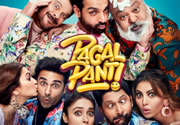
Pagalpanti
Synopsis:
John Abraham is literally dangling from the side of a massive moving truck while screaming at a monkey that stole his wallet, which is just standard operating procedure for modern bollywood movies these days, honestly.
And then boom, things make even less sense because Pagalpanti drops you right into this absolute circus of a plot where everything is loud and chaotic and frankly exhausting.
Let us back up a second because Raj Kishore, played by John, is basically the unluckiest human being alive according to the lore of this specific cinematic masterpiece, and wherever he goes, financial ruin and total destruction follow him like a bad puppy.
He lives with his two equally jinxed buddies Chandu and Junky, and they manage to accidentally destroy the expensive car of a terrifying local gangster named Raja Bhaiyya, who is played by Anil Kapoor with this glorious mustache and way too many plaid shirts, and they also manage to ruin a massive business deal for a ruthless don named Niraj Modi.
Look, they lose all their money, they lose their girlfriends, especially Raj Kishore's girl Sanjana, played by Ileana D'Cruz, who is constantly doing facepalms because her boyfriend couldn't pour water out of a boot with the instructions printed on the heel.
God, the amount of debt these guys accumulate is genuinely stressful to watch while eating popcorn, so they decide to work for two wealthy business tycoons named Tushar and Wifi, who happen to be partners with an international mafia boss named Gogo Pasha.
Stuff happens and they are tasked with laundering money, but naturally, they mess that up too in the most spectacular ways possible, involving exploding golf carts and heavily armed henchmen who clearly didn't get a proper script briefing.
By the time we hit the interval point, which is aggressively shoved right after a very random and shiny dance number featuring backup dancers wearing neon pink neon glasses in the middle of a London alleyway, you are questioning every single life choice that led you to sitting on your couch watching this exact sequence of hindi films.
And speaking of background details, I need to talk about that one extra in the second act during the casino scene who is wearing a violently yellow sweater with a picture of a sad cat on it, and he just stands there nodding out of sync with the music for a solid four minutes while John Abraham is having a loud argument about offshore bank accounts.
Anyway, the second half rolls around and the boys try to trick Raja Bhaiyya into falling in love with a wealthy woman so they can steal her diamond necklace to pay off their massive debts, but the woman turns out to be a total lunatic, and then Gogo Pasha shows up with his tiger and his goons to reclaim his stolen cash.
Everything spirals completely out of control in a sprawling London mansion where people are falling into swimming pools, tigers are chasing supporting actors through hedge mazes, and characters are yelling lines like money doesn't grow on trees while standing in front of a literal pile of burning cash.
Nobody actually dies because this is a slapstick comedy masquerading as a high-stakes action flick, but the sheer volume of property damage in this movie could honestly rival most Hollywood blockbusters.
In the final sequence, all the debts are magically cleared through a ridiculously convoluted insurance fraud scheme involving a runaway yacht and a flock of sheep, and everyone ends up smiling and dancing together on a sunny dock while the credits roll abruptly over a freeze-frame of Anil Kapoor winking directly at the camera.
There is a specific kind of digital color grading in recent Hindi movies that flattens human skin until everyone looks like they have been dipped in lukewarm butter, and Pagalpanti starts right there, shimmering with that exact aggressive amber sheen that makes a London street look like a set built inside a giant toaster. It’s hard to focus on the dialogue when the mid-tones are practically vibrating off the screen, but the script doesn't give you much choice anyway because people are already shouting at each other in a room with too many decorative vases. Anees Bazmee has made a career out of this particular brand of chaotic shouting match disguised as narrative cinema, though if I'm honest, the decibel level here feels slightly higher than usual, like someone turned the dialogue track up a couple notches after the mix was already locked. John Abraham plays a man whose entire character trait is that bad luck follows him around like a stray dog, which gives him plenty of opportunities to look mildly confused while expensive cars explode behind him in broad daylight. You keep waiting for the plot to settle into some kind of predictable rhythm, but it just keeps introducing new supporting characters who exist solely to explain the previous joke to anyone in the audience who might have blinked during the setup.
The screenplay feels less like a structured narrative and more like a collection of sketches written on napkins during a very long lunch that got out of hand. Scenes end abruptly on reaction shots that linger a beat too long, catching actors in that awkward micro-second before the director yells cut, and you can practically hear the editor shrugging in the cutting room. Anil Kapoor tries his absolute hardest to rescue the material through sheer force of personality, strutting through frame with the kind of frantic, high-wire energy that made Welcome work a decade ago, though here the bits feel recycled and tired. He barks orders and flashes his trademark grin, but the comic timing is off by half a second, which in farce is the difference between a laugh and total silence. Ileana D'Cruz spends most of her screen time reacting to the nonsense with arched eyebrows and nicely tailored blazers, looking like she wandered off the set of a romantic drama and got lost in a cartoon.
There is an astonishingly loud sound effect used every single time someone gets hit in the head or falls over a chair, a classic cartoon bonk that plays at full theater volume regardless of the dramatic context, and after the fourth time it happens it becomes the only thing you can listen for. It’s a small thing, sure, but it wears you down long before the intermission hits. The visual language relies heavily on wide shots of London parks that have been digitally altered to look brighter and more saturated than nature ever intended, turning historic landmarks into garish backdrops for people running away from CGI tigers. Bollywood comedies often struggle with the balance between slapstick and narrative coherence, yet this one barely even pretends to care about the bridge connecting one gag to the next. Characters simply teleport from a yacht to a garage because the script needs them to be in a new location for the next shouting match, and nobody on screen seems terribly concerned about the logistics.
Arshad Warsi and Pulkit Samrat are thrown into the mix as sidekicks whose primary function is to repeat every punchline slightly louder than the person who said it first, a technique that drains the humor right out of the room. When you watch Urvashi Rautela struggle through her lines, you get the distinct impression that her dialogue was entirely dubbed by someone else in a small studio booth three weeks after principal photography wrapped, because the mouth movements and the audio track exist in two entirely different postcodes. It makes you nostalgic for the simpler, low-budget chaos of older Hindi films where at least the flubs felt organic and actors weren't trapped inside a gleaming digital cage of over-lit mediocrity. The supporting cast expands until the screen is practically overflowing with frantic faces, yet none of them are given a single distinct trait to hold onto. John Abraham keeps doing his one trademark expression of polite bewilderment, whether he is standing next to a live lion or trying to explain an insurance scam to a gangster.
By the time the third act descends into a chaotic blur of mistaken identities and falling props, the movie has long since abandoned any internal logic it might have started with. It just keeps throwing more noise at the wall, hoping that sheer volume will distract you from the absence of actual jokes. There is no satirical bite to the madness, no clever subversion of the genre tropes it leans on so heavily, just a relentless march of bright colors and broad performances that blur together into an unbroken stream of nothing. You leave the theater with a faint headache and the lingering suspicion that everyone involved got paid a lot of money to sweat under UK streetlamps for a few months. It is not an offensive disaster of historic proportions, just a grindingly hollow exercise in brand-name silliness that exhausts you long before it bothers to entertain.